
USC Researcher Explores Quantum Computing for Database Optimization

Insider Brief
- USC researcher Ibrahim Sabek has received a $627,250 NSF CAREER Award to develop hybrid classical-quantum approaches for improving database system optimization.
- The five-year project aims to integrate quantum processors into database engines to address complex optimization tasks such as query planning, transaction scheduling, and index selection.
- The research will explore which database optimization problems could benefit from quantum advantages while developing practical tools for database developers.
- The study is based on USC Viterbi research materials and story is taken directly from them.
Modern database systems are struggling to maintain real-time performance as data volumes and workloads continue to grow exponentially.
Without more efficient optimization, the systems responsible for processing massive amounts of data will face significant delays and scalability challenges.
For decades, database systems have relied on rigid, pre-set guidelines programmed by humans, including heuristic-based systems and rule-based approaches that underpin many modern computing systems referred to as “wisdom rules.” Heuristic-based systems rely on predefined, rule-of-thumb logic, such as “if X, then Y” frameworks, to solve problems or make decisions quickly.
These traditional methods are limited when facing the complexity of modern, large-scale data environments. Heuristics follow fixed patterns and tend to settle for locally good but globally suboptimal solutions, creating a bottleneck that prevents more efficient solutions from being discovered.
While recent machine learning approaches have shown promise, they still face significant limitations. They often require large training datasets to perform well, struggle in “cold-start” scenarios with little or no prior data, and need frequent, computationally expensive retraining as workloads change. These challenges make them difficult to rely on for the complex, rapidly evolving optimization problems modern databases face.
The solution to this longstanding challenge in computing may lie in quantum computing.
Unlike classical computers, which process information as bits that are either 0 or 1, quantum computers use quantum bits, or qubits, that can exist in multiple states simultaneously. This allows them to tackle certain complex optimization problems far more efficiently than even the most powerful conventional computers.
USC’s Ibrahim Sabek aims to address database systems’ optimization challenges through a hybrid classical-quantum computing approach in an upcoming research project funded by the National Science Foundation (NSF).
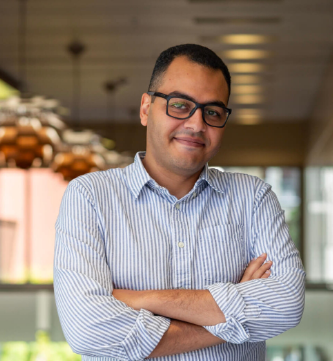
Titled “Toward Quantum-Augmented Database Systems,” the five-year project is supported by a $627,250 NSF CAREER Award and will contribute to USC’s broader quantum computing initiatives, an area in which Sabek is heavily involved.
As leader of the Next-generation Data-Intensive Systems Group (NexDIG) at USC, Sabek’s research explores the intersection of database systems and emerging quantum technologies. He is an assistant professor of computer science in the USC Viterbi School of Engineering’s Thomas Lord Department of Computer Science and the USC Mark and Mary Stevens School of Computing and AI, with a joint appointment in the USC Dornsife College of Letters, Arts and Sciences‘ Spatial Sciences Institute.
Sabek’s proposed solution involves integrating emerging quantum computing technologies directly into database engines to handle complex optimization tasks, such as query planning, transaction scheduling, and index selection.
Because today’s quantum hardware remains limited, his approach is hybrid: Quantum processors tackle the hardest combinatorial subproblems while classical components handle the rest, all coordinated within the database system optimizer.
He also aims to make these quantum capabilities practical for everyday database developers through high-level tools and reusable pipelines that allow a database system to treat a quantum solver as a built-in accelerator rather than requiring deep quantum expertise.
Through this research, Sabek hopes to move data-intensive systems into a new class of quantum-enhanced technologies capable of meeting growing global data demands with unprecedented speed and efficiency.
With Sabek’s research, database optimization tasks that currently create significant bottlenecks could be sped up dramatically.
Early prototypes from his group have already demonstrated speedups of more than 10 times over a conventional database optimizer on benchmark queries.
A broader goal of the project is to identify which database optimization problems stand to gain a “quantum advantage,” meaning they can be solved faster than with any known classical approach, and develop methods to realize those gains.
Consider a cloud database serving millions of applications worldwide. Every second, the system must decide how to execute thousands of concurrent queries while sharing limited computing resources. A quantum-augmented database could help identify better execution strategies in real time, improving both performance and resource utilization as workloads continue to grow.
This research has the potential to reshape the foundational software that powers global data centers.
Sabek’s work is further supported by access to world-class research infrastructure and equipment. As a leader in quantum computing, USC is home to the Quantum Computing Center, the first U.S.-based installation of the D-Wave Advantage system, and also launched the first IBM Quantum Innovation Center on the West Coast.
His team has access to more than 10 IBM quantum processors and the D-Wave Advantage system, enabling researchers to work with cutting-edge technologies as they seek to move quantum computing from a largely theoretical field into practical systems engineering.