
The Quantum Kid Podcast: How Do You Build a Quantum Startup?
Insider Brief:
- The Quantum Kid uses the curiosity and questions of nine-year-old co-host Kai to make quantum technologies more accessible to younger audiences and the wider public.
- In the latest episode, Kai explores what it takes to build and fund a quantum startup, including the scientific, engineering, hiring and commercial challenges founders face while the technology is still developing.
- A visit to ETH Zurich spin-off ZuriQ offers an inside look at its trapped-ion architecture, while David DiVincenzo and QAI Ventures CEO Alexandra Beckstein explain the foundations of quantum computing and what investors look for in emerging companies.
- Subscribe to The Quantum Kid on YouTube to follow future conversations with leading scientists, founders and innovators shaping the quantum future.
Quantum computing has no shortage of ambitious ideas. But explaining those ideas — and why they actually matter — is often just as challenging.
That was the inspiration behind The Quantum Kid.
Our podcast began with a simple observation: children often ask the questions adults overlook. Co-hosted by nine-year-old Kai and myself, his science commicator and theoretical physicist mom, the series explores quantum technologies through curiosity and big questions, tackling everything from qubits and quantum computers to black holes, time travel, drug discovery, robotics, entrepreneurship and the future of technology. Over the past year, we’ve had the pleasure to host such great minds in physics as John Preskill, Scott Aaranson, Steven Chu, Peter Shor, John Martinis, Karen Hallberg, Sabrina Maniscalco and many others.
The Quantum Kid is part of the Tesseract Quantum family, aimed at making quantum technologies more accessible to wider audiences — particularly the younger generation, who will ultimately inherit and help shape the quantum future.
That mission is also beginning to extend beyond the podcast through in-person learning experiences. An upcoming event at Innovation Park Zurich will invite young people to explore how quantum computing could shape the future of robotics, including through an encounter with the ANYmal robotic platform.
Starting a quantum startup
In our latest podcast episode, Kai investigates a topic that sits at the intersection of science, business and innovation: how do you build a quantum startup? Who funds them, when the technology is not fully there yet? What makes a good founder? How much money does it take to build a quantum computer? And what happens when a startup fails?
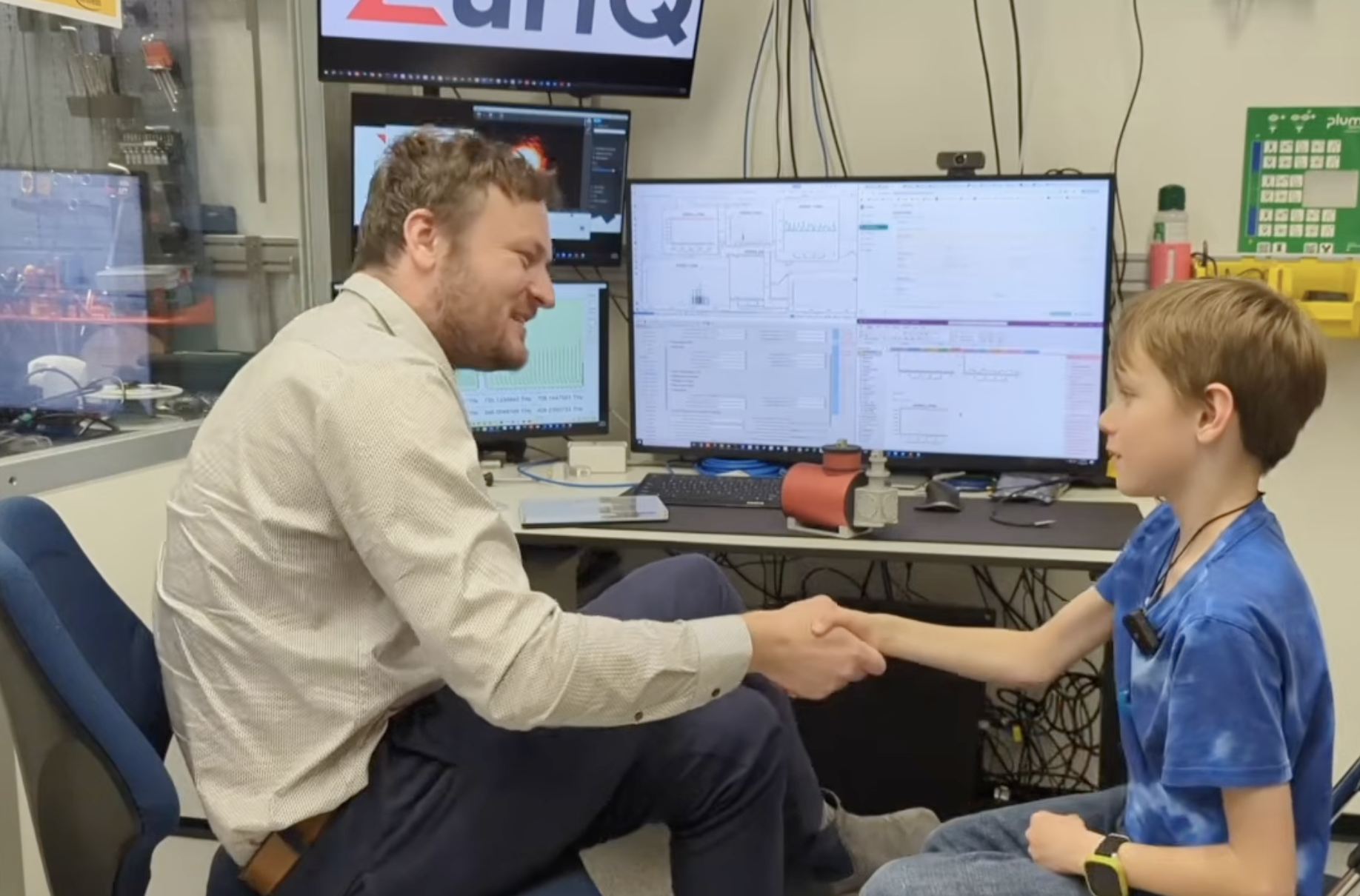
For this episode though, Kai visits ZuriQ, an ETH Zurich spin-off developing a novel trapped-ion quantum computing architecture. Peeking at the lab hosting a mega magnet, he learns how atoms can become qubits using electric fields, lasers and magnetic fields. He discovers what the founder of this startup, Dr Peter Hrmo, believes is its key differentiator: combining electric and magnetic fields to enable more flexible qubit architectures. The visit offers a rare glimpse into the realities of building quantum hardware. Beyond the science, there are engineering challenges, hiring decisions, product development questions and, ultimately, the challenge of finding customers willing to pay for a technology that is still evolving.
Back in the studio, Kai is joined by Prof David DiVincenzo, one of the pioneers of quantum computing, and Alexandra Beckstein, CEO of QAI Ventures — a VC fund based in Basel that has made it its mission to support quantum startups.
The episode is a whirlwind of ideas. DiVincenzo explains the famous DiVincenzo Criteria, the set of requirements that any quantum computing platform must satisfy. Qubits must exhibit quantum behaviour, remain isolated from noise, interact in controlled ways, support input and output, and ultimately scale from a handful of qubits to many thousands. Beckstein, meanwhile, focuses on a different challenge: building a company around the technology. According to her, successful quantum startups require much more than technical expertise. Founders need teams with complementary skills, a clear understanding of customers, a viable business model and access to funding. Investors are often looking not just at the technology, but at the people behind it.
And Kai then asks a question about something that makes many entrepreneurs worry: What if my startup… fails?
Now here, I won’t tell you what the guests tell our young host — watch the episode to find out!