
Thales Alenia Space Announces Successful High-Precision Quantum Transmission Between The Canary Islands of LaPalma And Tenerife
Insider Brief
- Thales Alenia Space and its partners completed a 140-kilometer quantum key distribution test between La Palma and Tenerife observatories as part of Spain’s GEO QKD satellite communications project.
- The experiment transmitted individual photons through turbulent atmosphere into a 10-micron optical fiber, validating critical calibration, synchronization and photon-transmission protocols for a future geostationary quantum communications system.
- The EU-backed initiative aims to support Europe’s quantum-secure communications infrastructure through the EuroQCI program, with Hispasat leading mission design and business planning activities.
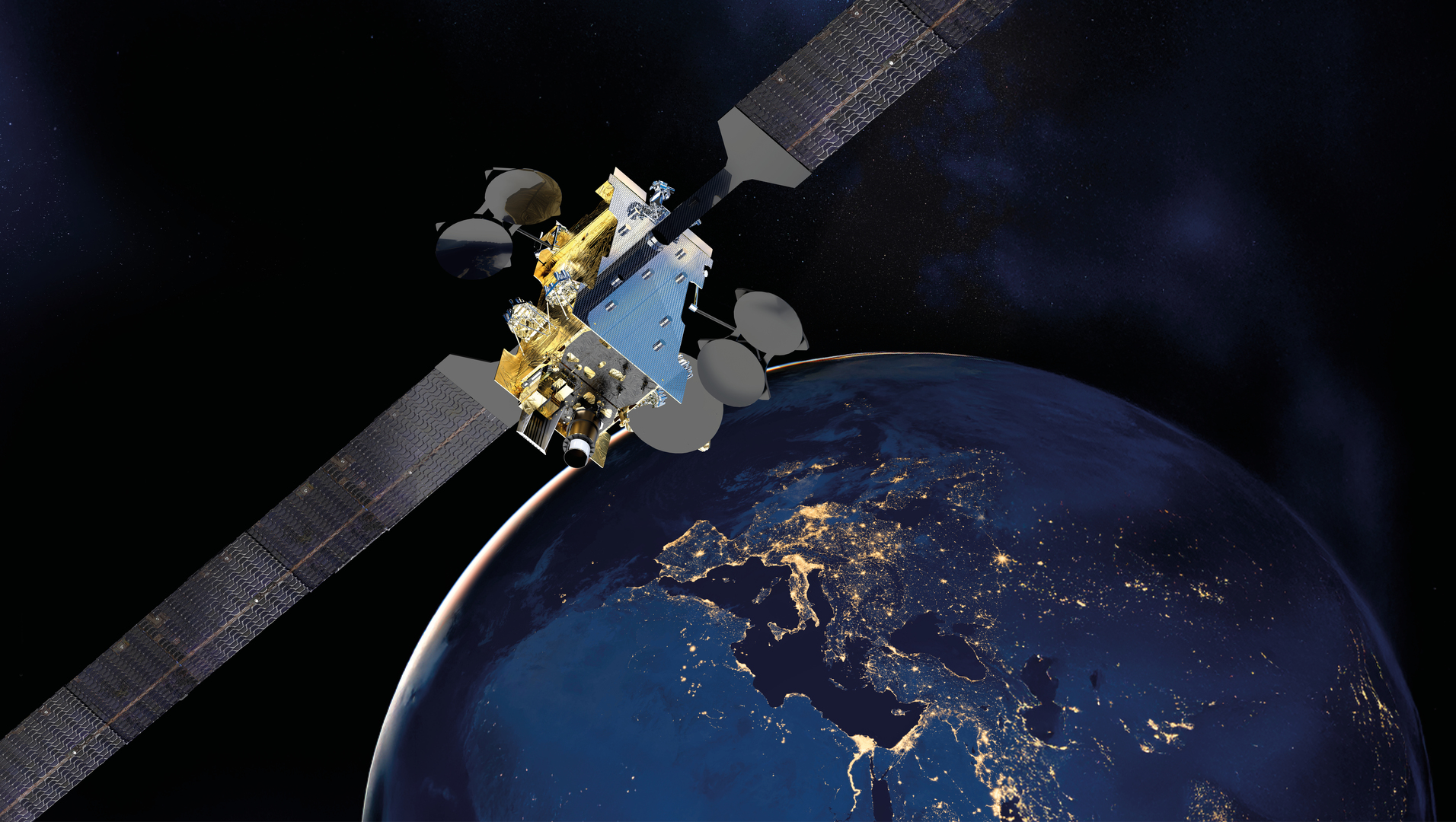
- Image: Thales Alenia Space_E.Briot
Thales Alenia Space and its partners said they have completed a long-distance quantum communications test between two Canary Islands, according to a statement from the company.
The announcement marks a key moment in Spain’s effort to build what could become Europe’s first geostationary quantum key distribution system.
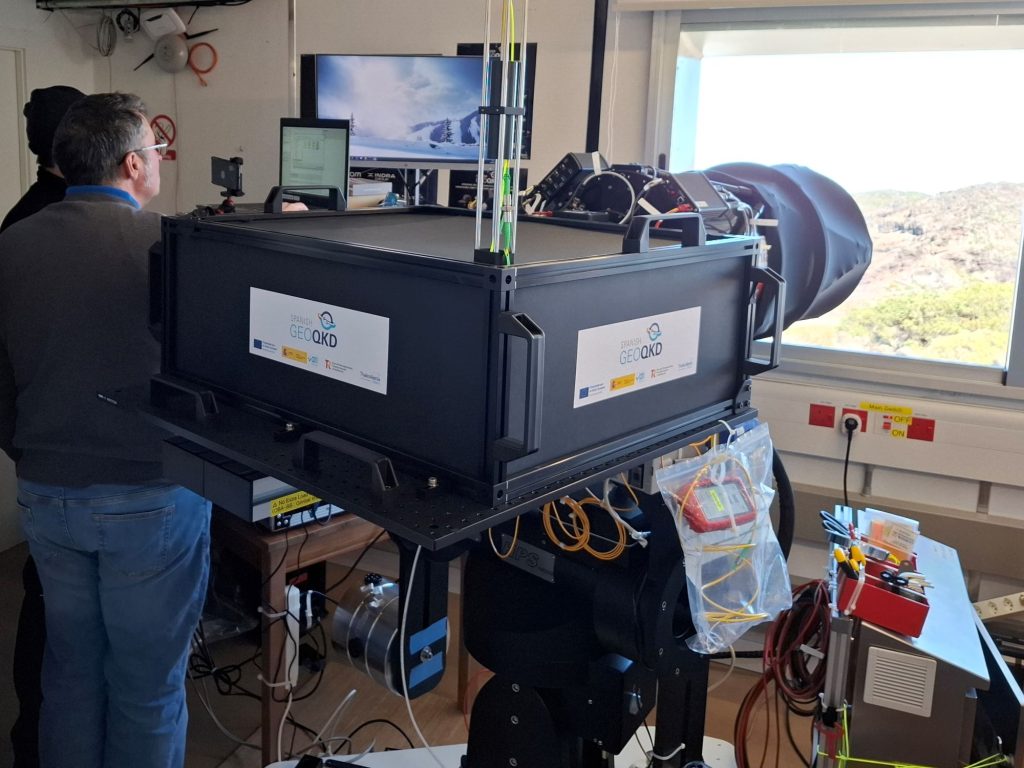
The experiment, conducted under Spain’s GEO QKD project, linked observatories on La Palma and Tenerife using individual photons transmitted across 140 kilometers of open atmosphere. The test is designed to validate the communications architecture planned for a future satellite-based quantum key distribution, or QKD, mission.
“The accuracy record we set during field trials of the GEO QKD system between La Palma and Tenerife places our optical quantum technology at the global cutting edge,” Ángel Álvaro, Thales Alenia Space’s Project Design Authority of the Spanish GEO QKD project said in a statement.
The company said the demonstration replicated the conditions expected in orbit by using an engineering model of both the satellite payload and the associated ground infrastructure. Teams operated from the Roque de los Muchachos Observatory on La Palma and the Teide Observatory on Tenerife.
The trial sought to address transmitting quantum signals through atmospheric turbulence with sufficient precision to inject the signal into a single-mode optical fiber measuring roughly 10 microns in diameter. This is one of the central technical challenges facing satellite-based quantum communications.
According to the consortium, the system successfully completed calibration, synchronization and photon-transmission protocols during the tests. Thales Alenia Space described the experiment as a potential world first for this type of free-space quantum optical link at that scale and precision.
Quantum key distribution, or QKD, uses the quantum properties of photons to generate encryption keys that can reveal whether communications have been intercepted. The technology is widely viewed as a potential safeguard against future cyberattacks from quantum computers, which are expected to eventually weaken some forms of classical encryption.
The GEO QKD project is part of broader European efforts to develop sovereign quantum communications infrastructure as governments and industry prepare for the long-term cybersecurity implications of quantum computing. Spain’s initiative is intended to contribute to the European Commission’s EuroQCI program, which aims to establish a secure pan-European quantum communications network.
The project is funded through European Union recovery funds under Spain’s PERTE Aeroespacial program and is managed by Spain’s Center for Technological Development and Innovation, known as CDTI, on behalf of the country’s State Secretariat for Telecommunications and Digital Infrastructure.
Hispasat is responsible for designing the geostationary mission architecture and defining the project’s commercial framework, while Thales Alenia Space in Spain leads the broader industrial consortium involving Spanish and European companies.
The test also reflects growing international competition in quantum-secure satellite communications. China has already demonstrated satellite-based QKD capabilities through its Micius satellite program, while European governments and aerospace firms have accelerated investment in domestic quantum infrastructure amid concerns about technological dependence and cybersecurity resilience.
Unlike terrestrial fiber-based QKD systems, which are constrained by distance due to signal loss in optical fibers, satellite-based systems could eventually enable secure key exchange across continents. Geostationary orbit, positioned roughly 36,000 kilometers above Earth, presents additional technical challenges because of the long transmission distance and the need for highly stable optical pointing systems.
Project teams said additional testing campaigns will continue in the Canary Islands in the coming months to refine system performance and complete the technical validation process ahead of a potential orbital deployment.
If successful, the GEO QKD mission could position Spain among a small group of countries pursuing operational quantum-secure satellite communications infrastructure and strengthen Europe’s push for greater digital and cybersecurity autonomy.