
Scientists Find Structural Guide to Unusual Magnetism in Quantum Materials
Insider Brief
- Researchers in Japan found that a crystal’s structural dimensions classified magnetic states more consistently than electron concentration across a family of complex alloys.
- The compounds exhibited distinct magnetic states at different lattice sizes, providing a guide for designing materials with targeted magnetic properties.
- The findings could help quantum researchers systematically explore unconventional magnetism and investigate how atomic structure influences collective behavior.
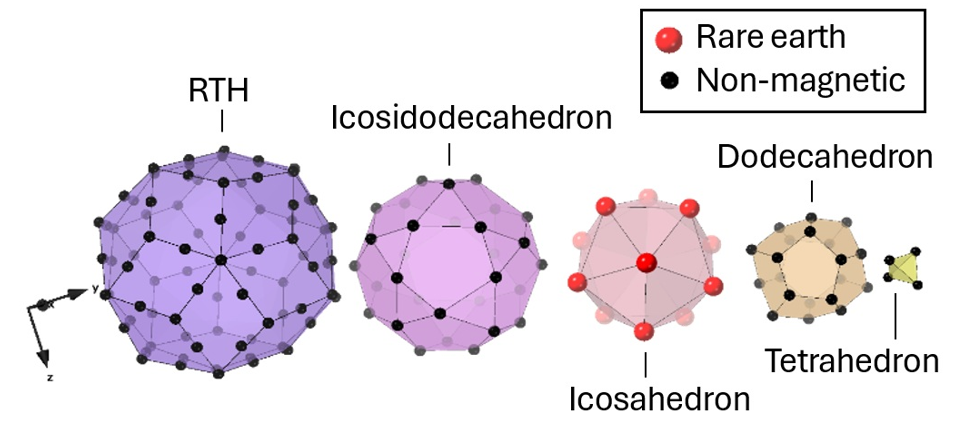
- Image: A Tsai-type cluster consists of nested atomic shells, including the rhombic triacontahedron, icosidodecahedron, icosahedron, dodecahedron, and inner tetrahedron. Rare-earth atoms occupy the icosahedral shell and provide the magnetic moments responsible for the magnetic response in these compounds. (Tokyo University)
Researchers in Japan have identified a structural measurement that could help scientists predict magnetic behavior in complex alloys, offering a more reliable way to search for materials with unusual quantum properties.
The finding gives researchers studying quasicrystals and related materials a practical guide to selecting compounds for further investigation. These materials have intricate atomic arrangements that can support unconventional magnetism, making them useful subjects for exploring how atomic structure shapes collective behavior.
According to a Tokyo University of Science news release, the size of a crystal’s repeating structural unit classified magnetic states more consistently than a commonly used measure of electron concentration across the compounds examined.
The research was led by Farid Labib of Tokyo University of Science and Kazuhiro Nawa of Tohoku University, alongside Tokyo University of Science professor Ryuji Tamura.
“Quasicrystals are among the most uniquely structured materials discovered to date and are expected to exhibit novel magnetic states and quantum phenomena not found in ordinary crystals,” Labib said. “Until now, there has been no unified guideline for systematically exploring these novel phenomena in quasicrystals and their approximant crystals.”
The study will be published in the Journal of the American Chemical Society on September 30, 2026.
For quantum researchers, the relevance lies in understanding and controlling how magnetic moments — the tiny magnetic properties associated with atoms — organize themselves. Different arrangements produce different material behaviors, and identifying reliable patterns can help researchers investigate unfamiliar states of matter.
The team studied Tsai-type approximant crystals, which contain nested atomic clusters and share structural features with quasicrystals. The researchers synthesized gold-based compounds containing aluminum or gallium and the rare-earth elements terbium, dysprosium or holmium.
Scientists have traditionally used the number of valence electrons per atom to help classify magnetic behavior in these materials. That measure, however, does not provide a consistent guide across different chemical compositions.
The researchers found that the lattice parameter, which describes the dimensions of the crystal’s repeating unit, organized the observed magnetic states with greater consistency.
Above approximately 14.72 angstroms, the compounds displayed a whirling antiferromagnetic state, an ordered magnetic arrangement with opposing contributions. Between approximately 14.62 and 14.72 angstroms, they displayed a whirling ferromagnetic state with an overall magnetization. Below that range, they formed a spin glass, in which magnetic moments freeze into a disordered arrangement.
An angstrom is one ten-billionth of a meter. The results therefore show how small structural differences can separate substantially different magnetic states.
“The unified magnetic phase diagram constructed in this study can serve as a practical roadmap for systematic exploration of new magnetic quasicrystals and approximant crystals exhibiting novel magnetic orders and quantum phenomena,” Nawa said.
The practical value is a clearer starting point for materials discovery. Researchers seeking a particular magnetic state could use the structural measurement to guide which compositions they make and examine.
The findings also suggest that explanations of magnetism in these complex alloys should explicitly account for structural dimensions alongside electron concentration. For researchers exploring quantum materials, that provides a more systematic basis for connecting atomic architecture with experimentally observed behavior.
“The unified magnetic phase diagram constructed in this study can serve as a practical roadmap for systematic exploration of new magnetic quasicrystals and approximant crystals exhibiting novel magnetic orders and quantum phenomena,” remarks Dr. Nawa. “It can also provide a guideline for designing new magnetic materials with targeted magnetic ground states, opening new opportunities for discovering unconventional magnetism in quasiperiodic and complex intermetallic systems.”