
SandboxAQ Tests GPS-Free Navigation on Northrop Grumman Drone
Insider Brief
- SandboxAQ and Northrop Grumman completed what they described as the first test combining magnetic and visual navigation on an attritable, one-way attack drone.
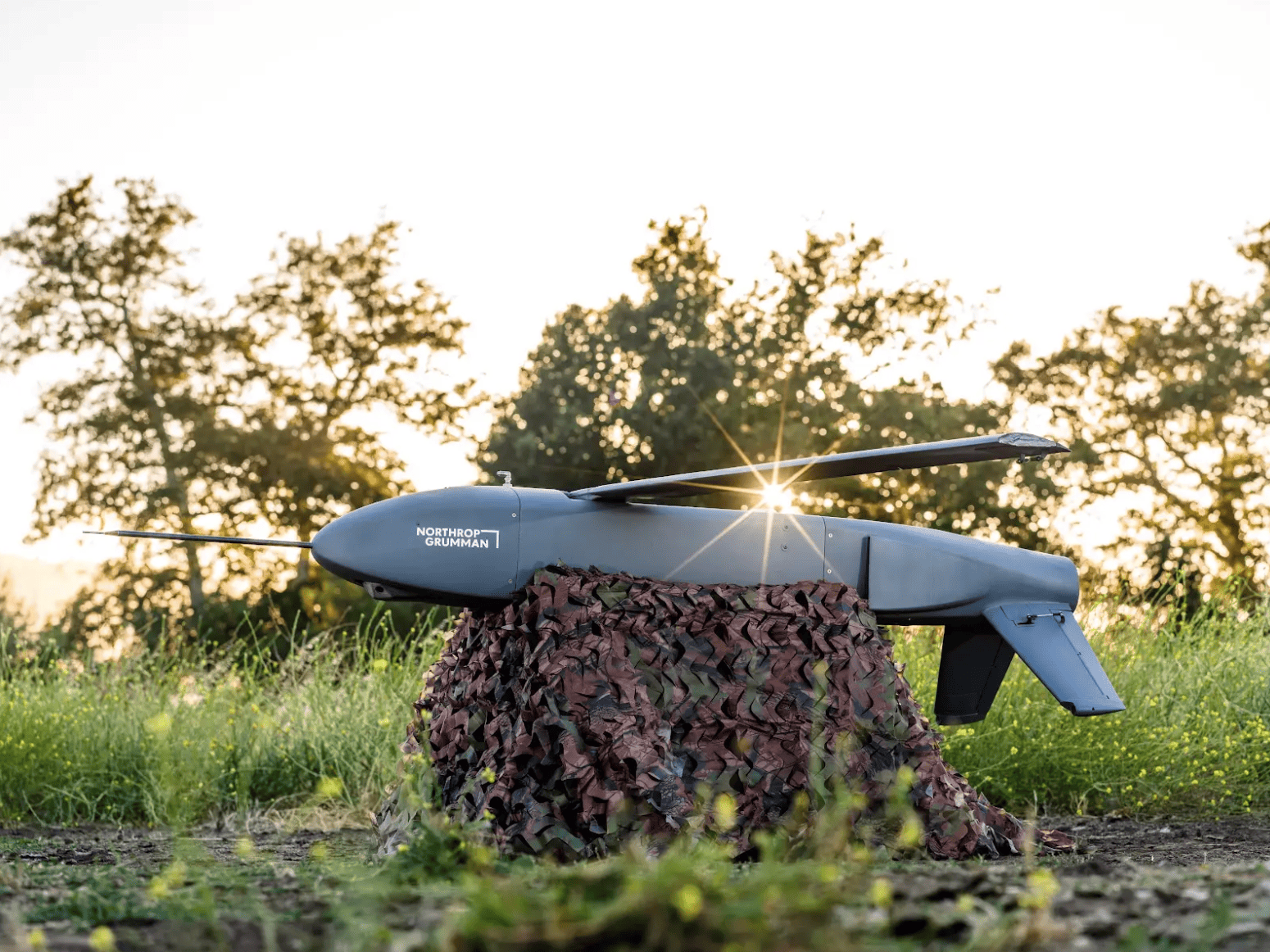
- SandboxAQ’s AQNav system provided Northrop Grumman’s Lumberjack drone with positioning capabilities that do not depend on GPS or other externally transmitted signals.
- Engineers installed the hardware-agnostic AQNav software on the drone’s existing computing systems in less than an hour, according to SandboxAQ.
- Image: Northrop Grumman
PRESS RELEASE — – SandboxAQ announced it has successfully completed the world’s first reported test of a magnetic navigation (MagNav) system on an attritable platform – Northrop Grumman’s Lumberjack®, a Group 3 UAS attritable drone. It was also the world’s first reported instance of a MagNav system being paired with a visual navigation system on an attritable, one-way attack platform. SandboxAQ has collaborated with Northrop Grumman (NYSE: NOC) to integrate and test its commercial, dual-use AQNav MagNav technology on this unmanned aircraft system.
Conflicts in Ukraine and the Persian Gulf States prove small, expendable drones are now regularly operating in GPS-denied and spoofed environments. UAVs are a tool of war in these conflicts and militaries around the world are ramping up their stockpiles of drones. Northrop Grumman’s Lumberjack, a one-way-attack drone, was designed and developed in under 14 months of its first flight. The versatility and modularity of this technology highlights Northrop Grumman’s multi-use, loitering munition capabilities.
“Today’s platforms need navigation systems they can trust as they operate in increasingly complex and contested environments. In collaboration with SandboxAQ, Northrop Grumman is aggressively enhancing our ecosystem of autonomous and unmanned systems with resilient and flight-hardened alternative navigation systems,” said Max Schuster, program manager, Lumberjack, Northrop Grumman. “Pairing AQNav with Northrop Grumman’s experience in unmanned aircraft and open mission systems will ensure our joint forces have an operationally validated navigation capability in even the most contested domains.”
“AQNav’s ability to provide unjammable navigation and positioning without GPS complements Northrop Grumman’s efforts to fulfill the operational and mission-specific requirements for autonomous aircraft and shape the future of next generation unmanned platforms,” said Luca Ferrara, General Manager of Navigation at SandboxAQ. “Leveraging our proven MagNav technologies and drone platform expertise, the flight test with Northrop Grumman further demonstrates the ease by which our AQNav software can be integrated into unmanned systems at the speed and scale required by leading defense organizations.”
AQNav enables continuous positioning without reliance on satellite or other externally transmitted signals. Its passive, all-weather, and terrain-agnostic navigation can serve as a standalone capability or complement inertial, visual, and satellite navigation systems, advancing the future of alternative positioning, navigation and timing (Alt-PNT). In addition, AQNav’s proven ability to operate over open water, feature-limited terrain, urban landscapes, and GPS-denied environments makes aircraft platforms more resilient and mission-capable.
AQNav’s Software Expands Accessibility Across Platforms
Our AQNav software platform, demonstrated during the recent flight, extends the company’s proven MagNav capabilities into a software-first architecture designed for rapid integration with current and future defense systems. This novel, hardware-agnostic offering processes sensor data in real-time, applies physics-based models to determine positioning, and provides continuous navigation that can be easily incorporated into a broader PNT architecture.
The software is designed to run on existing onboard compute infrastructure with operationally relevant latency, reducing the need for additional processing hardware. It supports open architecture interfaces that simplify integration across platforms.
“AQNav now offers OEMs two distinct paths for deployment – a full-stack, performance-optimized solution that’s built natively into your platform architecture, or a software-only solution developed specifically to deploy within existing architecture,” said Ferrara. “With Northrop Grumman’s Lumberjack, our engineers were able to install AQNav software into existing systems in less than an hour, giving the attritable platform MagNav capabilities for enhanced mission performance.”
Proven Performance Across Defense and Commercial Applications
Since 2023, AQNav has been flight-tested by military, government, and commercial aerospace partners including Airbus and Boeing. SandboxAQ has worked closely with the United States Air Force to flight-test AQNav for more than three years, including testing aboard C-17 Globemaster III and C-130J Super Hercules transports and participating in three large-scale military exercises. AQNav was also selected to participate in the 2025 NATO DIANA cohort.
AQNav currently participates in the Defense Innovation Unit’s (DIU) Transition of Quantum Sensing program (TQS), which tests MagNav technologies for military autonomous systems. Under that program, SandboxAQ integrated its AQNav software on a Group 3 unmanned aircraft platform and is evaluating its performance against defense-relevant use cases. The work with Northrop Grumman builds on those integration patterns and advances a shared objective of delivering scalable, resilient navigation for unmanned operations in GPS-contested environments.