
Researchers Create Room-Temperature Quantum Material That Filters Light by Its Quantum Statistics
Insider Brief
- Researchers demonstrated a new class of room-temperature quantum materials that selectively transmit or suppress different quantum states of light by engineering “allowed” and “forbidden” statistical bands, a capability that could support future quantum technologies and energy applications.
- The study showed that plasmonic metacrystals made from arrays of gold nanoantennas can manipulate the statistical properties of multiphoton light while preserving allowed quantum states as they propagate through the material.
- The researchers said the approach could provide a new platform for controlling many-body quantum systems, with potential long-term applications in photonic quantum computing, quantum communications and coherence-sensitive energy-harvesting technologies.
A Louisiana State University-led team of researchers have demonstrated what they describe as a new class of room-temperature quantum materials that can distinguish between different types of quantum light, a capability that could eventually aid the development of photonic quantum computers, quantum communications systems and more efficient energy technologies.
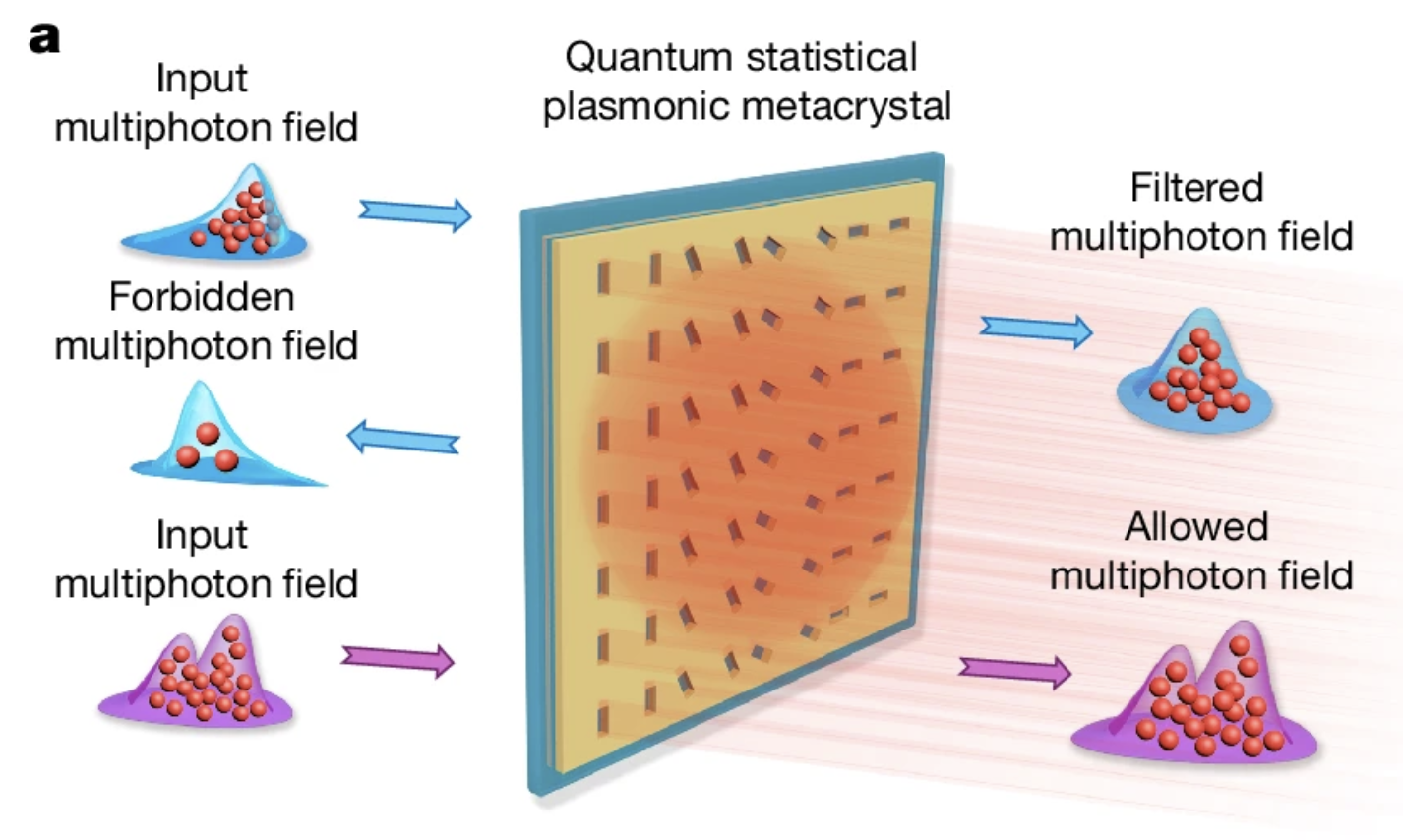
The study, published in Nature, introduces what the researchers call “quantum statistical plasmonic metacrystals” — engineered nanostructures that selectively transmit or suppress light according to its quantum statistical properties rather than conventional characteristics such as color, polarization or direction. According to the researchers, the work establishes the first room-temperature material intrinsically sensitive to the quantum coherence of multiphoton systems.
If confirmed and expanded, the approach could provide a new way to manipulate quantum states of light using compact nanostructures instead of larger optical systems, while opening new possibilities for quantum computing, quantum communications and other quantum technologies.
A New Kind of Band Structure
The researchers draw an analogy to semiconductors, whose electronic band structures determine whether electrons can move through a material. They write that their plasmonic metacrystals instead create “allowed” and “forbidden” quantum statistical bands that determine whether particular quantum states of light can propagate.
Rather than filtering photons based on wavelength or polarization, the structures respond to the statistical behavior of groups of photons.
Those statistical properties describe how photons are distributed within a beam of light. Different light sources — including lasers, thermal light and more exotic quantum light sources—possess different statistical signatures that influence how they interfere and behave in quantum systems.
Until now, according to the study, no material had been shown to directly respond to those statistical fluctuations themselves.
The material is built from arrays of nanoscale gold antennas that function as “meta-atoms.” By carefully controlling the size, orientation and arrangement of the nanoantennas, the researchers engineered statistical bands that determine how different quantum states of light travel through the material.
When incoming light possesses statistical properties that fall within an allowed band, it passes through the structure with little change. Light whose statistics fall inside a forbidden band is altered until it reaches the nearest allowed statistical state, according to the experiments.
The researchers liken the process to the way semiconductor band gaps prevent electrons from occupying forbidden energy levels.
Testing Different Forms of Quantum Light
To see whether the concept worked, the team fabricated plasmonic metacrystals containing 100 gold nanoantennas patterned onto a thin gold film. Each antenna measured approximately 200 by 400 nanometers and was positioned one micrometer from its neighbors.
The researchers then generated 13 different multiphoton light sources whose statistical properties ranged from coherent laser-like light to thermal and superthermal light.
Using photon-number-resolving detectors, they measured how the statistical properties of each beam changed after passing through the nanostructure.
The experiments showed that light already occupying one of the allowed statistical bands retained its original quantum characteristics during transmission.
In contrast, light prepared within forbidden statistical regions emerged with modified statistical properties that shifted toward one of the allowed bands.
The researchers also demonstrated that the statistical bands remained stable as the light propagated through the depth of the metacrystal. Additional measurements suggested that multiphoton quantum states could preserve their statistical behavior throughout the transport process despite losses that typically occur in plasmonic systems.
The study indicates that this robustness may be important for future photonic quantum technologies, where preserving fragile quantum states remains a central engineering challenge.
Quantum Implications
Although the work represents fundamental physics rather than a new computing platform, the researchers see several potential applications.
One involves photonic quantum computing, which uses particles of light instead of superconducting circuits or trapped ions to process quantum information.
Photonic quantum computers depend on manipulating increasingly complex multiphoton states while preserving quantum coherence. The researchers suggest that materials capable of selectively transmitting particular quantum statistical states could become useful building blocks for scalable photonic quantum processors.
The study also discusses implications for many-body quantum systems, in which large groups of quantum particles interact and behave collectively. Examples include trapped-ion, neutral-atom, superconducting and photonic quantum computers, all of which depend on precisely controlling complex many-particle quantum states. While this research centers on photons, the researchers say the broader principles could contribute to future scalable quantum technologies.
According to the researchers, their metacrystals enable controlled transport of multiphoton quantum states while maintaining statistical stability, potentially supporting future many-body quantum technologies operating without cryogenic cooling.
Another possible application lies outside quantum computing altogether.
Solar energy conversion depends partly on how incoming light maintains coherence as it moves through photovoltaic materials. The researchers report that engineered quantum statistical bands could eventually allow materials to optimize those coherence properties, reducing energy losses associated with disorder and improving transport within energy-harvesting systems.
The study also suggests opportunities for future optoelectronic devices that exploit quantum coherence under ordinary environmental conditions rather than requiring complex laboratory infrastructure.
An Early Demonstration
The work remains an early experimental demonstration, the researchers report.
The researchers studied carefully fabricated plasmonic nanostructures under controlled laboratory conditions rather than practical quantum devices. The experiments demonstrate a new physical mechanism for manipulating the statistical properties of light but do not directly improve quantum computer performance or demonstrate a commercial technology.
The metacrystals also operate within specific near-field propagation regimes where the statistical bands remain stable. Extending the approach to larger integrated photonic systems will likely require additional engineering and experimental validation.
Even so, the work expands the role metasurfaces may play in quantum technologies. Most quantum metasurface research has focused on manipulating conventional properties of photons, including polarization, frequency and orbital angular momentum, or integrating single-photon emitters with nanophotonic devices. This study instead targets the quantum statistical properties that distinguish different forms of multiphoton light.
If the approach proves scalable, it could introduce a new design principle for quantum photonic materials analogous to the importance that electronic band engineering has played in modern semiconductor technology.
The research team included Chenglong You, Riley B. Dawkins, Jannatul Ferdous, Mohammed Mehedi Hasan, Aadi Singh, Ziang Zhuang, Addison Wilberg, Ian Baum, Benjamin Bertoni and Omar S. Magaña-Loaiza of Louisiana State University’s Quantum Photonics Laboratory, and Mingyuan Hong, who is also affiliated with the University of Electronic Science and Technology of China. Chenglong You and Hong also hold appointments at the University of Electronic Science and Technology of China.