
One Giant Leap: Researchers Demonstrate Programmable Quantum Photonic Processor in Orbit
Insider Brief
- Researchers operated a programmable quantum photonic processor in orbit, demonstrating two-photon interference as an early step toward onboard quantum computing.
- The processor manipulated two photons in a six-path optical circuit, but detector failures, radiation damage and sunlight-related noise constrained its performance.
- Future work aims to process Earth-observation data aboard satellites, although the experiment did not demonstrate a practical computing task or an advantage over conventional computers.
Researchers have operated a programmable quantum photonic processor in orbit, demonstrating a light-based computing capability that could eventually help satellites analyze data before sending it to Earth.
The experiment used two photons traveling through a circuit with six optical paths aboard a spacecraft about 317 miles above Earth. Researchers programmed different circuit settings and observed two-photon quantum interference, a behavior needed for several approaches to photonic quantum computing.
Rather than demonstrating quantum advantage over classical systems, the study, posted to the preprint server arXiv, answers a basic question for quantum computing in space. The study addresses whether a compact system could generate, manipulate and detect quantum light after launch, despite radiation, temperature changes and equipment degradation.
The team included researchers affiliated with the University of Vienna, the German Aerospace Center and Italy’s National Research Council. Simon Steiner and Peter Schiansky were the study’s joint first researchers listed, with Iris Agresti and Philip Walther serving as corresponding researchers.
The payload launched June 23, 2025, on SpaceX’s Transporter-14 rideshare mission and operated aboard D-Orbit’s ION SCV orbital transfer vehicle. The study reports on the experiments during its first eight months in orbit.
A Computing Resource in Space
Previous satellite experiments have generated and transmitted quantum light for secure communications and tests of physics, according to the study. This project combined a programmable optical circuit with interference between photons, bringing together two elements needed to process quantum information aboard a spacecraft.
Producing individual photons is insufficient for this kind of computation, the paper suggests. The photons must also be indistinguishable in relevant properties, including their color, polarization and arrival time.
When those conditions are met, their possible paths through an optical circuit interfere. That interference changes where the photons emerge from the circuit, and that behavior can be used to process information.
There are potential commercial applications — or, at least, practical applications — for an eventual space-based quantum computing systems. The researchers identify onboard processing of Earth-observation data as a potential application. Satellites collect large volumes of information, while transmitting that information to the ground takes time and consumes limited communications capacity. Processing images where they are collected could allow a spacecraft to transmit selected findings instead of complete datasets.
According to the study, quantum light could eventually give certain machine-learning models greater capacity to represent complex relationships without enlarging the underlying optical circuit. Whether that translates into a useful advantage on an orbiting processor remains untested.
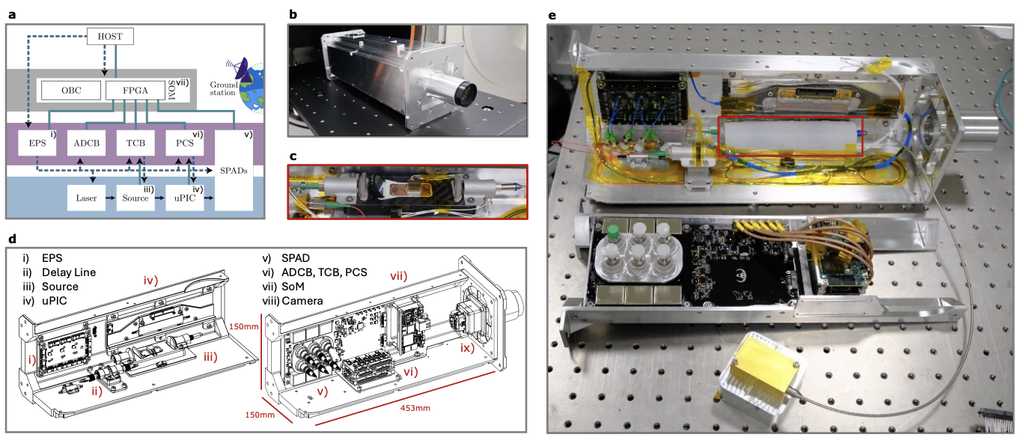
The payload was designed around spacecraft constraints. It weighed about 22 pounds, measured roughly 6 inches by 6 inches by 18 inches and consumed an average of 10 watts.
That power figure covers the payload, which combines quantum optics with conventional control electronics. Although light performs transformations as it passes through the circuit, the laser, temperature controls, detectors and programming hardware still require electricity.
How the Experiment Worked
The processor begins with a laser that pumps a crystal to produce photon pairs. Optical fibers guide the photons into a glass chip containing six light-carrying paths.
Tiny heaters change the chip’s optical properties, allowing researchers to program how light moves through the circuit and how different paths combine. Detectors then register photons emerging from the outputs.
The team first tested whether the circuit could reproduce expected detection patterns under different programmed settings. These measurements used distinguishable photons, separating the circuit’s programmability test from the subsequent quantum-interference experiment.
Across nine settings, the researchers reported an average fidelity of 0.888. Fidelity measures how closely the observed distribution matches the predicted one, with 1 representing a perfect match.
Just for context, teams operating ground-based photonic processors reported fidelities above 0.99 in selected tests comparing measured photon patterns with theoretical predictions. The orbital experiment’s average of 0.888 falls below that benchmark, but differences in hardware and testing conditions prevent a direct comparison.
Excluding two settings affected by apparent calibration problems raised the average to 0.949. Those higher figures therefore describe a subset of the measurements, rather than the processor’s performance across all tested settings.
The researchers then adjusted the photon-generating crystal’s temperature to make the photons match closely enough to interfere.
They looked for what’s called a Hong-Ou-Mandel dip, which is a standard quantum-optics test. When two indistinguishable photons enter opposite sides of a balanced beam splitter, they tend to leave together through the same output. As a result, detections occurring together at two separate outputs become less frequent.
The researchers adjusted the temperature of the crystal that produced the photon pairs to bring their colors into alignment. They observed the expected drop in separate-output detections near 32.5 degrees Celsius, or about 90.5 degrees Fahrenheit, closely matching the temperature needed in ground tests.
The reported interference visibility, a measure of the dip’s depth, was 0.908, with an uncertainty of 0.191. The researchers calculated that it exceeded the relevant classical limit by 2.14 standard deviations — a little more than twice its estimated statistical uncertainty — providing evidence of quantum interference, though it wouldn’t be classified as conclusive proof.
The analysis combined measurements from three separate operating days. The dip was independently reproduced on two of them, according to the study. The team also used a circuit setting in which interference was not expected and found no corresponding decrease, providing a check against an unrelated loss of signal.
Radiation and Equipment Failures
The experiment also exposed the engineering problems facing more capable orbital quantum processors.
Only three of the six detectors provided usable photon signals after launch. The supplementary material states that one was already defective before launch, while two additional channels may have suffered broken fibers during launch.
The researchers worked around those losses by using the full circuit to route selected outputs to the functioning detectors. In the end, their analysis covered accessible three-mode portions of the six-mode device.
Sunlight created another obstacle as detector noise rose sharply during illuminated portions of the spacecraft’s roughly 92-minute orbit, sometimes overwhelming the detectors. Measurements were therefore restricted to about 30 minutes per orbit in Earth’s shadow.
Charts in the paper show both the recurring sunlight-related noise and increasing detector dark counts — signals registered even without an incoming photon — over the mission.
Radiation progressively damaged the detectors, increasing noise and reducing their effectiveness. Meanwhile, laser power declined because material released by an internal adhesive contaminated optical components, according to the study.
Changing detector operating settings helped recover useful signals, but it did not eliminate the underlying deterioration. Temperature changes also complicated circuit calibration.
These problems are especially important in quantum because useful computing tasks require enough repeated measurements to distinguish meaningful patterns from noise. Demonstrating interference during selected measurement windows is an earlier milestone than maintaining it throughout lengthy processing jobs.
Next Steps
The researchers’ proposed next step is to encode Earth-observation data directly into the circuit’s programmed operations.
That would require advances in both hardware and algorithms. On the engineering side, the study identifies improved shielding, temperature control, radiation-tolerant packaging and automatic recalibration as priorities. It also discusses annealing, a treatment that can help repair radiation damage in detectors.
On the computing side, researchers must determine which features of an image should be represented in the limited optical paths available. The paper notes that an encoding method suited to this compact orbital platform has yet to be developed.
Longer-term proposals include satellite processors connected through quantum communication links. Such a network would require capabilities beyond those demonstrated in this experiment.
For a deeper, more technical dive, please review the paper on arXiv. It’s important to note that arXiv is a pre-print server, which allows researchers to receive quick feedback on their work. However, it is not — nor is this article, itself — official peer-review publications. Peer-review is an important step in the scientific process to verify results.