
IonQ, QuantumBasel Study Suggests Hybrid AI Workloads Could Gain Energy Advantages From Quantum Hardware as Systems Scale
Insider Brief
- IonQ and QuantumBasel found that a hybrid quantum-classical AI model matched or beat selected classical methods while showing potential energy advantages at larger scales.
- Tests on IonQ’s Forte Enterprise system found quantum energy use rose roughly linearly with qubit count, with a projected crossover against GPU simulation near 34 qubits.
- The results are limited to one workload, one hardware setup and quantum inference only, requiring broader testing to confirm the advantage.
A hybrid quantum-classical approach to fine-tuning artificial intelligence models could eventually consume less energy than classical simulation while matching or surpassing several conventional machine-learning methods on a text classification task, offering an early indication that quantum computers may provide practical advantages beyond computational speed.
The research, published on arXiv by scientists from IonQ and QuantumBasel, focused on energy-to-solution, a different measure of quantum performance that tracks total energy required to complete a computational task. Rather than relying on theoretical estimates, the team directly measured the electrical power consumed by an IonQ Forte Enterprise trapped-ion quantum computer while it executed quantum circuits used to fine-tune a foundation AI model.
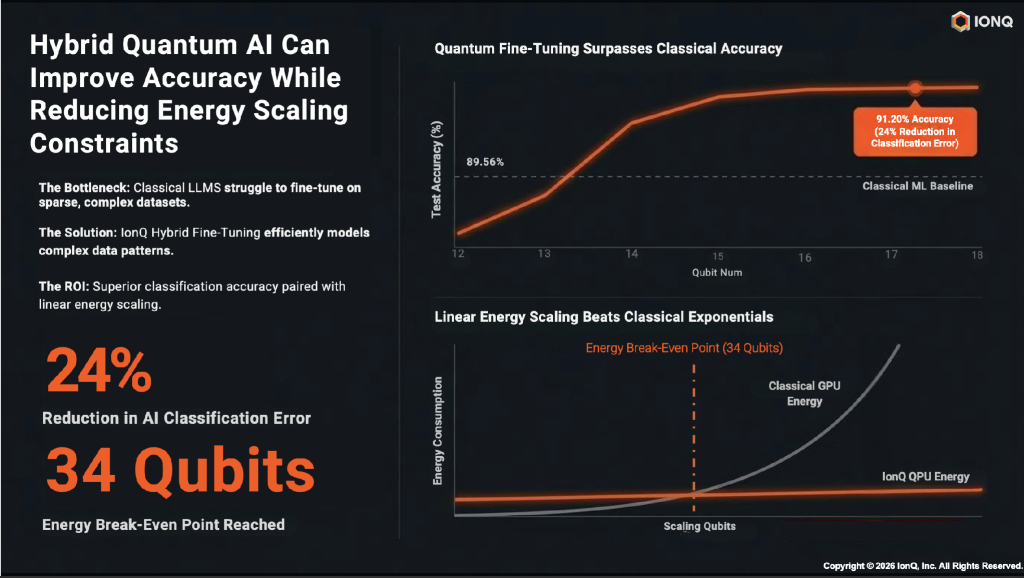
According to the study, which was submitted to the IEEE Quantum Week conference, the quantum processor’s energy consumption increased roughly linearly as the number of qubits grew, while the energy required to simulate the same circuits on a classical graphics processing unit (GPU) increased exponentially. Based on the measured data and the specific hardware and algorithms used, the researchers projected an energy break-even point at approximately 34 qubits, where executing the workload on the quantum processor would require less energy than classical state-vector simulation.
The researchers caution that this projected crossover depends on the particular quantum hardware, GPU, circuit design and experimental configuration used in the study. They also emphasize that the work examines a specific hybrid machine-learning application rather than demonstrating a general quantum advantage.
The work addresses a growing concern surrounding modern AI systems. Training and adapting large language models increasingly requires substantial computing resources and electricity. While techniques such as fine-tuning already reduce the need to retrain models from scratch, the researchers set out to see whether quantum hardware could further reduce the energy required for selected AI workloads.
“AI’s rapid growth is already straining global power grids — and the enterprise bottom line,” researchers wrote on an IonQ company blog post. “Future deployments will need to rein in both energy consumption and costs. A potential solution lies in trapped-ion quantum systems, which demonstrate impressive energy efficiencies without compromising accuracy.”
Hybrid Quantum AI
Rather than replacing an entire language model with a quantum computer, the researchers adopted a hybrid architecture.
The foundation model remained a conventional sentence transformer derived from the BERT family of language models. That model converted text into numerical representations known as embeddings. Instead of using a traditional neural-network classifier to interpret those embeddings, the researchers replaced the final classification layer with a parameterized quantum circuit executed on quantum hardware.
The approach effectively assigns a small but important portion of the AI workflow to the quantum processor while leaving the much larger language model running on conventional hardware.
The experiments focused on sentiment analysis using the Stanford Sentiment Treebank 2 benchmark, a standard dataset consisting of positive and negative movie reviews.
To evaluate performance, the researchers compared the hybrid quantum approach with several classical methods, including logistic regression and support vector classifiers trained on the same data.
The experiments were conducted on IonQ‘s 36-qubit Forte Enterprise trapped-ion quantum computer. The system’s all-to-all qubit connectivity allowed the quantum circuits to be executed without the additional routing operations often required on some other quantum computing architectures, reducing compilation overhead for the tested circuits.
Unlike many previous studies of quantum energy efficiency, which estimated power consumption by multiplying execution time by average system power, the researchers directly monitored electrical power across major components of the Forte Enterprise system throughout the experiments.
That allowed them to calculate the actual energy consumed during quantum inference jobs while separately estimating GPU energy consumption using CodeCarbon running on an NVIDIA L4 GPU hosted in Google Cloud.
Accuracy Plus Efficiency
The study also sought to determine whether the quantum hardware could perform useful machine-learning tasks while exhibiting favorable energy scaling.
Because today’s quantum processors remain susceptible to noise, the researchers introduced several modifications designed specifically for execution on real hardware.
These included simplifying the quantum classifier, generating multiple equivalent versions of each quantum circuit to average out hardware-specific errors and applying post-processing methods intended to reduce systematic bias in measurement results.
The quantum models themselves were trained using simulations that incorporated realistic hardware noise before being deployed onto the IonQ quantum computer for inference.
The researchers report that classification accuracy generally improved as additional qubits were used, despite the accompanying increase in circuit complexity.
Using error mitigation techniques, the best hardware results reached 91.2% accuracy on the sentiment classification benchmark. That performance approached the noiseless simulation result of 92.06% while exceeding the classical logistic regression and support vector classifier baselines included in the study.
According to the researchers, the best quantum model reduced classification error by about 24% relative to the best classical fine-tuned baseline in simulation and by roughly 16% when executed on quantum hardware with error mitigation.
The researchers report, however, that the evaluation used only 250 test samples, meaning the statistical uncertainty around individual accuracy measurements remains relatively large. They write in the study that the consistent trend across larger qubit counts provides stronger evidence than any single measurement alone.
Another observation that emerged from the experiments was that average power consumption of the quantum computer remained relatively constant regardless of circuit size.
Instead, increases in total energy consumption were driven primarily by longer execution times as circuits became larger. That finding supports the idea that execution time, rather than increased instantaneous power draw, determines energy scaling for the class of quantum circuits examined in the study.
What “Energy-to-Solution” Means
Energy-to-solution has become an increasingly important metric as AI and high-performance computing systems consume growing amounts of electricity.
Rather than measuring only processing speed, the metric captures the total electrical energy needed to complete a computational task successfully.
The researchers suggest that future quantum computing systems should be evaluated not only by whether they solve problems faster than classical machines but also by whether they do so using less energy.
For the shallow quantum circuits examined in the study, measurements suggested that quantum energy requirements scaled approximately linearly with qubit count. Classical state-vector simulation, by contrast, exhibited the expected exponential growth because each additional qubit doubles the size of the simulated quantum state.
The paper also covers another classical simulation technique known as matrix product states, or MPS, which can simulate some quantum circuits far more efficiently than full state-vector simulation.
The researchers acknowledge that MPS provides a substantially stronger classical comparison than state-vector simulation for many practical circuits. Their analysis suggests quantum hardware could eventually become more energy efficient than MPS for certain logarithmic-depth circuits, but that still remains theoretical and was not directly validated experimentally.
Limitations and Next Steps
The researchers present the work as an experimental proof of concept rather than evidence of broad quantum advantage.
Only inference — the stage in which a trained model makes predictions — was executed on the quantum processor. Training itself remained classical, with quantum circuit parameters optimized using simulation before deployment to hardware.
The experiments also involved relatively modest circuit sizes of up to 28 qubits for the energy analysis and up to 18 qubits for accuracy testing. The projected break-even point near 34 qubits represents an extrapolation rather than a direct measurement.
Similarly, the study examined only one hybrid machine-learning architecture performing one natural language processing task. Whether similar energy behavior extends to other AI models, datasets or quantum algorithms remains unknown.
The researchers also report that higher classification accuracy required substantially larger numbers of measurement shots, increasing overall energy consumption. Understanding the balance between accuracy and energy efficiency remains an important area for future study.
Looking ahead, the team identifies several next steps, including measuring the energy required to train quantum machine-learning models directly on quantum hardware and comparing quantum performance with larger-scale classical computing systems, including supercomputers.
The team also suggests that enterprises may not have to wait for fully fault-tolerant quantum computers before beginning to realize benefits from incorporating quantum computing into selected AI workflows.
“With the advantages of quantum fine-tuning firmly in place, enterprises can milk even today’s quantum hardware for compute efficiencies,” the researchers wrote on the blog. “Plagued by rising energy costs of AI deployment, they might benefit from adding QPUs to their tech stack today and stay ahead of the global data center energy crisis, forecasted to stall traditional classical competitors by 2027.”
For a deeper, more technical dive, please review the paper on arXiv. It’s important to note that arXiv is a pre-print server, which allows researchers to receive quick feedback on their work. However, it is not — nor is this article, itself — official peer-review publications. Peer-review is an important step in the scientific process to verify results.
The research team included Oliver Knitter, Sang Hyub Kim, Jonathan Mei, Claudio Girotto, Karen Horovitz, Chi Chen, Masako Yamada and Martin Roetteler of IonQ; Maximilian Wurzer and Frederik F. Flöther of QuantumBasel in Arlesheim, Switzerland; and Flöther also is affiliated with the Center for Quantum Computing and Quantum Coherence (QC2) at the University of Basel in Switzerland.