
Hybrid Quantum Algorithm Improves Portfolio Optimization on Trapped-Ion Quantum Computer
Insider Brief
- Researchers demonstrated a hybrid quantum-classical portfolio optimization workflow that outperformed standalone QAOA on real market-data tests using Quantinuum’s trapped-ion hardware.
- The system handled problems involving up to 225 financial assets, with quantum circuits using as many as 78 qubits and more than 1,000 two-qubit gates.
- The researchers caution that the study does not show practical quantum advantage in investing, but points to a possible role for quantum computers as specialized tools within hybrid optimization workflows.
Researchers have demonstrated a hybrid quantum-classical approach to portfolio optimization that solved real-world financial optimization problems more effectively than a standard quantum algorithm alone, offering evidence that near-term quantum computers may be most useful when paired closely with classical computing rather than expected to solve complex problems independently.
The study, posted on the preprint server arXiv by researchers from JPMorgan Chase, Amazon Advanced Solutions Lab, AWS, Quantinuum and 55 North Management, describes an end-to-end workflow that begins with historical market data and ends with the selection of diversified portfolios using a hybrid algorithm executed in part on Quantinuum’s 98-qubit trapped-ion Helios quantum computer. The team reports that the approach consistently outperformed the widely studied Quantum Approximate Optimization Algorithm, or QAOA, when tested on stock market data representing four major financial indices.
The work addresses one of the central questions surrounding practical quantum computing. Rather than asking a quantum processor to produce the final answer to a difficult optimization problem, the researchers used it to identify pieces of the solution that were likely to be correct, allowing conventional algorithms to finish the calculation.
That strategy, the researchers report, enabled the system to solve optimization problems involving as many as 225 financial assets while running quantum circuits containing up to 78 qubits and more than 1,000 two-qubit gates.
Although the study focuses on financial portfolio selection, the researchers report that the underlying technique could apply to a broad class of difficult optimization problems that appear across logistics, scheduling, manufacturing and other industries.
Portfolio diversification is a basic problem in finance. Investors generally seek collections of assets that reduce the chance of losses by avoiding investments that move together when markets change.
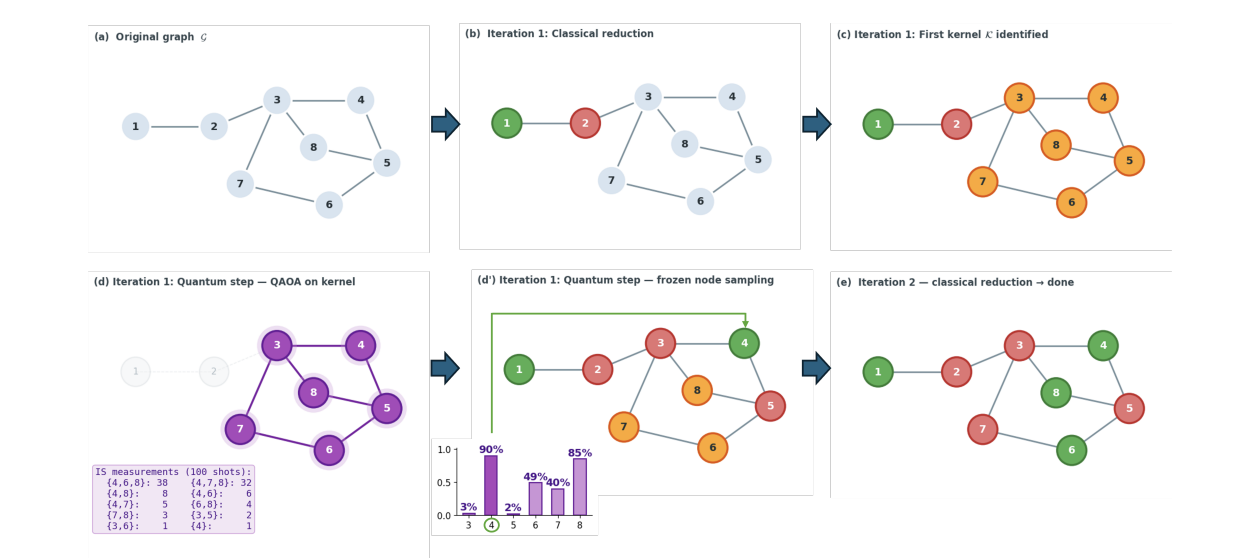
The researchers formulated that task as a mathematical optimization problem known as the Maximum Independent Set problem. In graph theory, assets become nodes in a network, while highly correlated assets are connected by edges. The objective is to identify the largest possible group of assets that are not strongly correlated with one another.
Finding those groups becomes increasingly difficult as the number of assets grows because the number of possible combinations expands rapidly.
Quantum algorithms have long been proposed as a possible way to address these kinds of combinatorial optimization problems. Among the most widely studied is QAOA, a gate-based quantum algorithm designed for noisy intermediate-scale quantum computers.
In practice, however, QAOA faces a significant challenge. As optimization problems become larger and more difficult, the probability that the algorithm directly samples the optimal solution falls sharply.
Rather than treating that limitation as a failure, the new study turns it into part of the solution.
The researchers developed a hybrid algorithm known as qReduMIS. Instead of expecting the quantum computer to identify the complete optimal portfolio, qReduMIS analyzes many quantum measurements to determine which individual variables appear most likely to belong in an optimal solution.
Those variables, referred to as “frozen nodes,” are then fixed into place, allowing classical reduction techniques to simplify the remaining problem before another quantum calculation is performed. The process repeats until the optimization is completed.
According to the study, this iterative workflow allows the quantum processor and classical computer to perform tasks that each handles well rather than forcing either system to solve the entire problem independently.
Hardware Demonstration Using Real Market Data
To evaluate the approach, the researchers constructed optimization problems using historical market data from four major stock indices including Germany’s DAX, the FTSE 100, the S&P 100 and Japan’s Nikkei 225.
The largest dataset contained 225 assets.
The quantum calculations were executed on Quantinuum‘s Helios trapped-ion quantum computer, which contains 98 physical qubits connected through an architecture that allows every qubit to interact directly with every other qubit.
That hardware characteristic proved important because financial correlation graphs are densely connected. Many quantum computing platforms require additional operations to connect distant qubits, increasing circuit complexity and the likelihood of errors. The all-to-all connectivity of trapped-ion hardware reduced that overhead.
The largest quantum circuits in the study operated on 78 qubits and required more than 1,000 two-qubit gates, representing one of the largest reported gate-based QAOA demonstrations on a practical optimization problem.
The researchers report that standard QAOA failed to find the optimal solution for the two largest benchmark problems involving the S&P 100 and Nikkei 225.
The hybrid algorithm, however, successfully solved those same instances substantially more often.
For the Nikkei 225 benchmark, qReduMIS achieved a reported success probability of 95%. For the S&P 100 benchmark, the reported success probability reached 40%. Across all four indices, the researchers report average approximation ratios of at least 0.96, indicating that the solutions remained close to mathematically optimal even when the exact optimum was not always reached.
The study also notes that the hybrid method required relatively few interactions with the quantum processor. In the hardware experiments, no more than five quantum processing unit calls were required to reach the reported solutions.
Better Scaling Than Standard QAOA
Beyond demonstrating that the algorithm worked on current hardware, the researchers examined how its performance changed as optimization problems became larger.
Using Quantinuum‘s H2-1 noisy emulator, they generated dozens of portfolio optimization problems of increasing size and compared the hybrid approach against standalone QAOA.
The researchers measured performance using a standard metric known as time-to-solution, which estimates how much computational effort is needed to achieve a successful result with high confidence.
According to the study, qReduMIS reduced the scaling exponent associated with time-to-solution by roughly a factor of 3.2 compared with standalone QAOA when using two-layer QAOA circuits.
That result suggests the hybrid approach becomes increasingly advantageous as optimization problems grow more difficult.
The researchers also found that solution quality remained relatively stable as problem size increased.
Standalone QAOA showed declining approximation quality on larger optimization problems, while qReduMIS maintained solutions that remained close to optimal across the benchmark set.
The study attributes much of that improvement to how the hybrid algorithm uses information generated by the quantum computer. Even when QAOA rarely produced the exact optimal solution, its measurement results still contained statistical patterns that correctly identified many frozen nodes.
The researchers found that the quantum computer often pointed the classical algorithm in the right direction. Even when it failed to identify the best portfolio outright, it consistently highlighted many of the assets that belonged in the optimal solution.
That observation supports the central premise of the work that quantum computers can contribute useful information without needing to solve the entire optimization problem directly.
Implications Beyond Finance
Although the experiments focused on portfolio diversification, the researchers report that the approach is not specific to finance.
Maximum Independent Set problems arise in numerous fields including telecommunications, logistics, scheduling, network design and manufacturing.
The researchers also evaluated the algorithm on random graph structures beyond financial market networks and reported that the approach maintained strong performance, suggesting that the method is not limited to one particular class of optimization problems.
The study also reflects a growing trend within quantum computing toward hybrid architectures that combine conventional and quantum processors.
Rather than positioning quantum computers as replacements for classical systems, many researchers increasingly view them as specialized accelerators capable of contributing to portions of larger computational workflows. The present work fits squarely within that philosophy by assigning each computing platform a distinct role.
The classical computer performs exact reductions and bookkeeping while the quantum processor supplies probabilistic information that would otherwise be difficult to obtain.
Limitations and Future Work
The researchers emphasize that the work should not be interpreted as demonstrating a practical quantum advantage for financial investing.
The optimization addressed portfolio diversification rather than predicting market returns or constructing complete investment strategies.
Portfolio allocation, risk management and other financial decisions would still require additional processing after the diversification step.
The study also does not compare the hybrid method against the strongest available classical optimization algorithms at large scales.
The researchers report that simulated annealing, a widely used classical heuristic, solved most of the relatively small benchmark problems accessible to today’s quantum hardware with little difficulty. They note that current quantum devices remain limited to problem sizes where advanced classical methods often perform well.
Instead, the researchers position the work as an indication of how quantum-classical hybrid algorithms may evolve as hardware improves.
Larger quantum processors with lower error rates could enable deeper quantum circuits, larger optimization kernels and more challenging benchmark problems that begin to exceed the capabilities of existing classical heuristics.
Future work may also explore improved methods for identifying frozen nodes, optimizing QAOA parameters and extending the approach to weighted portfolio optimization and other industrial optimization problems.
For a deeper, more technical dive, please review the paper on arXiv. It’s important to note that arXiv is a pre-print server, which allows researchers to receive quick feedback on their work. However, it is not — nor is this article, itself — official peer-review publications. Peer-review is an important step in the scientific process to verify results.