
Cancer May Behave Like a Quantum System, Columbia Studies Suggest
Insider Brief
- Columbia researchers found that cancer cells may resemble quantum systems by occupying a limited number of stable biological states despite their many possible mutations.
- Researchers identified six recurring cell states in pancreatic cancer and seven in diffuse midline glioma, a rare pediatric brain cancer.
- The findings suggest that drug combinations targeting every cancer-cell state could work across many patients, although the approach still requires clinical testing.
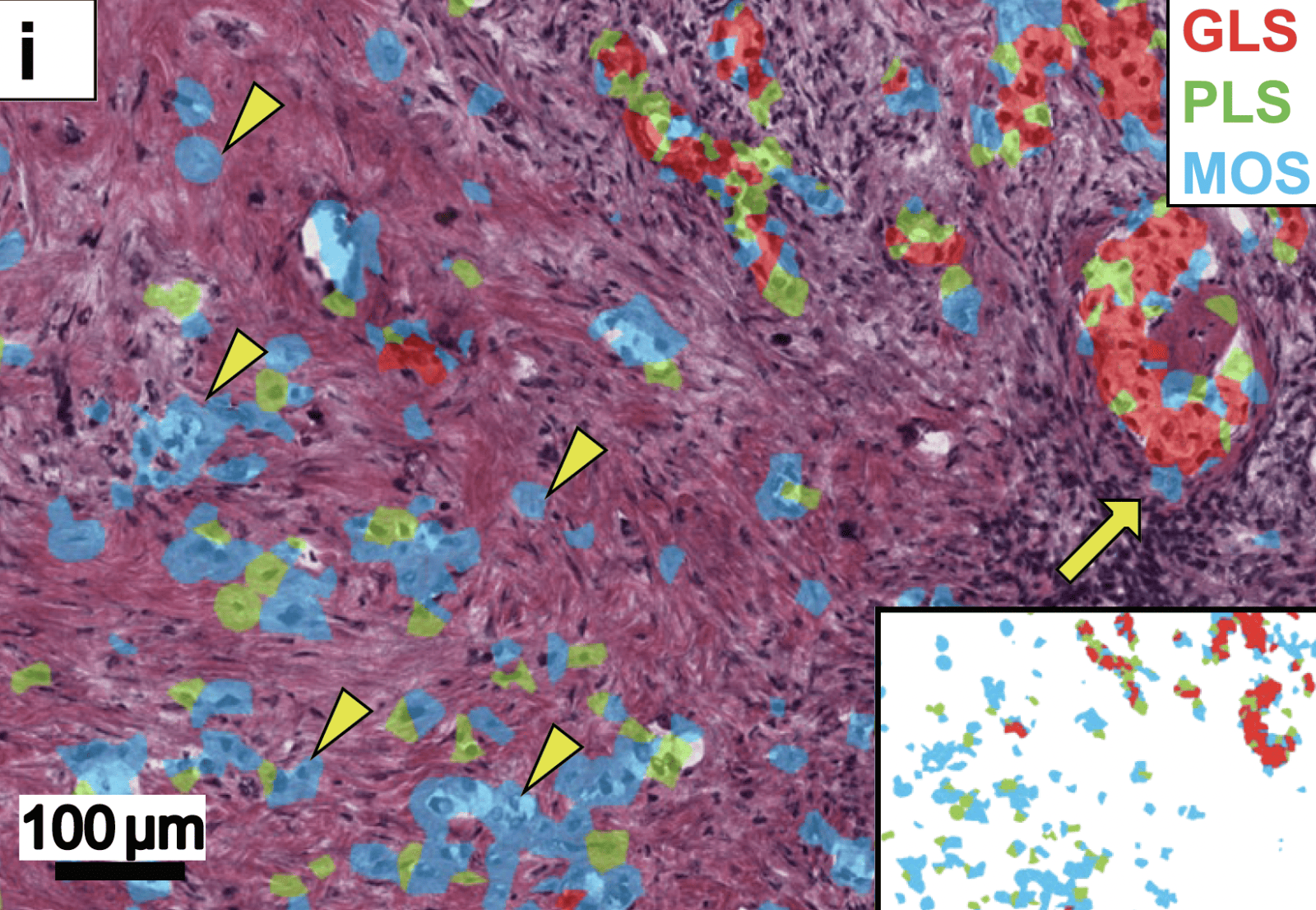
- Image: Colorized cells represent cells in different cellular states in a pancreatic cancer tumor. Among all pancreatic tumors examined by the researchers, only six distinct states were identifed. (Laise et al. 2026. Nature Genetics)
Cancer cells may behave in a way that resembles one of the defining rules of quantum physics, occupying only a limited number of stable states rather than an unlimited range of biological forms, according to Columbia University researchers.
The comparison does not mean cancer is driven by quantum effects at the atomic level. Instead, Andrea Califano, a systems biologist who began his career as a physicist, uses the term “quantum disease” to describe how cancer cells appear to organize themselves.
In an atom, an electron cannot occupy just any energy level. It is restricted to a set of discrete, or quantized, states. Califano’s laboratory has found a similar pattern in cancer. Despite the enormous number of mutations that can contribute to the disease, cancer cells appear to settle into a small number of recurring biological states or move rapidly between them.
Those states are not necessarily unique to individual patients. They appear to be conserved across nearly everyone with the same type of cancer, according to two studies — here and here — from Califano’s laboratory published in Nature Genetics.
“We’re really just following the data,” said Califano, the Clyde ’56 and Helen Wu Professor of Chemical Biology at Columbia University Vagelos College of Physicians and Surgeons and head of Biohub New York. “What we’ve seen over and over again is that each type of cancer has a limited number of cellular states. Just as electrons are restricted to a limited number of quantized energy states in an atom, cancer cells can only occupy one of these stable states or be in rapid transit between them. More critically, these states are conserved across virtually all patients with a specific type of cancer.”
One of the new studies found that malignant cells in pancreatic cancer occupy six recurring states. The other identified seven states in diffuse midline glioma, a rare and fatal pediatric brain cancer, and proposed a three-drug combination designed to target all of them.
The findings could change the central question behind personalized cancer medicine. Instead of attempting to develop a treatment for every possible combination of mutations, researchers may be able to design combinations that cover the handful of cellular states found in a particular cancer.
“If cancer is quantum, the good news is that we may not need personalized medicine,” Califano said. “A combination of therapies targeting the handful of distinct, detectable states may be all that is needed, and those combinations should be effective for virtually every patient.”
It’s important to point out that, as of now, the idea remains a model of cancer biology, not a proven clinical treatment strategy. The proposed drug combinations require further study, including clinical trials to determine whether they are safe and effective in patients. Still, the findings offer evidence that the apparent genetic complexity of cancer may converge on a far simpler set of biological outcomes.
What Makes the States “Quantum”
The term quantum usually describes physics at the scale of atoms and subatomic particles. In that world, some properties do not vary continuously, but, rather, come in fixed units.
An electron bound to an atom, for example, can occupy one permitted energy level or another. It can also transition between those levels, but it cannot remain at an arbitrary point between them.
Califano sees an analogous pattern in cancer cells. A malignant cell has thousands of active genes and proteins, but that does not mean it can adopt an unlimited number of stable identities. Networks of regulatory proteins appear to pull the cell toward one of several stable configurations.
A state describes more than the presence of a particular mutation. It reflects the combined activity of proteins that control which genes are turned on or off, how the cell uses energy, what kind of tissue it resembles and how it responds to drugs.
Cells can move from one state to another. Some transitions happen spontaneously, while others may occur under pressure from a treatment. The ability to change, known as cellular plasticity, could allow tumors to survive drugs that kill only one type of cancer cell.
The quantum analogy therefore has two parts. Cancer cells occupy a limited number of recognizable states, and they can transition between those states. It does not imply that the cells are in quantum superposition or that the studies detected quantum phenomena inside tumors.
Even though this doesn’t suggest the rules of quantum are governing cancer growth, the potentially important result is what is termed a biological compression. This means that the number of possible cancer mutations is vast, but the number of stable outcomes produced by those mutations may be relatively small.
Califano’s earlier research analyzed more than 10,000 samples across more than 20 cancer groups and identified 112 distinct states. More recent work at the level of individual cells has found no more than seven states in any cancer studied by the laboratory, according to Columbia. Only one cancer examined so far had a single state.
From Mutations to Master Regulators
Traditional cancer therapies, including chemotherapy and radiation, attack rapidly dividing cells by causing extensive damage to their DNA. These treatments can kill cancer but can also harm healthy cells.
Targeted therapies take a more selective approach. They are designed to block the effects of particular cancer-related mutations or proteins. Herceptin, for example, targets HER2 in cancers driven by excessive activity of that protein.
These drugs helped establish personalized medicine, in which treatment is tailored to the mutations found in an individual patient’s tumor. The challenge is that about 2,000 genes can contribute to cancer, producing a huge number of possible mutational patterns.
“Going after mutations in cancer genes — so called oncogenes — is a very powerful concept,” Califano said. “Yet, most often, it only buys patients some extra time. The reality is that cancer is much more complex, because the potential number of mutational patterns in about 2000 oncogenes is larger than the number of atoms in the universe.”
Califano’s laboratory looks downstream from those mutations. Its researchers analyze gene activity in living cancer cells to reconstruct the networks of proteins that maintain the cells’ malignant behavior.
Within these networks, some proteins act as central control points. The researchers call them master regulators because they organize the broader program that defines a cell’s state.
“These are the generals that control the state of the cell,” Califano said. “If you shut down these proteins — we call them cancer’s master regulators — the cell can’t sustain its malignant state anymore.”
Different sets of mutations may activate the same master regulators and push cells into the same state. That could explain how genetically different tumors end up sharing similar behavior and drug vulnerabilities.
It also suggests a possible alternative to mutation-by-mutation treatment. Researchers could identify the states present in a type of cancer, determine which master regulators sustain each one and assemble a small set of drugs that collectively disrupts them all.
Six States in Pancreatic Cancer
In the pancreatic cancer study, researchers led by Pasquale Laise, Mikko Turunen and Alvaro Curiel-Garcia analyzed malignant cells from 110 pancreatic ductal adenocarcinoma samples contained in six datasets.
Pancreatic ductal adenocarcinoma is the most common form of pancreatic cancer. It is highly resistant to chemotherapy, targeted medicines and immunotherapy, with many tumors quickly developing resistance to treatment.
The researchers used gene-regulatory network analysis to estimate the activity of more than 1,800 regulatory proteins in individual cancer cells. This method allowed them to classify cells according to their operating programs, including cases in which conventional genetic measurements could not directly detect the relevant proteins.
The analysis identified three broad paths that cells take as they develop — or, developmental lineages. One resembled gastrointestinal tissue, another reflected pancreatic development and a third was associated with poorly differentiated cancer cells that had lost many features of normal tissue.
Each lineage could also appear in a state with either high or low activity in the mitogen-activated protein kinase — MAPK — signaling pathway. This pathway carries instructions that help regulate cell growth and survival and is often disrupted in cancer. The three lineages and two MAPK conditions produced a total of six states.
The six states appeared across virtually all the patient samples, according to the researchers. About 87% of malignant cells could be assigned to one of them. An additional 11% showed features of multiple states, consistent with cells moving from one state to another, while 2% could not be classified.
“What really differed among patients wasn’t their cancer cells’ states but rather the fraction of cells in one state versus another, which seems to be key effect of mutations,” Califano said.
The team used molecular barcodes to follow cancer cells over time. The experiments showed that cells could switch spontaneously among the developmental and MAPK states. Treatment with a drug that inhibits part of the MAPK pathway could also prompt a rapid transition from high to low MAPK activity.
That flexibility may help explain why pancreatic cancer is difficult to eliminate. A drug that attacks one state may spare cells in another. Surviving cells may also switch states and restore the tumor’s original mix.
“The good news is that, because the same states are found in every patient, if you find a few drugs that, together, target all the states, that combination could be potentially curative,” Califano said. “The bad news is that in pancreatic cancer each state can spontaneously change into any of the other states, suggesting that we may never be able to treat these tumors with a single drug.”
As Califano suggests, the study did not identify a curative treatment. It instead established a map of pancreatic cancer states and the regulatory proteins on which those states depend, providing possible targets for future drug combinations.
Targeting Every State at Once
The second study applied the approach to diffuse midline glioma, an aggressive brain cancer that primarily affects children. The location of these tumors in critical central parts of the brain makes surgery difficult, and the disease is considered universally fatal.
Ester Calvo Fernández, a graduate student in Califano’s laboratory, and colleagues identified seven cancer-cell states associated with the disease. They then used two computational methods, OncoTreat and OncoTarget, to search for existing drugs predicted to disrupt the master regulators supporting those states.
The analysis selected avapritinib, ruxolitinib and larotrectinib. The drugs have been developed or approved for other indications, but the researchers proposed combining them because their effects appeared to cover all seven states.
Laboratory experiments confirmed that the drugs individually targeted the states predicted by the analysis. The researchers also tested two-drug combinations aimed at complementary states. All but one substantially outperformed the corresponding single-drug treatments, according to the study.
The full three-drug combination has not yet been tested in patients. The researchers hope to evaluate it in a clinical trial, which would need to determine whether the combination can reach the tumor, whether children can tolerate the drugs together and whether the treatment improves survival.
The larger principle is that a successful combination may need to target every stable state available to the cancer. Leaving one state untouched could give surviving cells a reservoir from which to rebuild the tumor. In cancers with extensive plasticity, cells could also escape treatment by transitioning into a state that the drug does not affect.
The findings do not establish that every tumor behaves as a quantized system or that every cancer will be vulnerable to a small drug combination. Researchers will need to map additional cancers, test whether their states remain stable across broader groups of patients and validate predicted treatments in clinical studies.
Still, the work presents a potentially simpler view of cancer. Its genetic causes may be almost immeasurably diverse, while the number of biological states that must be treated may be small.
“That’s the ultimate goal. A lot of our work sound theoretical,” Califano said. “But everything we predict gets tested in the lab and, when possible, in the clinics. We’ve already shown that these analyses can predict therapies for patients who had failed multiple lines of therapy.”
“Hopefully, the identification of drugs targeting hyperconserved, quantized cancer states will help many more.”