
Aegiq Uses NVIDIA cuQuantum to Develop Quantum-Ready CFD Methods
- Aegiq is developing quantum-ready computational fluid dynamics (CFD) methods that use tensor network techniques to improve the efficiency of high-fidelity fluid simulations.
- The company combined its tensor-network-based CFD approach with NVIDIA cuQuantum tools, demonstrating logarithmic runtime scaling and generating meshes with more than one billion nodes on an NVIDIA L40S GPU.
- Aegiq’s methods are designed to run on current GPU hardware while remaining compatible with future fault-tolerant quantum computers.
- The material in this article is taken directly from content published on Aegiq’s website and reflects the company’s description of its research and development efforts.
Computational fluid dynamics has become one of the essential tools of modern engineering and science. It shapes the design of aircraft and jet engines, informs the aerodynamics of cars and ships, and underpins the numerical models used to forecast weather and understand climate. In each of these domains, the ambition is the same: to predict the behaviour of complex fluids accurately enough to make better decisions before anything is built, launched, manufactured, or deployed.
Yet the most faithful way to simulate fluid flow remains impractical for many real-world problems. Direct numerical simulation (DNS) resolves the full range of turbulent motion directly, without relying on turbulence models or empirical assumptions. In principle, it offers a route to first-principles prediction. In practice, however, the computational cost grows so rapidly that DNS is restricted to relatively simple configurations and low complexity flows.
This limitation forces a compromise at the heart of CFD. Aerospace engineers must balance accuracy against turnaround time when assessing drag, lift, noise, icing, combustion, or boundary-layer transition. Automotive teams rely on approximations to explore aerodynamic efficiency, thermal management, cabin comfort, and vehicle stability within design-cycle constraints. Weather and climate models must parameterise unresolved processes, from cloud microphysics to turbulent mixing, because global predictions cannot explicitly resolve every relevant scale. These approximations are useful, but create uncertainty precisely where higher fidelity would have the greatest value.
At Aegiq, we are exploring a different path. Our quantum-ready methods use tensor network techniques to reimagine how high-dimensional flow problems are represented and computed. Rather than simply attempting to push classical CFD harder with larger meshes and more processors, we are investigating new mathematical representations to change the scaling of the problem itself. The goal is not to replace today’s CFD workflows overnight, but to enable simulations that are currently impractical: higher-fidelity, more efficient, and capable of overcoming bottlenecks in aerospace, automotive design, and climate and weather modelling.
A story about length scales
Across physics, complexity is often structured rather than arbitrary. Strong correlations tend to occur between similar length, time, or energy scales. In CFD, this appears in the turbulent energy cascade, where energy moves through neighbouring eddy scales before being dissipated. In chemistry, the Born–Oppenheimer approximation exploits the separation between fast electronic motion and slower nuclear motion. In many quantum systems, entanglement can decay with distance, allowing the most important correlations to be captured compactly.
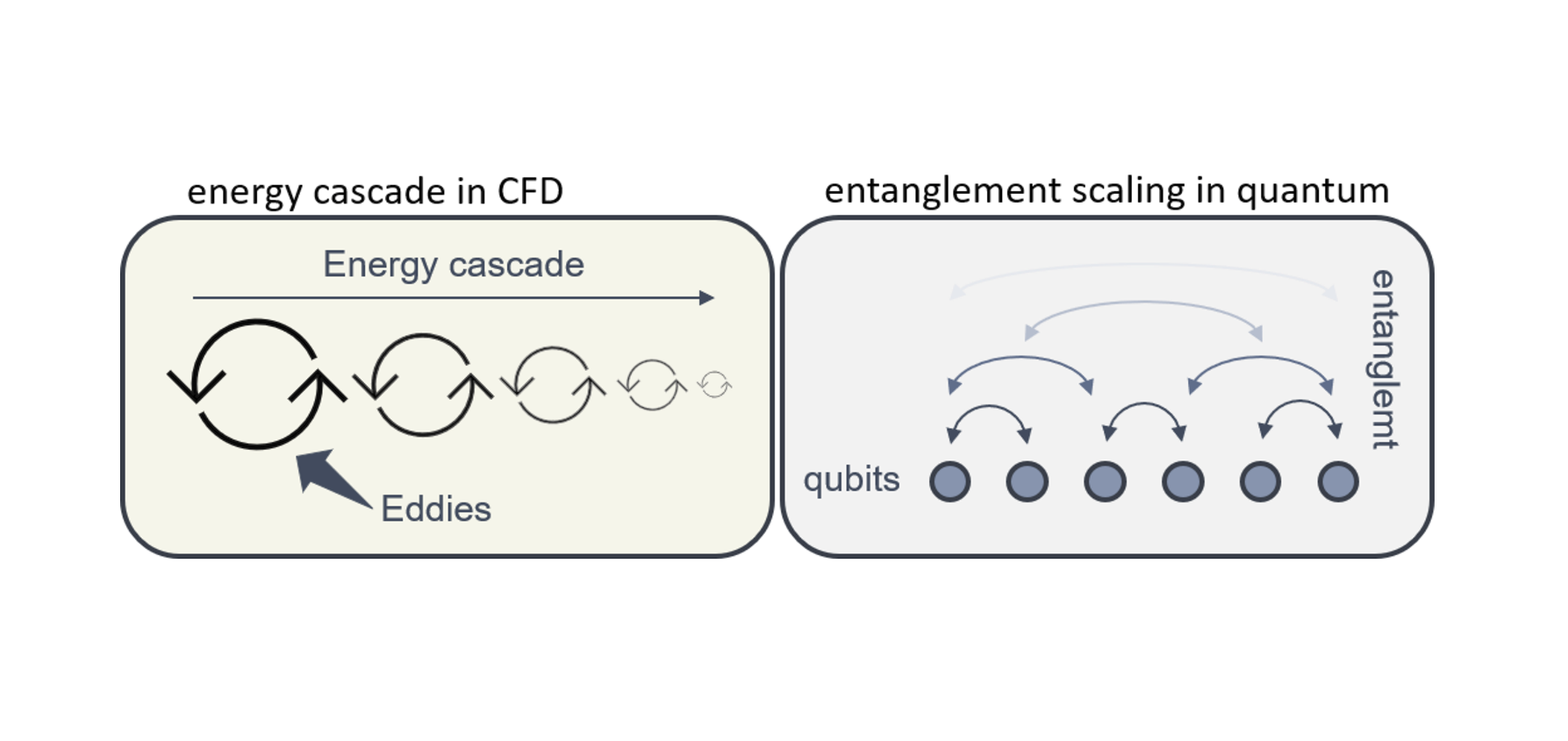
Tensor network methods were developed to exploit this kind of structure in quantum systems. By representing only the relevant correlations, they can avoid storing the full exponentially large state and, in suitable cases, achieve logarithmic scaling in memory use and runtime when deployed on CPUs or GPUs. Also, quantum-ready approaches are easily translatable to future fault tolerant quantum computers, which will unlock the ability to scale beyond the available memory of conventional hardware.
Recently, the same perspective has been applied to CFD. The turbulent energy cascade has a natural hierarchy of scale-to-scale correlations, making it well suited to tensor network representations. For textbook examples, e.g. Taylor-Green vortices, this has already shown logarithmic scaling in both memory and runtime.
Aegiq is now using GPU-accelerated tools within the NVIDIA cuQuantum SDK to take these ideas beyond textbook demonstrations, developing quantum-ready CFD methods for real-world problems in aerospace, automotive design, and climate and weather modelling.
Mesh generation is key
A critical part of any CFD workflow is mesh generation. The mesh determines how the physical domain is represented, how accurately flow features can be resolved, and how efficiently the resulting equations can be solved. For real-world problems mesh quality is often just as important as the solver itself.
This means mesh generation needs specific attention in any tensor-network-based CFD approach.
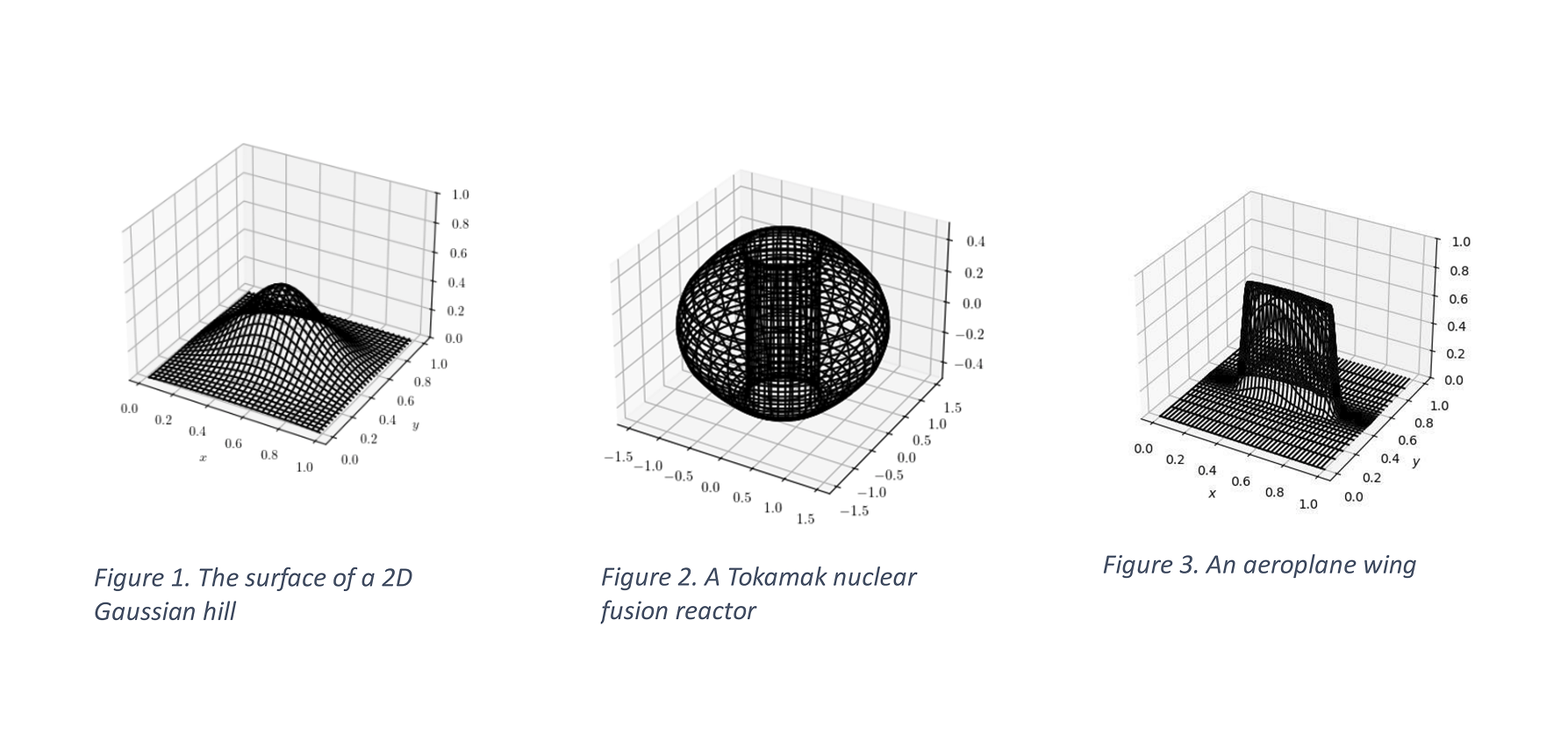
Aegiq has pioneered a mesh generation scheme designed specifically for quantum-ready CFD methods. By constructing meshes that align naturally with tensor network representations, this approach helps unlock the logarithmic memory and runtime scaling demonstrated in simplified CFD examples and makes it applicable to realistic geometries and boundary conditions.
Scaling made easy with NVIDIA
Aegiq’s quantum-ready CFD algorithms are designed to exploit tensor structure, but practical deployment requires high-performance execution on current hardware. To achieve this, we have integrated NVIDIA’s cuTensorNet libraries, part of the cuQuantum SDK, which provide GPU-accelerated tools for tensor network algorithms.
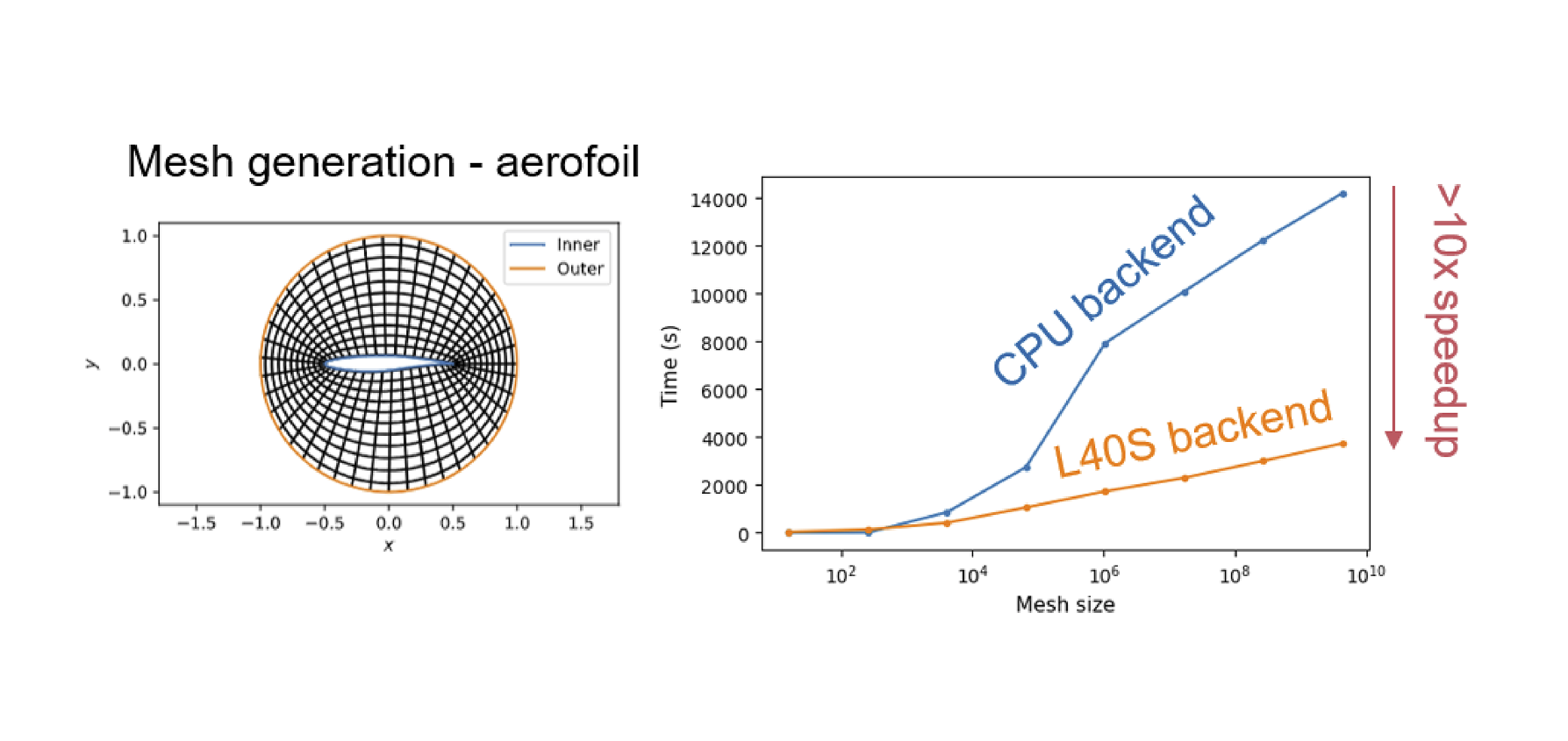
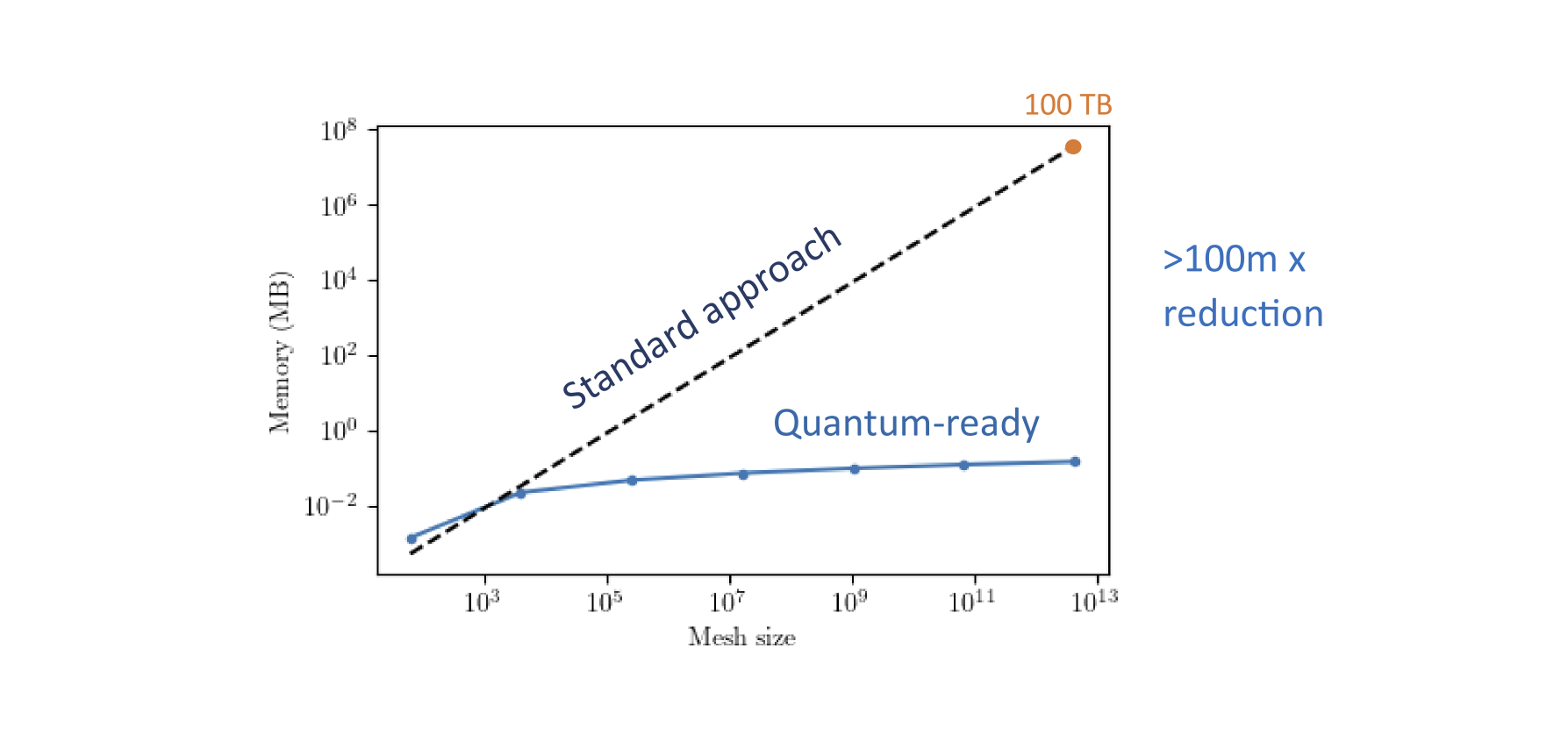
This allows our methods to move quickly from theoretical scaling advantages to practical, scalable implementations. Using cuTensorNet acceleration, Aegiq deployed its quantum-ready mesh generation approach on an NVIDIA L40S GPU in a matter of days after the algorithm’s development. This has enabled Aegiq to demonstrate logarithmic runtime scaling while generating meshes with more than one billion nodes.
This is a key milestone: it demonstrates that Aegiq’s quantum-ready CFD solutions can meet and exceed current industrially relevant mesh sizes on existing GPU hardware to enable immediate, measurable performance gains.
The same algorithms are designed to map directly to fault-tolerant quantum computers as they emerge, meaning businesses can extract value now and transition seamlessly to quantum hardware in the future.