
Haiqu Releases AgenticOS to Plan and Check Quantum Research
Insider Brief
- Haiqu launched AgenticOS, a system that coordinates specialized AI agents to plan, validate and prepare quantum research experiments for hardware execution under human oversight.
- In a chemistry test, Haiqu reported that four of 10 unassisted AI agent runs violated setup instructions, while AgenticOS maintained the approved protocol and produced a simulated result within approximately 3.4% of an exact reference.
- Haiqu reported that AgenticOS developed and ran a 3-by-3 Hubbard model experiment on an IBM quantum computer, reducing circuit depth by 75% and proposing a calibration that aligned hardware results with an error-free simulation of the same method.
PRESS RELEASE — Existing AI models have advanced to the point that they can contribute to real science, but they have their limits. An AI agent can produce convincing math and working code, but it might alter the underlying science while doing so, leaving researchers with results that look right but aren’t. Today, Haiqu is addressing that by unveiling AgenticOS, giving quantum researchers a team of AI agents that are built for scientific exploration, and designed to catch mistakes before they happen.
In complex scientific calculations, general-purpose AI agents can make small changes no one asked for, like shifting a molecular geometry or slipping in an unapproved approximation. The calculation then answers a different question, or returns a result that is simply incorrect. With the Haiqu AgenticOS, researchers can now design an entire quantum project — from the initial question to an experiment that’s ready for quantum hardware — and assign multiple teams of AI agents to validate and confirm the research findings every step of the way. The team overseeing the experiment can then inspect each assumption and conclusion to determine how to proceed.
“Turning a promising research idea into a real experiment demands years of specialized, hands-on expertise in highly technical methods, all of which takes time and resources,” said Mykola Maksymenko, co-founder and CTO of Haiqu. “AgenticOS takes on much of that labor-intensive work, freeing up researchers so they can spend their time working on the right questions, reaching results much faster without sacrificing accuracy.”
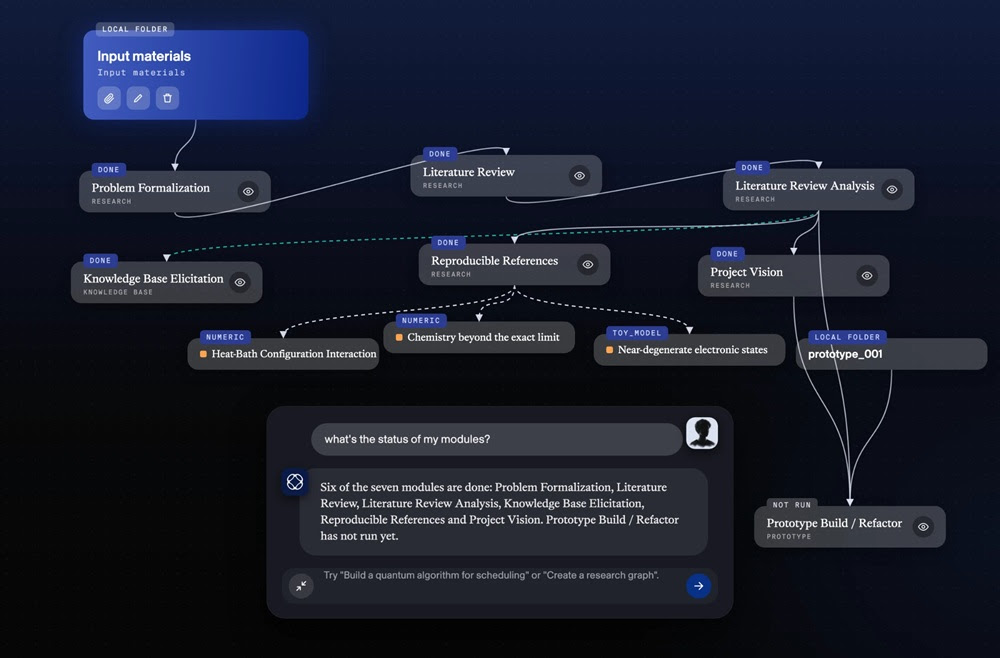
AgenticOS builds on the Haiqu platform announced in May. A researcher starts with a question, and the system assigns teams of specialized AI agents to review the literature, work through first-principles mathematical derivations, assess quantum feasibility and check the results. Haiqu’s AgenticOS shows its investigative process as a map of connected research tasks. Results are checked against classical baselines, tests, critic agents and human review, with formal verification. Scientists decide what gets locked, which tasks run on their own and where a human signs off.
During a recent chemistry study accepted at the NeurIPS 2026 workshop in Paris focused on AI for Scientific Discovery, Haiqu demonstrated the need for its platform by giving leading AI agents the same research brief, with and without AgenticOS. On their own, four of 10 agent runs ignored an explicit setup instruction, resulting in widely different answers. Using Haiqu’s AgenticOS, the same models held to the approved protocol from start to finish and produced a simulated quantum result within approximately 3.4% of the exact diagonalization reference.
“Being able to organize, ground and check an AI agent’s work matters as much for scientific research as improving the models themselves,” said Richard Givhan, co-founder and CEO of Haiqu. “Every lab will soon have access to the same powerful AI. The ones that pull ahead will be the ones that can trust what it produces, and that’s exactly what we built AgenticOS to do.”
AgenticOS has already been deployed to work on one of the hardest problems in physics. The Hubbard model describes electrons hopping across a grid and repelling each other when they meet. Haiqu targeted a 2D “doped, frustrated with diagonal hopping” version of the model, which is used to study high-temperature superconductivity in copper-based materials known as cuprates. Starting from a scientist’s idea, AgenticOS built the experiment on a 3-by-3 grid, small enough to cross-check against an exact classical solution, and ran it on an IBM quantum computer. It reduced circuit depth by 75% and proposed a calibration that brought the hardware result in line with what an error-free quantum computer would produce using the same method. That shows a way to apply the same approach to larger simulations that classical computers can’t solve exactly.
Haiqu’s platform serves enterprise teams testing individual use cases, university research labs and scientists from other fields looking to take their first step into quantum computing. Agents can help users determine if a specific quantum approach is worth pursuing, while mapping out algorithm options, identifying the assumptions and identifying the classical benchmarks needed to judge the result.
When a research plan is ready, AgenticOS hands it straight to Haiqu’s quantum software stack. The Haiqu SDK squeezes more out of today’s noisy hardware with data loading, circuit compression and error mitigation. The Haiqu Runtime then manages execution on simulators and quantum processors from IBM, IonQ, IQM, AWS and others, cutting time and cost by up to 1,000x. The same platform that helps a researcher frame the question can take the answer all the way to a quantum computer.
Availability
AgenticOS is included with the Haiqu operating system, and is available now to enterprise R&D teams upon request. Companies can request access and book a demo now.
Academic researchers can apply for free access to the Haiqu platform, including AgenticOS, through the company’s Academic Program. Participating labs get the Haiqu SDK. They can also apply for AWS credits to cover classical and quantum computing workloads.
Details are at haiqu.ai/academic.