
Washington Begins to Treat Quantum Technology as a Strategic Priority
Insider Brief
- U.S. quantum policy discussions are shifting from research leadership to commercialization and deployment, reflecting a new phase of the technology.
- Lawmakers and industry leaders emphasized urgency around global competition, supply chains, workforce development, and sustained federal investment.
- Multiple legislative efforts and industry alignment are emerging, but political timing and funding constraints could slow progress if momentum is not maintained.
Tuesday in Washington offered a clear picture of where quantum technology now stands, not as a future concept, but as a present responsibility.
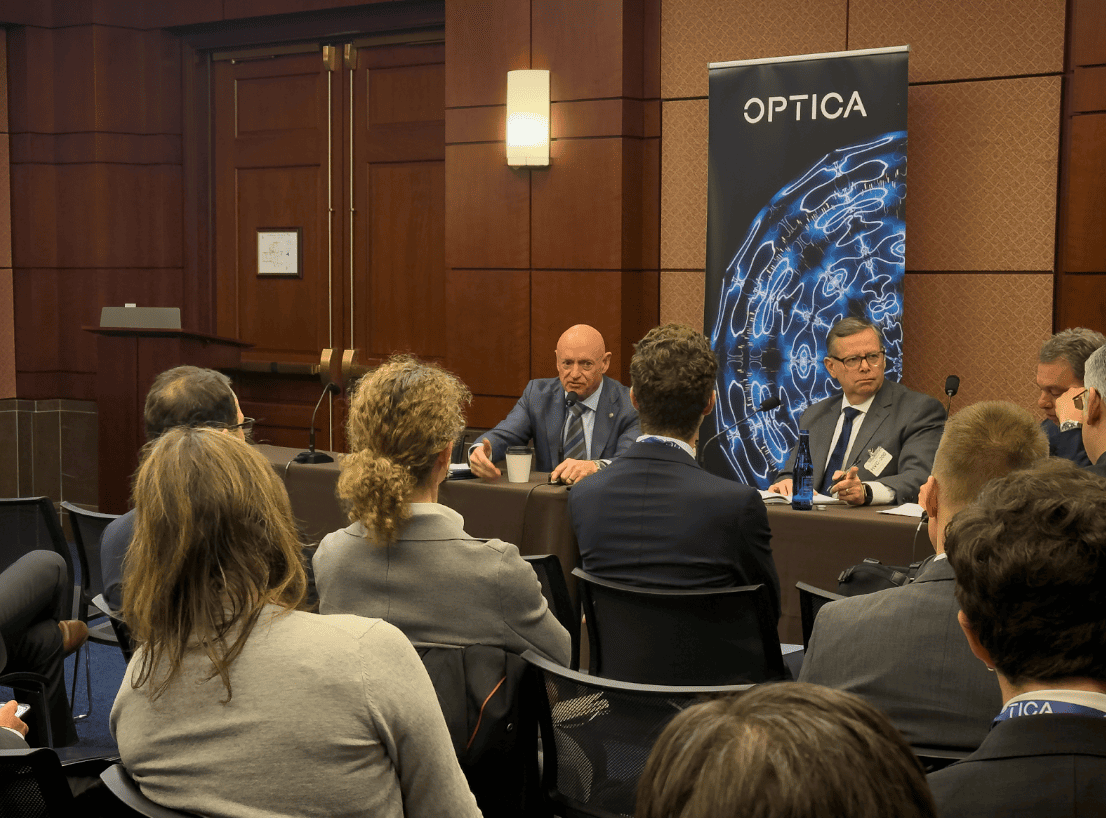
Meetings on Capitol Hill, organized by Optica, brought together lawmakers, federal agencies, and leaders from across the quantum ecosystem to focus on what comes next. The conversations were not about introducing the importance of quantum. That case, for the most part, has already been made. What is changing is how the conversation is being framed. The question is no longer whether quantum will matter, but whether the United States is prepared to act with the urgency and coordination required to lead.
The Quantum Insider was present throughout the meetings, providing a consolidated view into discussions that are typically spread across committees, agencies, and private briefings. What emerged was not a single announcement, but something more consequential: a shared understanding that the United States is moving from a phase defined by research leadership into one that will be defined by commercialization and deployment.
That distinction came through most clearly in the remarks of Sen. Todd Young, who has been one of the leading voices as a sponsor of the National Quantum Initiative Reauthorization Act. “It’s not enough to have best-in-class innovators,” Young said. “If you’re not deploying, you risk losing your edge.” The United States has historically led in foundational research. That leadership has been one of its greatest advantages. But in emerging technologies, leadership in discovery does not automatically translate into leadership in use.
The National Quantum Initiative, first enacted in 2018, helped establish the federal framework for research and coordination. The reauthorization now under consideration reflects a different phase of the technology. It expands the focus beyond basic science into engineering, applications, workforce development, and supply chain resilience, while encouraging greater coordination across agencies and with international partners. The goal is not only to support innovation, but to ensure that innovation can be translated into real systems that operate at scale.
That shift has been gradual, and at times delayed. Reauthorization has been anticipated for several years, even as the underlying technology has continued to advance. During that same period, other countries have moved forward with more explicit national strategies. Governments around the world have committed billions of dollars to quantum programs. The United Kingdom, Germany, France, and Japan have all launched coordinated efforts, while China’s investment has reached into the tens of billions. The result is that quantum is no longer just a scientific competition. Recent disruptions in semiconductor supply chains have already demonstrated how quickly technological dependence can become a national vulnerability, a lesson increasingly shaping how lawmakers think about quantum infrastructure.
“They understand what is at stake,” Young said. “Congress should not sit idly by.”
That sense of urgency was echoed across the meetings, though often in different language. Sen. Mark Kelly, who serves on the Armed Services and Intelligence committees, described the issue in more direct strategic terms. “We’re in a race,” Kelly said. “Whoever gets there first on some of this is going to have a significant advantage.” His focus extended beyond quantum computing itself to include sensing and communications, areas that are less visible but equally important in shaping future defense and intelligence capabilities. He also pointed to something that is sometimes overlooked in policy discussions: that the United States’ economic strength has long been tied to sustained investment in science. “We’ve had the world’s biggest economy because of our ability to invent and innovate,” he said. “That comes from science.”
Sen. Marsha Blackburn approached the issue from a similar vantage point, emphasizing the implications for national security, particularly as quantum capabilities intersect with encryption, communications, and critical infrastructure. The concern is not only that quantum systems will become more powerful, but that they will do so in ways that outpace the cybersecurity protections currently in place.
If there is a broad agreement on the importance of quantum, there is less clarity on how quickly policy can move to match it. Conversations with House and Senate staff reflected a process that is active, but constrained by familiar realities. Bipartisan support is present, but it does not eliminate the challenges of timing, jurisdiction, or funding. In an election year, the window to move legislation is narrow, and missing it could delay progress by another cycle.
At the same time, the policy landscape itself is beginning to expand. A newly introduced bipartisan bill led by Sens. Kirsten Gillibrand, Chuck Schumer, Marsha Blackburn, and Reps. Jay Obernolte and Laura Gillen aims to accelerate American quantum innovation through expanded investment, commercialization pathways, and workforce development. Its introduction alongside the reauthorization effort suggests that quantum policy is developing across multiple fronts, rather than through a single legislative vehicle.
Industry’s role in this process has also evolved. Executives and researchers from across the quantum ecosystem, including companies such as IonQ, D-Wave, Quantinuum, IBM, and Google, were present throughout the meetings. Many of these organizations compete directly. In Washington, however, they spoke with a degree of alignment that reflects the stage the industry is in. The request was not for a narrow set of provisions, but for consistency: sustained investment, clearer pathways to deployment, and a stronger signal that the federal government intends to support the ecosystem as it matures.
That consistency matters because the challenges ahead extend beyond research. They include building supply chains, developing a workforce, enabling commercialization, and ensuring that the United States can manufacture and deploy the technologies it invents. The Department of Energy’s recent Genesis Mission, backed by $293 million in funding, reflects an effort to integrate quantum technologies with artificial intelligence and high-performance computing into a broader national framework. It is an acknowledgment that quantum will not develop in isolation, but as part of a larger system that defines how advanced technologies are built and deployed.
For lawmakers such as Rep. Joe Morelle, the issue ultimately comes down to commitment. “This is not only economic security,” Morelle said. “It’s national security.” His point is less about any single program and more about continuity. Technologies like quantum require sustained investment over time. They do not align neatly with short political cycles, and they are difficult to restart once momentum is lost.
There are meetings in Washington every day about quantum technology. What felt different this week was that the conversation is beginning to move toward execution. A relatively small group of lawmakers has spent years advancing the issue. Their efforts have brought quantum to the point where it can become a sustained national priority. Whether it does will depend on whether that understanding extends more broadly across Congress.
As several lawmakers made clear, legislation of this kind does not move on its own. It moves when the case for it is made clearly and consistently, not just in Washington, but in districts across the country. The lawmakers leading this effort cannot carry it alone. They will need their colleagues to understand both the opportunity and the consequences of delay.
For the quantum community, the implication is clear. Continued engagement, clearer communication, and a coordinated effort to demonstrate real-world impact will be essential in helping policymakers translate understanding into action.
The foundation is in place. What happens next will depend on whether the urgency expressed in these meetings is matched by the follow-through required to sustain it.