
TQI’s Top Quantum Research Stories of 2025
As 2025 draws to a close, it’s once again time at The Quantum Insider to step back from the daily churn of preprints, press releases and policy announcements and take stock of the research stories that captured the community’s attention.
The following top ten research stories of 2025 are drawn from The Quantum Insider to give you a snapshot of which developments resonated most strongly with our audience over the past year. It’s certainly not comprehensive — 2025 was an extremely busy year for quantum research. The list was pulled together using web analytics, but we added some personal favorites to make sure the list represented the spectrum of quantum news that hit the internet during 2025.
The list knits together several threads that defined quantum research in 2025: renewed debates over the foundations of quantum mechanics, credible claims of quantum advantage and beyond-classical performance, rising geopolitical competition, and an expanding curiosity about how quantum theory intersects with biology, consciousness, and the limits of computation itself. If nothing else, these stories reflect a field that is no longer confined to the lab — and is increasingly comfortable questioning its own assumptions along the way.
Clarke, Devoret And Martinis Win 2025 Nobel Prize in Physics For Revealing Quantum Effects in Macroscopic Circuits
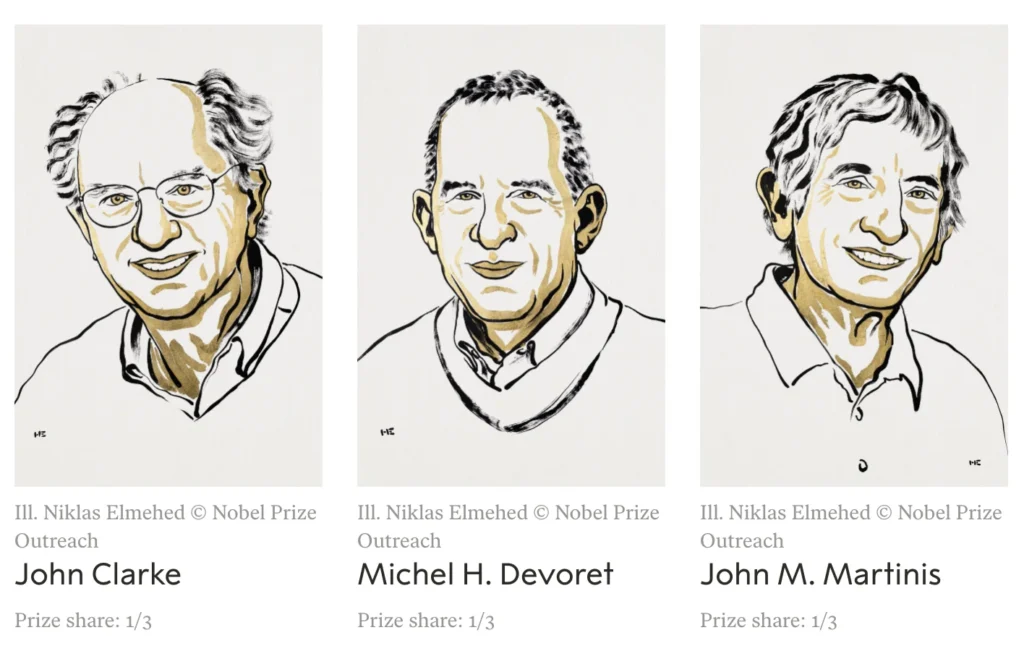
The Royal Swedish Academy of Sciences awarded the 2025 Nobel Prize in Physics to John Clarke, Michel H. Devoret and John M. Martinis for their work in the discovery of macroscopic quantum mechanical tunnelling and energy quantisation, according to a statement from the academy. Their work, carried out in the 1980s, proved that quantum phenomena such as tunneling and energy quantization can occur on macroscopic scales, reshaping how scientists think about the boundary between classical and quantum physics.
Google Quantum AI Shows 13,000× Speedup Over World’s Fastest Supercomputer in Physics Simulation
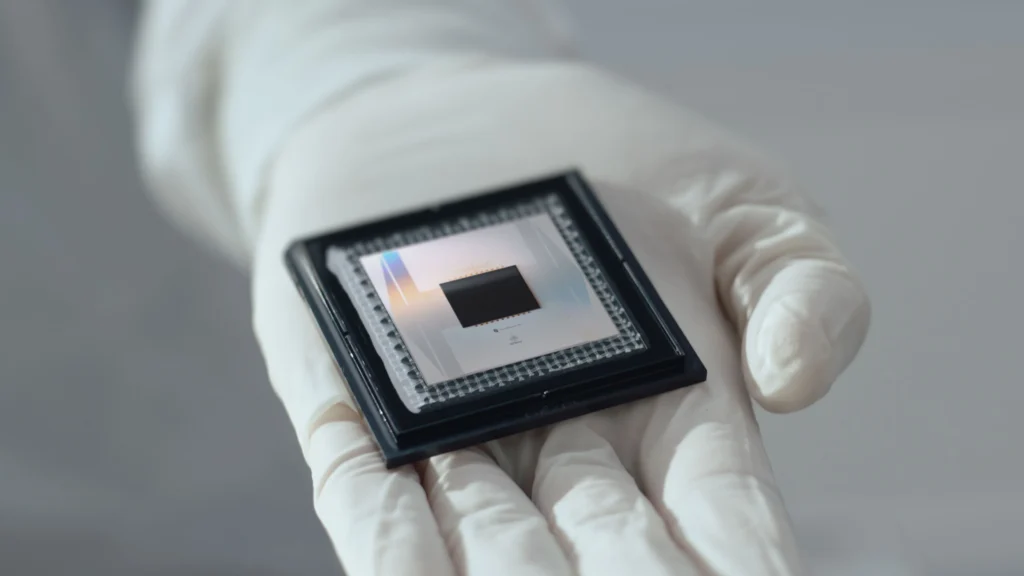
Google Quantum AI has reported a physics experiment that pushes quantum computing further into what researchers call the “beyond-classical” regime, where even the world’s most powerful supercomputers fail to keep up. In a paper published in Nature, the team describes using its 65-qubit superconducting processor to measure a subtle quantum interference phenomenon called the second-order out-of-time-order correlator, or OTOC(2).
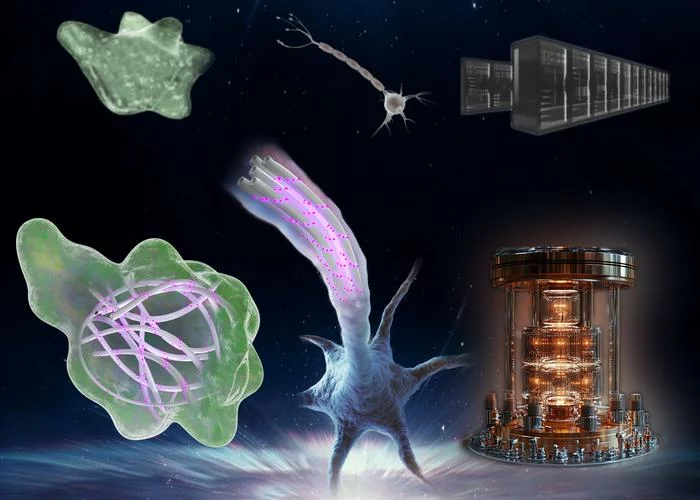
Study Finds Cells May Compute Faster Than Today’s Quantum Computers
More than 80 years ago, Erwin Schrödinger, a theoretical physicist steeped in the philosophy of Schopenhauer and the Upanishads, delivered a series of public lectures at Trinity College, Dublin, which eventually came to be published in 1944 under the title What is Life?
Now, in the 2025 International Year of Quantum Science and Technology, Philip Kurian, a theoretical physicist and founding director of the Quantum Biology Laboratory (QBL) at Howard University in Washington, D.C., has used the laws of quantum mechanics, which Schrödinger postulated, and the QBL’s discovery of cytoskeletal filaments exhibiting quantum optical features, to set a drastically revised upper bound on the computational capacity of carbon-based life in the entire history of Earth. Published in Science Advances, Kurian’s latest work conjectures a relationship between this information-processing limit and that of all matter in the observable universe.
Google Researcher Lowers Quantum Bar to Crack RSA Encryption
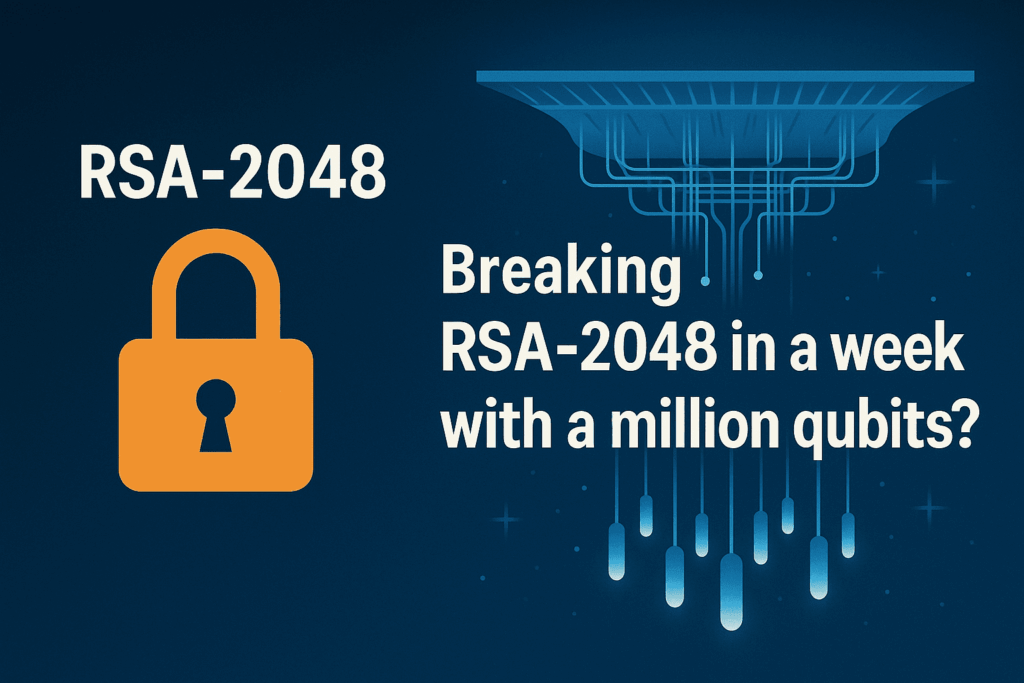
A new study from a Google Quantum AI researcher suggests that a 2048-bit RSA encryption key, a common standard for securing online data, could be cracked in less than a week using a quantum computer with fewer than a million noisy qubits—an order-of-magnitude drop from previous estimates.
The paper, authored by researcher Craig Gidney and posted to arXiv, redefines the technical barrier required to threaten one of the most widely used public-key cryptography systems in the world. The revised estimate represents a sharp drop from Gidney’s own 2019 projection, which pegged the cost at around 20 million qubits.
Quantum Advantage Claim — Quantum Entanglement Gives Players a Significant Edge in Strategic Game
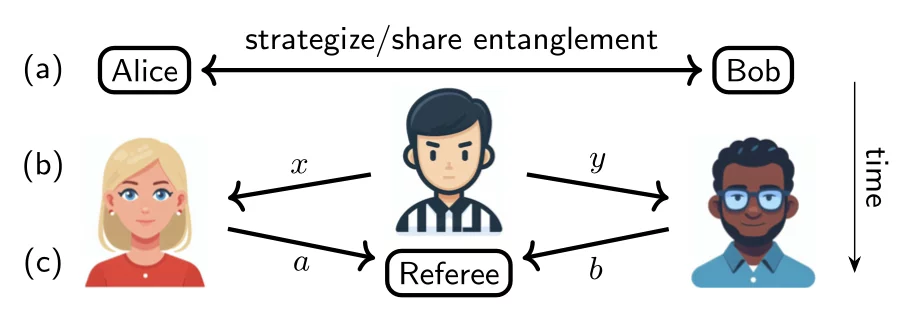
Scientists claim they demonstrated a quantum advantage in a strategic game, showing that two players using entangled particles can outperform the best classical strategy by a statistically significant margin.
The findings, published in Physical Review Letters, offer new evidence that quantum mechanics enables superior performance in certain tasks, even when players are separated and unable to communicate.
Chinese Team Officially Report on Zuchongzhi 3.0, Claims Million Times Speedup Over Google’s Sycamore
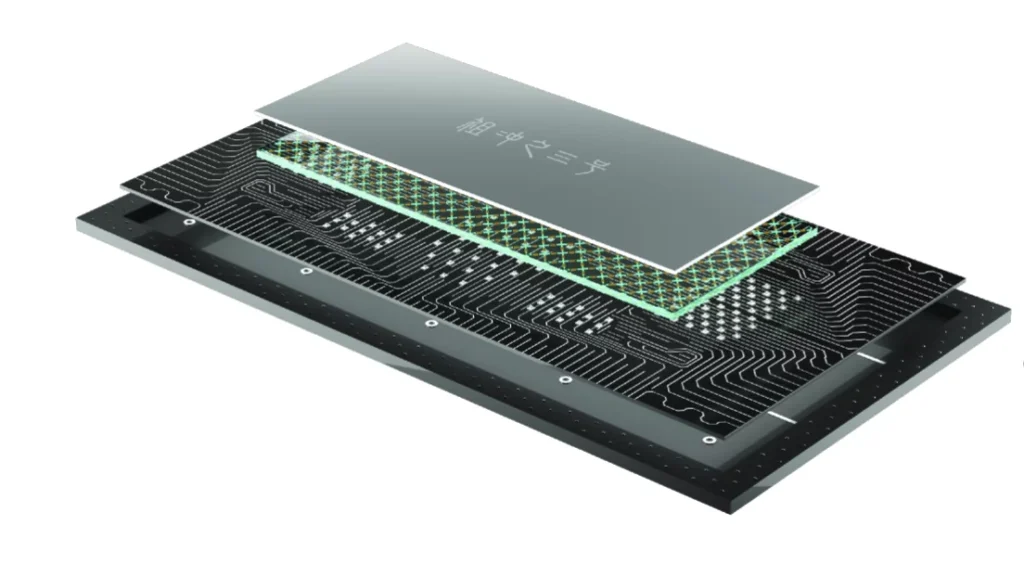
A Chinese research team has officially published findings that their quantum processor, Zuchongzhi 3.0, outperforms Google’s Sycamore quantum computing efforts by a factor of one million. The study, released in Physical Review Letters and detailed previously on arXiv, reinforces China’s growing influence in the race for quantum computational advantage, a milestone where quantum computers outperform classical machines in specific tasks.
Initial details on the experiment had been released prior in the pre-print server for early review.
Is Consciousness Research The Next Big Quantum Use Case?

The once shiny, exciting use cases for quantum technology may turn out to be pretty mundane if a small, but courageous band of researchers proves their theories correct. After all, using quantum computers to find new drug treatments, navigate the world without global positioning systems, and optimize complex portfolios may seem downright boring compared to using them to explore the myriad of questions that surround the hard problems of consciousness. Questions like: what the heck even is consciousness — and, does it have a connection to quantum mechanics? And, can quantum computing help make robots conscious — and should we make them conscious?
Tough questions, for sure, but here we’ll introduce a few researchers and entrepreneurs who are heading in that direction right now and leaning into what might turn out to be the ultimate quantum computing use case of all time: consciousness.
Nobel Laureate Says Quantum Mechanics Is on The Wrong Track
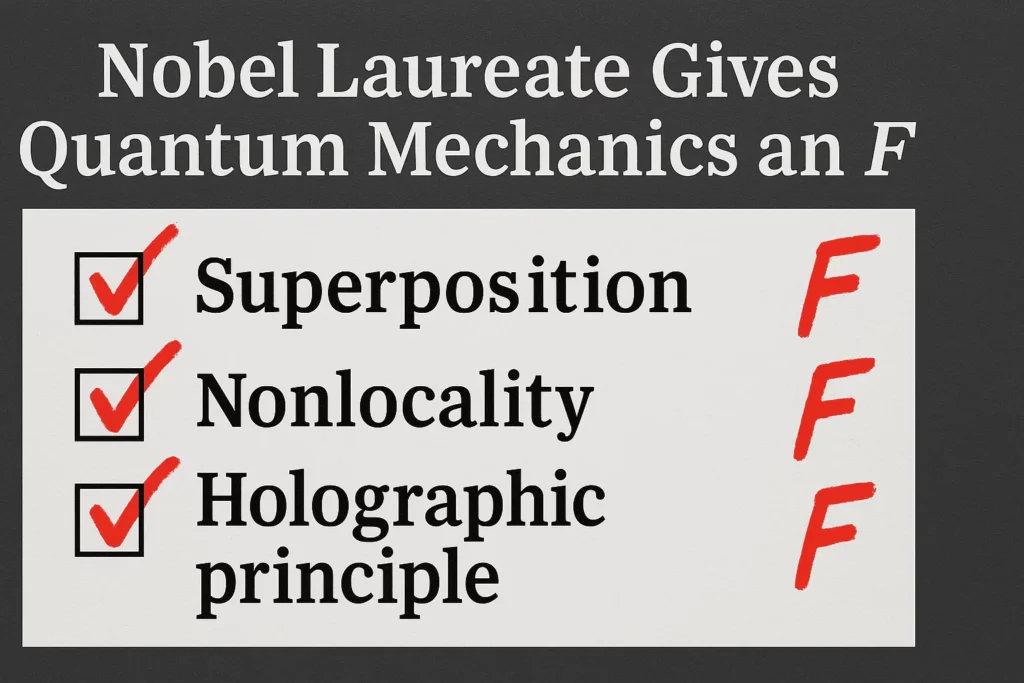
While quantum mechanics is often referred to the most accurate scientific theory in history, one Nobel Laureate isn’t a big fan.
Gerard ’t Hooft, one of the most respected figures in theoretical physics, believes the foundation of modern quantum theory is built on a misconception — and that belief is holding back progress in science.
In a wide-ranging interview with Lee Billings, of Scientific American, the Nobel Prize-winning physicist expressed his growing dissatisfaction with quantum mechanics, calling the standard interpretation “nonsense” and arguing that researchers must rethink their assumptions if they want to make real breakthroughs in understanding the universe.
Top Universities For Quantum Research — 2025
The following is a non-exhaustive list of top universities engaged in quantum research. While we can unequivocally say that the following universities are global leaders in quantum research, we acknowledge that comparisons are difficult, if not impossible, and that research output is not the only measure of quantum leadership. Research quality, educational quality, educational opportunity and mentorship, while harder to quantify, are indeed facets of quantum research leadership.
However, in order to move beyond a top-of-mind list, we use output as a way to add rigor and justify entry on the list of Top Universities for Quantum Research. We also include a measure of output based on the number of students at the school to create a fairer standard.
Researchers Discover Universal Laws of Quantum Entanglement Across All Dimensions
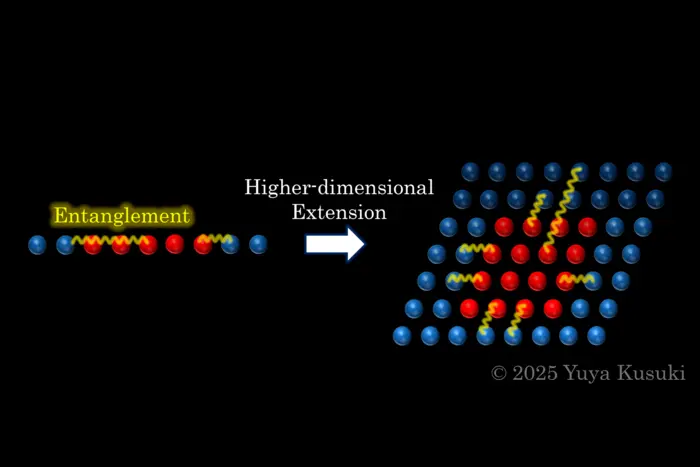
A team of theoretical researchers used thermal effective theory to demonstrate that quantum entanglement follows universal rules across all dimensions. Their study was published online on August 5, in Physical Review Letters as an Editors’ Suggestion.
“This study is the first example of applying thermal effective theory to quantum information. The results of this study demonstrate the usefulness of this approach, and we hope to further develop this approach to gain a deeper understanding of quantum entanglement structures,” said lead author and Kyushu University Institute for Advanced Study Associate Professor Yuya Kusuki.