
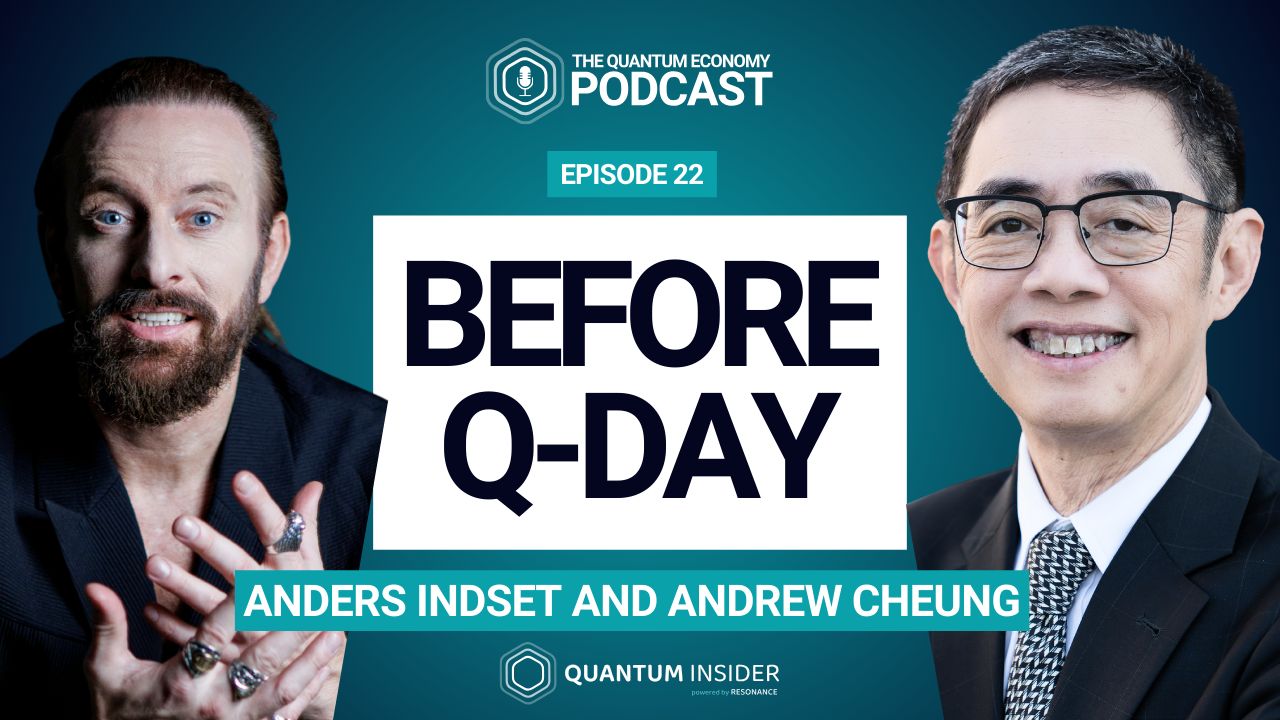
The Quantum Economy Podcast: Before Q-Day With Andrew Cheung and Anders Indset
Insider Brief:
- Anders Indset and Andrew Cheung make the case that quantum risk is already present, as data encrypted today can be harvested now and decrypted later once sufficiently powerful quantum systems emerge.
- Cheung emphasizes that the main challenge in post-quantum security is execution, noting that migration requires system-wide change across legacy infrastructure rather than simple cryptographic upgrades.
- The discussion clarifies the distinction between post-quantum cryptography and quantum key distribution, explaining why PQC is essential for securing open, global communication systems while QKD serves narrower, closed-network use cases.
- Indset and Cheung frame quantum-safe migration as a leadership and governance challenge, where early, proactive decisions will shape institutional resilience, trust, and strategic autonomy well before Q-Day arrives.
In the latest episode of The Quantum Economy Podcast, host Anders Indset is joined by Andrew Cheung, Founder and CEO of 01 Quantum, for a focused discussion on Q-Day and why quantum risk is no longer a future concern. Cheung reframes the narrative around quantum security by emphasizing that the most consequential threat is already underway; data encrypted today can be harvested now and decrypted later, once sufficiently powerful quantum systems become available. This reality challenges conventional timelines for cybersecurity planning and raises urgent questions about long-term data protection.
A central theme of the conversation is the growing disconnect between awareness and action. While post-quantum cryptographic standards exist and the technical path forward is increasingly clear, Cheung argues that execution remains the real bottleneck. Transitioning to quantum-safe security is not a simple software upgrade but a system-wide transformation involving legacy infrastructure, interoperability constraints, and organizational inertia. Waiting for visible disruption, he warns, is itself a strategic failure, as the cost of acting too late far outweighs the cost of early adoption.
The episode also clarifies a persistent source of confusion in the market: the distinction between post-quantum cryptography and quantum key distribution. Cheung explains that while QKD can secure closed, private networks, it is not a substitute for post-quantum cryptography, which is required to protect open, global systems such as the internet, cloud services, and public communication networks. Treating these approaches as interchangeable risks misaligned investments and incomplete security strategies at a national and enterprise level.
Beyond the technical considerations, Indset and Cheung place quantum security within a broader context of leadership, trust, and global competition. As quantum capabilities advance unevenly across regions, organizations and governments face increasing pressure to make proactive decisions under uncertainty. The conversation positions quantum-safe migration not as a reaction to hype, but as a governance challenge that will shape institutional resilience, strategic autonomy, and confidence in digital systems well before Q-Day formally arrives.
This episode touches on:
- Q-Day and the long-term risk of data being harvested today and decrypted in the future
- Why post-quantum security is an execution challenge, not a cryptography problem
- The distinction between post-quantum cryptography and quantum key distribution, and why both matter in different contexts
- Legacy infrastructure, migration complexity, and the hidden costs of delayed action
- Leadership, trust, and governance decisions in an emerging post-quantum security landscape
Listen and Learn
You can access this episode of The Quantum Economy Podcast on all major platforms:
- Listen on Spotify
- Listen on Apple Podcasts
- Listen on YouTube
New episodes of The Quantum Economy Podcast will be featured on The Quantum Insider. As quantum technologies evolve alongside other exponential fields, thoughtful engagement with the broader questions they raise on design, governance, value, and responsibility remains essential.
About the Host
Anders Indset is a Norwegian-born business thinker and investor known for bringing together philosophy and emerging technology. He is the author of The Quantum Economy, a book that examines how the logic of quantum computing, its uncertainty, entanglement, and probabilistic nature, can be applied to institutions and economies facing complexity and rapid change. His framework, Triangular Alchemy, proposes a new approach to organizational leadership in exponential times: balancing innovation (Forge), efficiency (Optimize), and investment (Scale) through anticipatory governance. His new book, The Singularity Paradox: Bridging the Gap Between Humanity and AI, is available now.
The podcast draws on this background while integrating real-time insights from global practitioners. It is not a promotional platform, but a curated forum for meaningful dialogue around technological transformation and human responsibility.