
New Teaching Approach Could Open The Door to Quantum Computing
Insider Brief
- A programming-first approach to teaching quantum computing is gaining traction as a way to make the field more accessible by prioritizing coding concepts over advanced mathematics.
- Developed by Aws Albarghouthi, the method introduces quantum concepts through familiar programming frameworks before transitioning to linear algebra.
- Early classroom use at universities such as UW–Madison and Louisiana State University suggests students can engage with quantum computing concepts more effectively without requiring advanced math backgrounds.
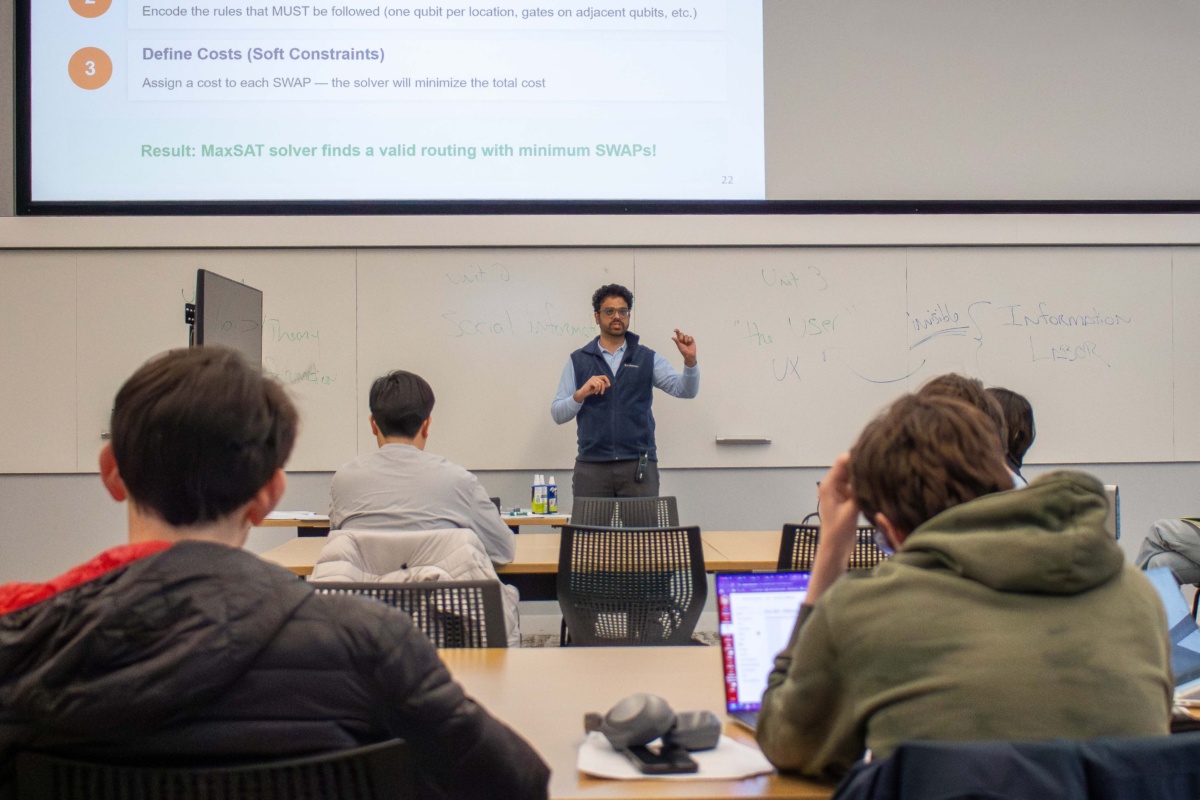
- Image: Tannu guides students through the fundamentals of quantum error correction. (Rachel Robey)
- Story: University of Wisconsin, School of Computer, Data and Information Sciences.
PRESS RELEASE — Quantum computing, an emergent technology with the potential to solve otherwise impossible problems, grew out of quantum mechanics, the branch of physics that explores how matter behaves at the tiniest of scales. In contrast to what’s known as a classical computer, the kind you and I use every day, a quantum computer can track many possibilities at once, enabling it to perform complex calculations in minutes that would take classical computers thousands of years (if at all).
Recent advances have made small, experimental quantum computers possible, attracting substantial investment and a projected economic impact of up to $80 billion for the Wisconsin-Illinois-Indiana region by 2035. With that, the number of regional jobs in quantum is expected to increase in the region from around 9,000 to over 190,000. This exponential increase presents an exciting opportunity to innovate and expand quantum education, and ensure the region remains a nationwide leader in quantum.
Yet the way quantum computing is traditionally taught may limit who feels able to enter the field. Despite its name, quantum computing is still typically taught through the language of physics and linear algebra, rather than computer science — an approach that, for many students, can make the field feel inaccessible by default. Associate Professor of Computer Sciences Aws Albarghouthi instead has a “provocative vision” for how to teach quantum computing that overcomes common learning barriers for students: beginning with computer programming.
A programming-first approach to quantum
“Quantum computing,” Albarghouthi explains, “inherits a lot of the mechanics from physics, even when there is a simpler way to describe what’s happening using computer programming.” In other words, quantum computing often uses terminology more familiar to those experienced with physics and algebra, such as “vector spaces” and “operators,” which can be unfamiliar, or even intimidating, to those who haven’t taken coursework in advanced linear algebra.
In contrast, by presenting quantum mechanics “in programming style,” and subsequently progressing to linear algebra, Albarghouthi’s approach can lower the barriers to entry for students and demystify some of its core concepts:
While the linear-algebraic view is a powerful theoretical foundation, it often complicates and obscures the simple mechanics of quantum computation. My goal…is to present a different view of quantum computing that is hopefully more accessible to computer scientists and software engineers.
This approach shifts quantum computing toward the language of programming that computer science students are most familiar with, as a set of commands to explore the data and experiment with quantum concepts in whichever computer programming language the student is most comfortable with, from Python to Java.
Last year, Albarghouthi created a publicly accessible computer programming package that allows users to simulate and experiment with quantum computing on a small scale without resorting to algebra. This pedagogical shift is already influencing how quantum computing is taught, both in Wisconsin and out of state.
Bringing the approach into the classroom
This semester at UW–Madison, Albarghouthi’s approach is being used in a new undergraduate course, CS 639 Systems Architecture for Quantum Computers, taught by Assistant Professor of Computer Sciences Swamit Tannu. “The key pedagogical difference from many standard quantum computing courses is the sequence in which we introduce the ideas,” Tannu explains. “A typical course starts with heavy linear algebra…and leans quickly into abstract theory. That approach is valuable, but it can be hard to access — especially for undergraduate students.”
“In CS 639, we start with a practical programming model of a quantum computer: a correct but simplified description of what the hardware can do, and how those operations are represented mathematically. Inspired by Albarghouthi’s approach, we build intuition using analogies from digital logic (which is already part of the core curriculum) and reinforce the concepts through hands-on programming assignments. “
From Wisconsin to a wider community of learners
A thousand miles away, at Louisiana State University, instructors adopted the approach proposed by Albarghouthi last fall as the entry point for a new undergraduate and graduate quantum computing course. After building students’ intuition with quantum, the course transitioned to more advanced frameworks. The instructors reflected that “without requiring advanced mathematics,” this approach allowed “all students to meaningfully engage with early course content.”
As quantum computing continues to move from theory to practical applications, innovations in teaching are a promising way to ensure that quantum computing is accessible, both at UW–Madison and universities across the country.
Professors Albarghouthi and Tannu are members of the Wisconsin Quantum Institute, which brings together departments, including Statistics and Computer Sciences, from across campus to advance quantum research. UW–Madison is also a member of the renowned Chicago Quantum Exchange and offers a Master of Science in Quantum Computing, the first graduate degree of its kind in the United States.