
How Will The Military Use Quantum Artificial Intelligence? Quantum AI May Reshape Military Planning Before It Reaches the Battlefield

Insider Brief
- A new military-focused study suggests quantum artificial intelligence is unlikely to arrive first as a weapon but could influence military planning, simulation and operational management long before quantum systems are deployed in combat.
- The researchers identify potential uses for quantum AI in areas such as drone coordination, logistics optimization, battlefield simulation and data analysis, while emphasizing that current hardware remains noisy and experimental.
- Both the study and broader defense efforts, including DARPA’s benchmarking programs, stress that near-term value will depend on hybrid quantum-classical systems and measurable utility rather than theoretical breakthroughs.
Throughout history, military planners have adapted existing technology for use on the battlefield. Rarely have they been asked to plan for the effects of technologies that remain largely theoretical. Quantum artificial intelligence may be an exception.
While it is unlikely to arrive first as a weapon, a new military-focused study suggests it could already be reshaping how armed forces plan, simulate and manage complex operations, well before quantum systems appear in combat.
The study, presented at the International Conference on Military Technologies and published in IEEE, examines how quantum computing could be paired with artificial intelligence to support military decision-making, logistics and autonomous systems. Rather than predicting near-term breakthroughs, the authors outline where quantum-enhanced AI could realistically provide advantages and where it remains constrained by immature hardware and high error rates.
The paper, written by researchers at the University of Defence in the Czech Republic and funded by the country’s Ministry of Defense, frames quantum AI as a long-term capability investment rather than a disruptive replacement for classical systems.
What Is Quantum Artificial Intelligence?
First, because quantum AI is theoretical — and often obscured by hype — it’s important to define the technology. The study refers to quantum AI as a research field that explores how quantum computers could support or enhance certain artificial intelligence tasks. Rather than replacing today’s AI systems, quantum AI is largely about using quantum hardware to assist with specific computational problems that classical computers struggle to manage.
At its core, quantum AI combines quantum computing — which relies on the probabilistic behavior of quantum bits, or qubits — with machine-learning techniques such as classification, optimization and reinforcement learning. Unlike classical bits, which store information as zeros or ones, qubits can exist in in multiple probabilistic states that allows for certain calculations to be explored in ways that can’t be done with classic computational approaches.
The study indicates that most, if not all quantum AI systems are expected to be hybrid. Classical computers would still manage data preparation, training and control, while quantum processors would handle narrowly defined tasks, such as searching large solution spaces or optimizing complex systems.
The study also cautions that quantum AI remains largely experimental. Current quantum hardware is noisy and error-prone, and for most real-world problems classical AI still performs better. As a result, quantum AI is best understood today as a long-term research direction rather than a near-term operational technology.
From Autonomy to Optimization
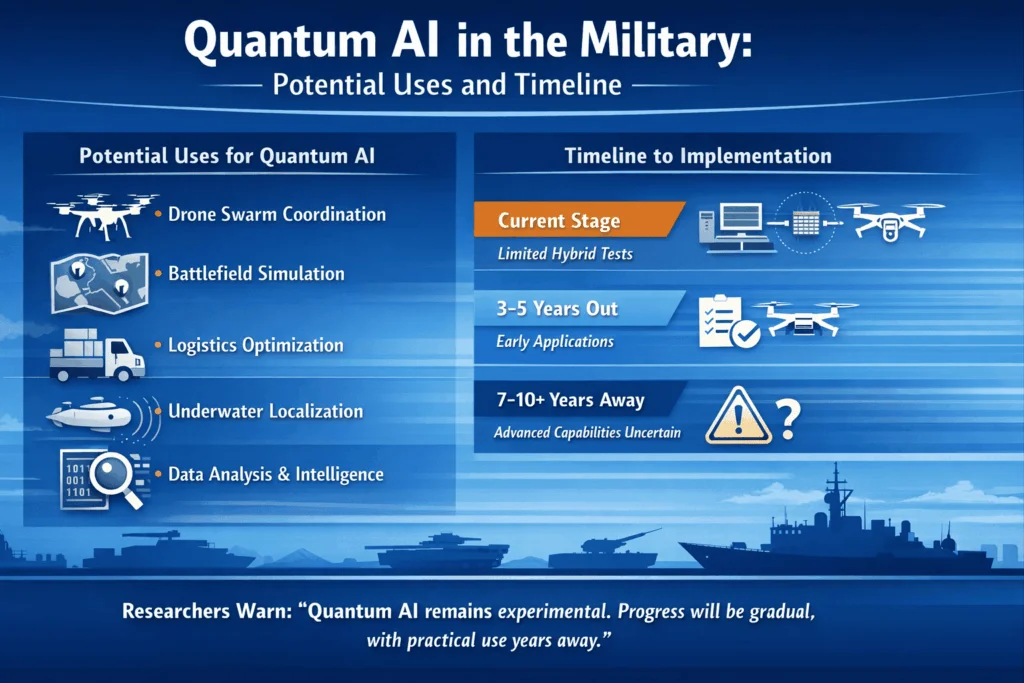
The researchers list several potential military use cases for quantum AI:
- Drone swarms and multi-agent control
- Target detection and binary image classification
- Battlefield simulation and unit movement optimization
- Logistics and supply-chain planning
- Underwater acoustic localization
- Information analysis and language modeling for large data streams
For a little more depth, here are summaries of the above use cases.
Drone swarms and multi-agent control
Currently, militaries are interested in managing large numbers of autonomous systems, particularly drone swarms. According to the researchers, controlling many unmanned vehicles at once quickly becomes a mathematical problem that overwhelms traditional AI as the number of agents grows. Quantum-assisted reinforcement learning, they argue, could eventually help explore coordination strategies more efficiently.
Target detection and binary image classification
Militaries rely heavily on artificial intelligence to sift through large volumes of imagery collected by satellites, aircraft and drones. According to the study, many of these tasks can be reduced to binary questions — whether an object, pattern or anomaly is present or absent. As datasets grow and environments become more cluttered, traditional AI systems can struggle to maintain accuracy without extensive training data. The researchers suggest that quantum machine-learning methods could eventually assist with these classification tasks by exploring complex decision boundaries more efficiently, particularly in situations where labeled data is limited. The goal is not full autonomy, but faster and more reliable triage of imagery to support human analysts.
Battlefield simulation and unit movement optimization
Modern military planning depends on simulations that model unit movements, terrain constraints, logistics and adversary behavior. The study indicates that these simulations often involve evaluating vast numbers of possible outcomes, a process that becomes increasingly computationally expensive as scenarios grow in scale. Quantum AI could help accelerate certain optimization steps within these models, allowing planners to examine more courses of action in less time. Rather than predicting outcomes with certainty, quantum-assisted systems could help planners explore tradeoffs and constraints more efficiently during training and operational planning.
Logistics and supply-chain planning
Military logistics involves routing vehicles, scheduling deliveries and allocating resources under uncertain and often changing conditions. According to the study, these problems are well suited to quantum annealing, a quantum approach designed to search for efficient solutions to complex optimization challenges. While classical systems already perform these tasks, the researchers suggest quantum-enhanced methods could eventually help planners adapt more quickly to disruptions by evaluating alternative routes and schedules at scale. The potential advantage lies in speed and flexibility, not in replacing existing logistics systems.
Underwater acoustic localization
Detecting and tracking objects underwater presents unique challenges due to noise, signal distortion and limited sensor coverage. Quantum-inspired and quantum-assisted methods could improve acoustic localization, particularly when real-time processing is constrained. In these approaches, much of the computation occurs during training, which theoretically allows deployed systems to estimate locations more efficiently during operations. The researchers suggest that quantum annealing could help refine probability models used in underwater detection, though practical deployment remains dependent on future hardware improvements.
Information analysis and language modeling for large data streams
Military organizations process vast amounts of text data, including reports, communications and open-source information. According to the study, classical language models often rely on brute-force statistical correlations, which can make it difficult to interpret results or identify meaningful structure. Quantum AI approaches, the researchers argue, may offer alternative ways to model relationships within language data, potentially improving pattern discovery and anomaly detection. Rather than replacing existing tools, quantum-assisted language analysis could serve as a supporting capability, helping analysts navigate large information flows more efficiently.
The study emphasizes that such systems would most likely rely on hybrid architectures, with classical computers handling training and oversight while quantum processors assist with specific calculations. This is needed because current quantum machines remain noisy and fragile, limiting their ability to operate independently.
While the authors stop short of claiming performance superiority over classical methods today, they report that quantum AI could eventually help military planners evaluate more scenarios faster, particularly in large-scale deployments.
An Unexpected Role: Trust And Transparency
Quantum AI may appeal to military users not because it is faster, but because it could be easier to understand and audit. Classical AI systems, particularly large neural networks, often operate as black boxes, making it difficult to explain how decisions are reached.
Quantum gate-based models, the authors argue, can encode information in ways that more explicitly reflect problem structure. If those claims hold up, quantum AI could support military requirements for traceability, validation and compliance with rules of engagement, areas where opaque systems face institutional resistance.
The researchers also report that quantum AI may first be used during training and development rather than deployment. In this model, quantum resources would help optimize or refine AI systems that ultimately run on classical hardware in the field.
DARPA and Broader Context
The U.S. Defense Advanced Research Projects Agency has been one of the few major defense research organizations to pursue quantum computing with a distinctly utility-first agenda — a stance that largely aligns with the measured view of the military-oriented study. Rather than hyping breakthrough capabilities, DARPA’s Quantum Benchmarking Initiative seeks to test and validate whether any quantum computing approach can become “utility-scale” — that is, to deliver more computational value than it costs to build and run — by as early as 2033, a timeline the agency has publicly stated. DARPA is funding a range of companies and architectures to answer this question, and advancing them through staged technical reviews and independent verification.
DARPA’s take seems to echo the study’s insistence that current hardware is limited by noise and error rates, and that most early value will come from hybrid systems and benchmarking against real tasks rather than speculative battlefield autonomy. DARPA’s approach is not to declare imminent operational use but to separate hype from measurable progress and build confidence in where quantum computing — and by extension quantum AI — might genuinely offer advantage.
Unkown Unknowns and Exotic Quantum AI Uses
Even as militaries map specific uses for quantum artificial intelligence, defense analysts warn that there may be far-flung applications that today’s planners have not fully anticipated. These “unknown unknowns” arise not from current roadmaps but from the interaction of quantum computing and AI — a combination that could create effects not evident when either technology is considered alone.
Some researchers and strategic reports suggest that fully mature quantum AI could influence cyber operations on a strategic scale, including both defensive encryption and offensive code-breaking. In theory, a sufficiently powerful quantum engine could break certain forms of public-key cryptography much faster than classical computers, and when paired with adaptive AI, could reorganize network defenses or exploits in real time. That possibility is already part of U.S. and allied planning for post-quantum cryptography, even though neither quantum computers nor quantum AI have demonstrated such capability yet.
Another speculative area is quantum sensing tightly integrated with adaptive AI systems. Unlike today’s sensors, future quantum sensors could detect subtle phenomena — from minute magnetic signatures to displacement effects — that classical systems cannot. Coupled with AI that can learn and respond instantly, these capabilities might enable new forms of navigation in GPS-denied environments or novel electronic-warfare tactics.
Defense strategists also speculate that quantum AI could enable new forms of deception and decision support. Information environments shaped by entangled data structures could, in principle, make it harder for adversaries to interpret intent or pattern, even as friendly systems extract meaning more efficiently.
These scenarios remain speculative because they depend on advances in both quantum hardware and AI integration that have not yet occurred. But their plausibility is why national security planners emphasize broad research portfolios, horizon scanning and international collaboration — to prepare not just for what is expected, but for what may emerge at the intersection of quantum physics and machine intelligence.
Limits, Risks and What Comes Next
Despite this broad survey of applications, the study repeatedly emphasizes the limits of current technology. Quantum computers remain highly sensitive to noise, suffer from short coherence times and require extensive error correction. For most tasks, classical supercomputers will remain dominant for years.
The authors also caution that quantum advantages tend to be problem-specific and that data preparation can erase theoretical gains. Encoding classical data into quantum form, they note, is often expensive, which is why quantum sensing — where data is generated in quantum form — may become strategically important.
In the future, the researchers recommend that militaries focus less on headline qubit counts and more on measurable utility. That includes benchmarking quantum systems against real military tasks, developing hybrid architectures that clearly separate quantum and classical roles and investing in research that can determine where quantum AI offers genuine advantages.
For now, the paper concludes, quantum artificial intelligence should be treated as a planning and research tool rather than an operational capability — one that could shape how militaries think about complexity, uncertainty and decision-making long before it reshapes the battlefield itself.