
Guest Post — Helium-Free Magnetic Refrigeration Supports Continuous Milli-Kelvin Temperatures For Quantum Research
Guest Post by by Jim McMahon
Cryogenic characterization is a must to accelerate and enable breakthrough science and quantum technologies. Quantum sensors, quantum communication devices and future quantum computers will rely on scalable and efficient cooling for their operation.
Quantum computers rely on qubits, which can exist in multiple states simultaneously. These quantum states are extremely fragile and susceptible to disruption from environmental noise, especially thermal energy. Many quantum computing approaches, especially those utilizing superconducting qubits, rely on superconductivity, which occurs at extremely low temperatures. Cryogenic temperatures, near absolute zero, minimize thermal fluctuations, allowing qubits to maintain their coherence for longer, enabling complex quantum computations.
Magnetic refrigeration is emerging as a promising technology for achieving these conditions. Traditional cryogenic cooling using liquid helium is expensive and complex, while magnetic refrigeration offers a potentially simpler, more scalable, and cost-effective solution.
Magnetic Refrigeration
Magnetic refrigeration aids in producing extremely low temperatures at almost absolute zero temperature (called sub-Kelvin temperatures, below -273°C) by using the relationship between a magnetic field and entropy in certain materials.
Entropy refers to the disorder or randomness in a material. In magnetic materials, the entropy is composed of essentially two parts: a) the entropy of the crystalline structure, where greater entropy means higher temperature due to vibrations of the crystal lattice; and b) the entropy of the magnetic moments of the crystalline material. Magnetic moments are a vector quantity that represents the magnetic strength and orientation of the magnetic object. A collection of magnetic moments is called a spin system. The way the entropy of this spin system responds to a magnetic field is at the very core of magnetic refrigeration.
Here is the process:
1) magnetic moments are ordered; 2) applying a magnetic field orders moments, increases temperature; 3) temperature will relax back to equilibrium; 4) removing the magnetic field leads to cooling.
Adiabatic Demagnetization Refrigeration
Adiabatic Demagnetization Refrigeration (ADR) is a specific process within magnetic refrigeration. Adiabatic refers to a process where no heat is exchanged with the surrounding environment. Demagnetization means reducing the magnetic field. Refrigeration refers to the cooling process.
In the ADR process, material, often a paramagnetic salt, is first pre-cooled to a relatively low temperature, typically using a cryocooler. The process involves two additional key steps:
- Magnetization – The material is then placed in a strong magnetic field. This causes the magnetic moments (oppositely charged particles) within the material to align, reducing its entropy. Heat is generated during this process, which is absorbed by a cryocooler thermal bath.
- Demagnetization – The material is then thermally isolated, preventing heat exchange with the surroundings. The magnetic field is slowly reduced. As the field decreases, the magnetic moments/spins attempt to return to a more disordered, high-entropy state. To achieve this, they draw energy from the material’s internal thermal energy, causing its temperature to drop significantly.
ADR achieves cooling at very low temperatures (milli-Kelvin range). It is a method for reaching temperatures close to absolute zero.
Cryostats and Continuous ADR
Continuous adiabatic demagnetization refrigeration (cADR) is a variant of adiabatic demagnetization refrigeration that provides continuous cooling at ultra-low temperatures close to absolute zero. cADR is a multi-stage cooling system commercialized by kiutra GmbH (kiutra). It consists of at least two ADR units and works by cooling with one ADR unit while the other ADR unit is being regenerated, and vice versa. This is a significant improvement over ADR because it provides continuous cooling, whereas ADR is a single-shot method that can only hold the object being cooled to milli-Kelvin temperatures for a limited amount of time.
kiutra’s Continuous ADR Helium-Free Cryogenic Platform
The sole supplier of continuous cADR cooling solutions that generate extremely low temperatures down to 100mK or -273.05°C is kiutra. In contrast to conventional helium-based cooling methods, kiutra’s helium-3-free magnetic cooling technology is user-friendly, requires little maintenance and is scalable. Its robust, low-temperature systems, highly suitable for cooling quantum technologies on an industrial scale, achieve and maintain super-cold temperatures without cryogenic liquids.
“kiutra’s S-Type cryogenic platform is uniquely equipped with two ADR units that enable continuous, cryogen-free sub-kelvin cooling,” said Dr. Steffen Säubert, Senior Product Manager with kiutra. “It can also operate in one-shot mode to achieve even lower temperatures for a limited duration. In both modes, the cooling process is fully automated and can be managed through an intuitive graphical user interface.”
“With a small footprint, the compact S-Type cryogenic platform provides simplified, adaptable and cryogen-free cooling for a range of uses, including as an operating and testbed system by various research partners worldwide,” added Dr. Säubert.
Optical Access with an Ultra-Low
Vibration Decoupling Platform
A variant of kiutra’s S-Type cryogenic platform, the S-Type Optical, includes a large free-beam vertical optical access permitting expanded optical investigations into the sub-kelvin temperature range.
A unique feature about the S-Type Optical cryogenic platform is its capability for eliminating vibrations which could disturb both optical results and quantum computing.
Quantum systems, including qubits, are highly sensitive to their environment. Vibrations from the surrounding environment, whether from the refrigerator cooling the system or even sound waves in the room, can introduce energy into the qubit, disrupting its delicate quantum state and causing it to lose its superposition, a key feature of quantum computation.
“After careful review, our engineering team selected Negative-Stiffness vibration isolation to support our S-Type Optical cryogenic platform,” continued Dr. Säubert. “kiutra chose Negative-Stiffness isolators because of their passive capability, 0.5 Hz resonant frequency, and they are very easy to optimize for vibration decoupling without opening the system to adjust during operation.”
Negative-Stiffness Vibration Isolation
Introduced in the mid-1990s by Minus K Technology, Negative-Stiffness vibration isolation has been widely accepted for vibration-critical applications, largely because of its ability to effectively isolate lower frequencies, both vertically and horizontally. The company’s isolators are used by more than 300 universities and government laboratories in 53 countries.
Negative-Stiffness isolators are unique in that they operate purely in a passive mechanical mode. They do not require electricity or compressed air. There are no motors, pumps or chambers, and no maintenance because there is nothing to wear out.
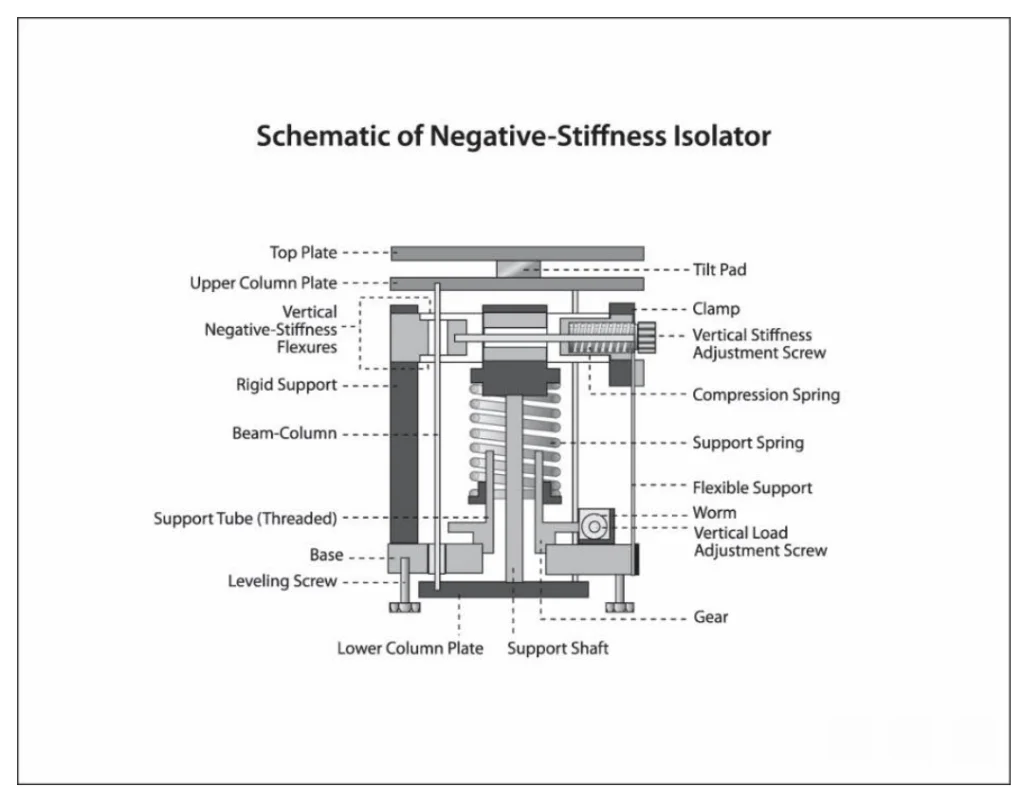
“Vertical-motion isolation is provided by a stiff spring that supports a weight load, combined with a Negative-Stiffness mechanism,” said Erik Runge, Vice President of Engineering at Minus K. “The net vertical stiffness is made very low without affecting the static load-supporting capability of the spring. Beam-columns connected in series with the vertical-motion isolator provide horizontal-motion isolation. A beam-column behaves as a spring combined with a negative-stiffness mechanism. The result is a compact passive isolator capable of very low vertical and horizontal natural frequencies and high internal structural frequencies.”
Negative-Stiffness isolators achieve a high level of isolation in multiple directions, with the flexibility of custom-tailoring resonant frequencies to 0.5 Hz vertically and horizontally (with some versions at 1.5 Hz horizontally)*. When adjusted to 0.5 Hz, the isolators achieve approximately 93 percent isolation efficiency at 2 Hz, 99 percent at 5 Hz, and 99.7 percent at 10 Hz.
(Image courtesy Minus K Technology)
*Note that for an isolation system with a 0.5 Hz natural frequency, isolation begins at 0.7 Hz and improves with increase in the vibration frequency. The natural frequency is more commonly used to describe the system performance.)
“Being inherently modular, our S-Type Optical cryostat can be configured and upgraded to match a wide range of user requirements,” explained Dr. Säubert. “The Negative-Stiffness isolator has been designed to fit perfectly into this modular platform.”
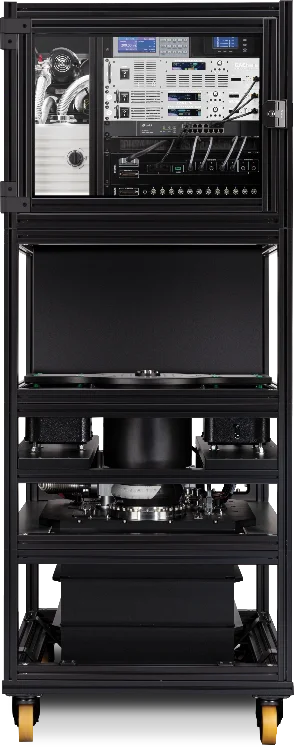
Negative-Stiffness vibration isolation. (Image courtesy kiutra GmbH)
In Support of Quantum Technologies
“Due to our many years of hands-on experience working with cryogenic systems, at kiutra we are convinced that magnetic cooling is an extremely versatile and elegant tool to provide research at low temperatures relating to quantum technologies.” added Dr. Säubert. “And specifically cryogen-free, continuous-cooling magnetic refrigeration systems, which definitely stand out above other cryogenic systems for their superior performance at sub-Kelvin temperatures.”