
Chinese Researchers Clear Hurdles for Long-Distance Quantum Networks
Insider Brief
- Chinese researchers reported advances that move quantum communication closer to practical networks, combining longer-lived quantum memory with record-setting demonstrations of ultra-secure key distribution over fiber.
- The team generated device-independent quantum encryption keys over 11 kilometers of optical fiber, extending the previous distance record by roughly 3,000 times, and validated the approach at distances up to 100 kilometers.
- Separately, the researchers demonstrated a scalable building block for quantum repeaters, addressing signal-loss limits that have constrained long-distance quantum networks.
A Chinese research team has reported a pair of advances that could remove two of the biggest technical barriers to building large-scale quantum communication networks, including the generation of ultra-secure encryption keys over 11 kilometers of optical fiber and the validation of the approach at distances up to 100 kilometers, according to China Daily, a state-associated news service.
Researchers from the University of Science and Technology of China said they have demonstrated, for the first time, a scalable core component of a quantum repeater — a long-sought technology needed to extend quantum communication across long distances — while also setting new records for ultra-secure quantum key distribution over fiber networks.
The findings were published in Nature and Science, underscoring their significance within the international research community. Noted Chinese physicist Pan Jianwei led the work.
Quantum networks aim to transmit information using the rules of quantum physics rather than classical electronics. In theory, they allow messages to be shared with security guaranteed by physical laws, not by the difficulty of breaking mathematical codes. In practice, however, such networks face severe limits because light signals weaken as they travel through optical fiber, making it hard to send quantum information over long distances.
Overcoming this loss problem is central to turning quantum communication from a laboratory demonstration into usable infrastructure.
Beating the Distance Problem
At the heart of the experiment — and the challenge, itself — is quantum entanglement, a fragile link between particles that allows information to be shared in ways that have no classical equivalent. Entanglement degrades rapidly as photons travel through fiber, which sharply restricts how far quantum signals can go.
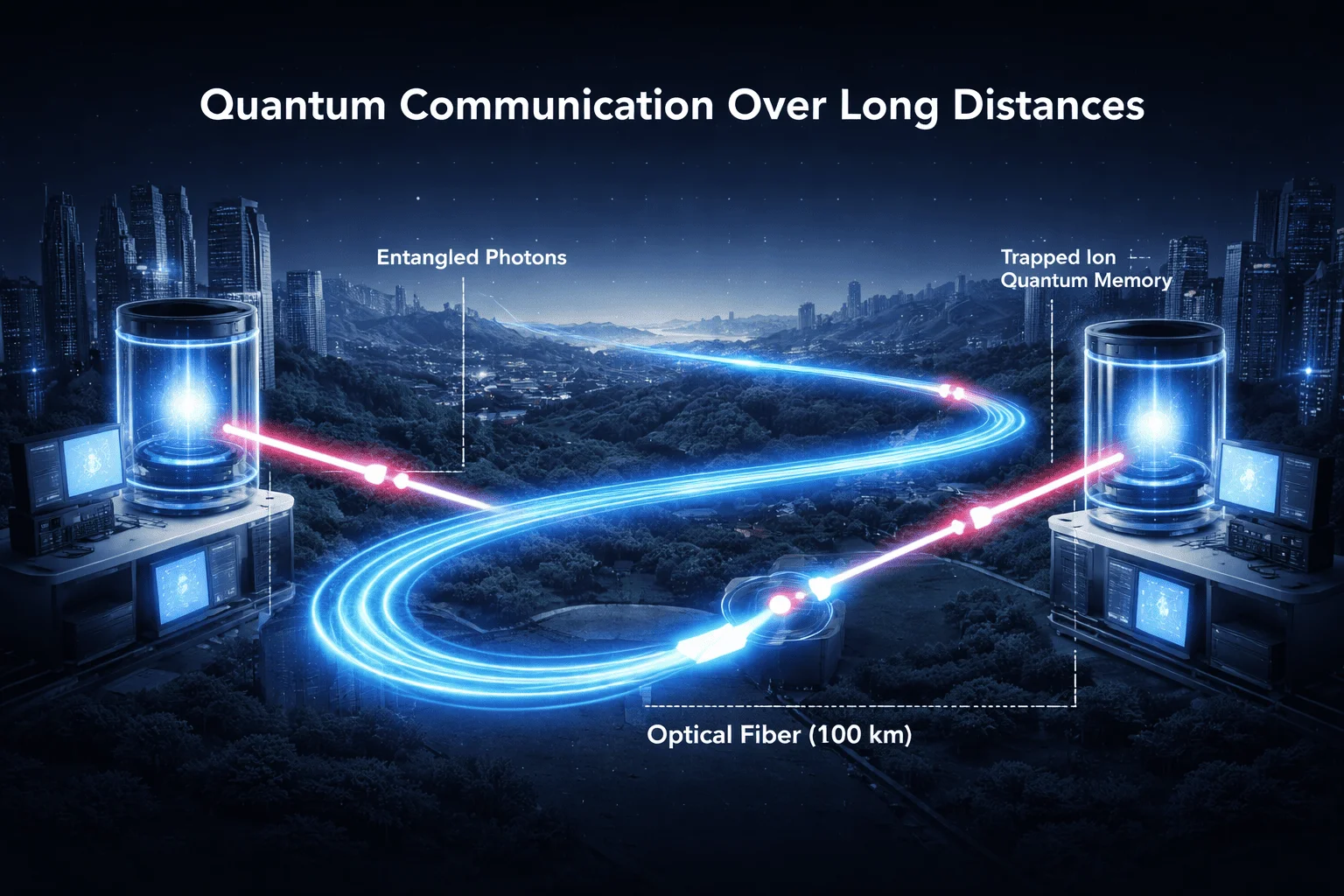
To address this, scientists have long proposed quantum repeaters. Instead of sending a signal all the way from one end of a network to the other, a repeater divides the route into shorter segments. Entanglement is created within each segment and then connected step by step. The idea is similar to relaying a message through a chain of stations rather than shouting it across a valley.
The problem is that quantum states usually do not last long enough to survive this process, China Daily reports. By the time entanglement is ready to be linked across segments, it has often already decayed.
The USTC team tackled this by combining three technical advances. They developed a long-lived quantum memory based on trapped ions, built an efficient interface that links ions with light particles and designed a protocol that connects segments with high accuracy. Putting all these elements together allowed entanglement to persist longer than the time needed to establish links between network segments.
According to the university, this marks the world’s first experimental demonstration of a scalable building block suitable for a quantum repeater. China Daily reports the result as a key step toward making long-distance quantum networks technically feasible.
Pushing Secure Communication Further
In a second line of work, the same group used related techniques to tackle another major goal in quantum communication: device-independent quantum key distribution, or DI-QKD.
Traditional encryption relies on assumptions about computing limits. DI-QKD, by contrast, is designed so that security does not depend on trusting the hardware. Even if communication devices are flawed or partially compromised, the laws of quantum physics ensure that any eavesdropping attempt can be detected.
China Daily reported that the researchers generated high-quality entanglement between two rubidium atoms located far apart and used this setup to demonstrate DI-QKD over urban-scale fiber networks for the first time.
According to the papers, the team successfully transmitted secure keys over 11 kilometers of optical fiber, which is roughly 3,000 times farther than previous demonstrations. They also verified that secure keys could, in principle, be generated over 100 kilometers of fiber, more than two orders of magnitude beyond earlier international benchmarks.
The advances also arrive amid intensifying global competition in quantum technology, where governments see secure communication as both an economic and national-security priority.
The results from both experiments suggest that several pieces required for practical quantum networks are beginning to fall into place. Quantum repeaters address the distance problem, while DI-QKD provides a method for secure communication that does not rely on trusting devices or software.
China Daily framed the work as an important milestone for China’s quantum communication program, signaling that fiber-based quantum networks are moving out of the purely theoretical realm. While large-scale deployment would still require substantial engineering, cost reductions and standardization, the experiments show that key technical hurdles can be cleared under real-world conditions.
From a national security perspective, the work points to future military networks that could transmit commands and intelligence with security guaranteed by physics rather than encryption software, reducing the risk of interception or decryption. Such quantum links could be used to secure communications between command centers, satellites, and forward units, particularly in environments where adversaries have advanced cyber or signal-intelligence capabilities.
China Daily is owned and operated by the Publicity Department of the Chinese Communist Party and functions as China’s official English-language newspaper.