
This Roblox Game’s Levels Are Generated by a Real Quantum Computer
Insider Brief
- The Quantum Kid’s latest episode explores quantum computing through gaming, featuring a Roblox-style game whose levels are generated by a real quantum computer rather than a standard game server, developed by MOTH Quantum’s James Wootton and MiTale’s Natasha Skult.
- 10-year-old host Kai also plays a live match of quantum chess against researcher Tamás Varga, winning by putting his own queen into superposition — a legal, winning move only possible under quantum rules.
- The episode also touches on using quantum computers to generate music, illustrating how quantum computing’s applications are expanding into gaming, entertainment, and creative fields beyond traditional research and hardware development.
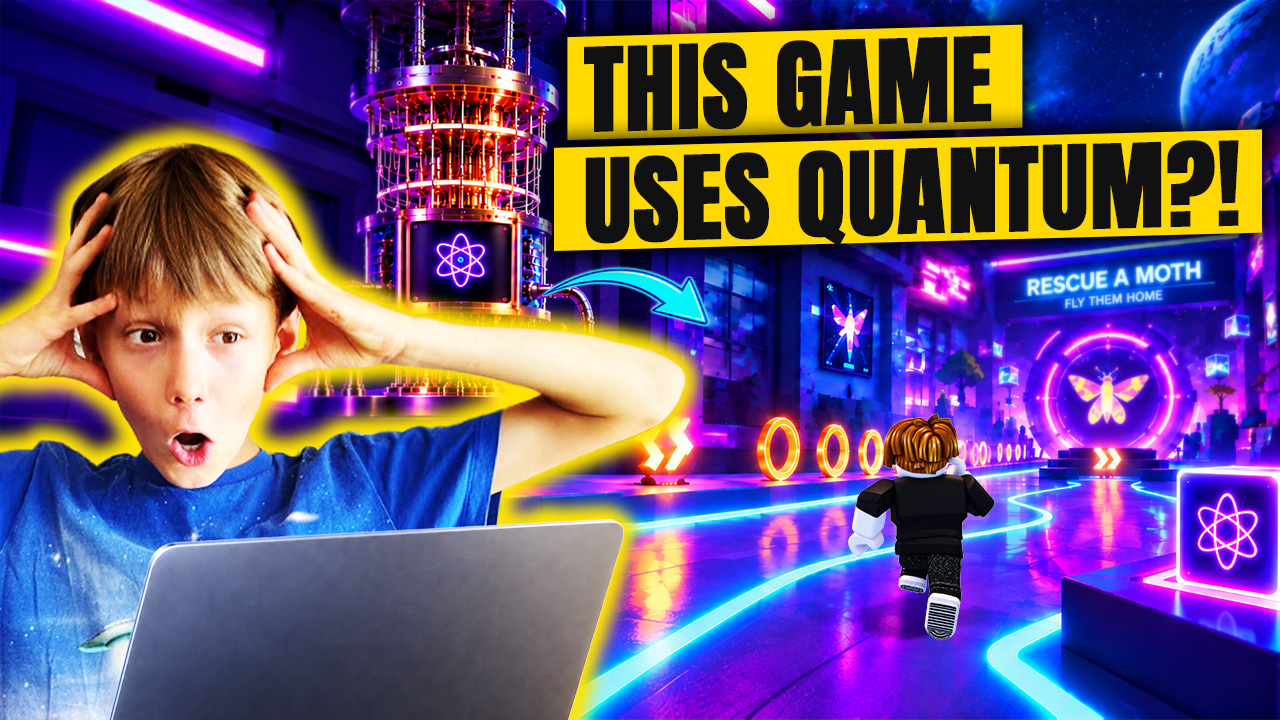
Video games and quantum computing don’t usually share a sentence, let alone a screen. But in the latest episode of The Quantum Kid, 10-year-old Kai discovered a game where quantum computer game levels aren’t just a concept — they’re real, generated live by actual quantum hardware. The result surprised even him.
The episode is also a good entry point into what The Quantum Kid is trying to build more broadly. Through conversations with some of the field’s most recognizable names — including Peter Shor, Scott Aaronson, and John Preskill — the show is actively looking to reach a wider set of audiences: students exploring what a future in quantum might look like, curious adults with no technical background who want to actually understand the technology reshaping headlines, and vocational and workforce-development programs looking for accessible ways to introduce quantum concepts to people entering the field. The goal isn’t just to entertain — it’s to take insights from some of the sharpest minds in the industry and make them genuinely usable for people deciding whether, and how, to get involved in quantum.
How quantum computer game levels actually get made
At first glance, the game Kai plays looks like a typical Roblox-style title: obstacles, levels, a simple objective. Players move through a sequence of challenges that, on the surface, could belong to almost any casual mobile or browser game. But under the hood, something different is happening. Instead of generating levels on a standard game server using conventional pseudo-random number generation, the game contacts a real quantum computer, which determines the sequence and structure of the obstacles players face in real time.
“Wait — what?” is Kai’s genuine, unscripted reaction the moment he realizes what’s actually happening behind the game he’s playing — a reaction that captures exactly what makes this episode worth watching. It’s one thing to be told a game uses quantum computing; it’s another to watch a 10-year-old’s realization land in real time, which is precisely the kind of moment The Quantum Kid has built its format around.
To explain how and why this works, Kai talks with James Wootton, Chief Science Officer at MOTH Quantum, a quantum startup with a presence in the UK and Basel, Switzerland, and Natasha Skult, CEO of MiTale, a gaming company based in Finland that is also actively exploring how quantum computing can be applied to video game development more broadly. Together, they walk through how quantum computing can be used for procedural level generation, why quantum randomness behaves fundamentally differently from the pseudo-randomness classical computers rely on, and what this could mean for the future of game design — not as a distant, theoretical application, but as something already running today.
Chess, but with superposition
The episode’s second half moves from gaming to something even stranger: quantum chess. Kai plays a real match against researcher Tamás Varga, where the core rules of chess are rewritten by quantum mechanics. Pieces can exist in a superposition of multiple positions at once — meaning a single pawn might occupy two different squares simultaneously, until an observation (in this case, another player’s move) forces it to “collapse” into one definite position, exactly as a qubit would.
Kai wins the match by using exactly this principle: putting his own queen into superposition, a move that would be nonsensical — even illegal — in traditional chess but is a perfectly legal, and ultimately winning, strategy in the quantum version. Watching the match unfold, it becomes clear why quantum chess has become a popular teaching tool in its own right: it takes an abstract, often intimidating concept and turns it into something with visible, immediate consequences on a familiar board.
It’s a rare case where a game doesn’t just use quantum computing as a marketing buzzword, but makes a core, counterintuitive concept like superposition genuinely playable and intuitive, without requiring a single equation to understand what’s happening or why it matters.
Beyond gaming: quantum-generated music
The episode also touches on a third, less expected application: using quantum computers to generate music. As with the gaming segment, the appeal isn’t just novelty — it’s a concrete demonstration of how quantum systems can produce genuinely different kinds of outputs than classical algorithms, whether that output is a game level, a musical sequence, or something else entirely still being explored.
The segment reinforces a theme that runs through the whole episode: quantum computing’s near-term value isn’t confined to optimization problems or cryptography — it’s already showing up in creative and cultural spaces most people wouldn’t expect.
Why this episode matters
The Quantum Kid‘s format, built around Kai’s real, often unfiltered curiosity, has become known for making advanced quantum concepts accessible without oversimplifying them. This episode is a particularly clear example: entanglement, superposition, and quantum randomness are all present, but none of them are introduced as abstract theory. Each concept is something Kai directly interacts with, wins or loses because of, or reacts to in real time — a structure that makes the show as useful for a classroom or training program as it is for casual viewing.
For an industry often focused on hardware roadmaps and algorithmic benchmarks, it’s a reminder that quantum computing’s cultural footprint — how it shows up in gaming, entertainment, and everyday curiosity — is expanding just as quickly as its technical capabilities. And for the students, adults, and workforce-development programs The Quantum Kid is aiming to reach, episodes like this one offer a genuinely different way in: not a lecture, but a demonstration.
Watch the full episode: https://www.youtube.com/watch?v=7RCtYQ_Bejo&t=300s
The Quantum Kid is produced by Tesseract Quantum, a Swiss educational non-profit and newest partner of The Quantum Insider.