
UC San Diego Advances Quantum Metamaterials for Ultrafast Optical Computing
Insider Brief
- UC San Diego researchers are advancing quantum metamaterials that use nanoscale quantum materials to create smaller, faster and more controllable optical devices with applications ranging from imaging to optical computing.
- The research builds on UC San Diego‘s pioneering demonstrations of negative refraction in metamaterials, extending the field by using quantum materials as active building blocks to manipulate electromagnetic properties at visible-light wavelengths.
- Researchers reported that a quantum metamaterial based on multiple metallic quantum wells converted ultrafast infrared light into visible light with more than 1,000 times the efficiency of conventional metal structures, potentially enabling ultracompact optical computing systems.
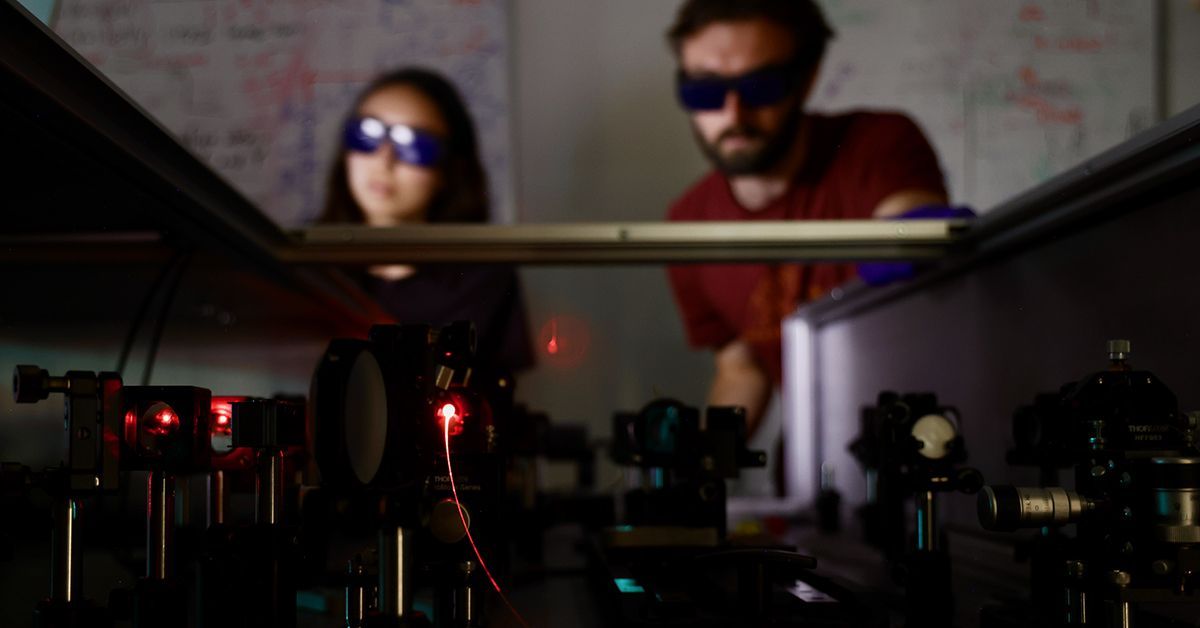
- Image: UC San Diego MRSEC researchers Deanna Diaz Aguilara (left) and Luke Herman (right) measure the dynamic response of a quantum metamaterial using ultrafast laser spectroscopy in the laboratory of electrical and computer engineering professor Zhaowei Liu. (Michael J. Sailor)
PRESS RELEASE — Quantum metamaterials are one of the two research themes of the UC San Diego Materials Research Science and Engineering Center (MRSEC), which is supported by the U.S. National Science Foundation (NSF). Quantum metamaterials are a cutting-edge subset of metamaterials. In general, metamaterials control how light moves through the material — amplifying the light, bending it, and changing its speed. Although metamaterials were invented only about 25 years ago, they are used in many important technologies. For example, metamaterials are being developed for use with clinical magnetic resonance imaging (MRI) scanners to shape radiofrequency fields, with the potential to improve image quality and reduce acquisition times.
In 2000 and 2001, UC San Diego researchers provided the first experimental demonstrations of negative refractive index and negative refraction in a metamaterial. David R. Smith ‘88, PhD ‘94, working with physics professor Sheldon Schultz, helped create a structure composed of copper rings and wires that bent microwaves in the opposite direction from that expected in conventional materials such as glass or water.
“The quantum metamaterials effort in our MRSEC is a direct descendant of David Smith’s original metamaterials experiments,” said Richard Averitt, professor in the Department of Physics at the UC San Diego School of Physical Sciences, who co-leads quantum metamaterials research in the MRSEC. “The new frontier is to use nanoscale quantum materials as the active building blocks of metamaterials. This allows us to create much smaller structures with effective optical and electronic properties that are larger, faster and more readily controlled than conventional metamaterials.”
The nanometer-sized quantum elements can be designed to tailor the electromagnetic response of the metamaterial into the visible light region. “We recently found that a metamaterial comprised of multiple metallic quantum wells can convert an ultrafast pulse of infrared light into visible light with an efficiency more than a thousand times greater than conventional metal structures,” said Zhaowei Liu, professor in the Department of Electrical and Computer Engineering at the UC San Diego Jacobs School of Engineering who co-leads quantum metamaterials research in the MRSEC. “These quantum-engineered structures can also be packed into much smaller device structures, which should enable new ultracompact optical computing systems.”