
NSF Funds 12 New Regional Innovation Engines Including Quantum Technologies Initiative
Insider Brief
- The National Science Foundation awarded 12 new NSF Engines projects, including the NSF Quantum Technologies Engine in Connecticut, to support regional innovation across critical technology sectors.
- Each selected team will initially receive $15 million over two years, with the potential for up to $160 million in NSF funding over a decade based on progress toward milestones.
- The NSF Engines program aims to connect regional research, industry, and government partners to strengthen technology development, supply chains, and economic growth.
Press release – The U.S. National Science Foundation announced it awarded the newest NSF Regional Innovation Engines (NSF Engines) awards to 12 U.S. teams across 20 states. These NSF Engines will build and scale innovation clusters that aim to accelerate the development of critical technologies, prepare talent for emerging jobs and grow regional economies. Building on decades of NSF investments in foundational research, the NSF Engines partner with the private sector to advance technology deployment and secure America’s position at the forefront of science and technology.
“These new NSF Engines will be transformational for America’s innovation infrastructure — helping secure our national competitiveness in technologies and future industries that will be critical to our economic and national security for decades to come,” said Brian Stone, performing the duties of the NSF director. “These engines will unlock innovation and enable technologies that will improve the quality of life and result in good-paying jobs for all Americans.”
The newest NSF Engines awards span critical technologies and applications ranging from enhancing energy grid security to maximizing the yield of critical mineral mining extraction to advancing quantum computing. Each team, led by a coalition of regional organizations, including universities, nonprofits and private industry, will initially receive an award of $15 million over two years. Teams that demonstrate progress on well-defined milestones will have the potential to eventually receive up to $160 million each from NSF over the next decade as they seek to build an internationally competitive technology and innovation cluster in their region.
No single region can solve America’s technology challenges alone. NSF Engines are designed as a connected national network, linking complementary regional strengths. Together, they build domestic supply chains, fill capability gaps and accelerate technology advancement across key sectors and regions.
The NSF Engines program is beginning to demonstrate significant returns and impacts as a result of the nation’s investment via the inaugural NSF Engines funded two years ago. To date, an initial investment of $135 million in taxpayers’ dollars across nine inaugural NSF Engines has garnered more than $2 billion in matching commitments from private industry, philanthropy and state and local governments. These investments are also advancing technologies that maintain American competitiveness in critical areas, including advanced chipmaking, next-generation artificial intelligence, agriculture and food production, disaster preparedness and energy storage. This cohort of NSF Engines coincides with another round of funding released this summer for the inaugural NSF Engines that have demonstrated sustained progress over the first two years of performance.
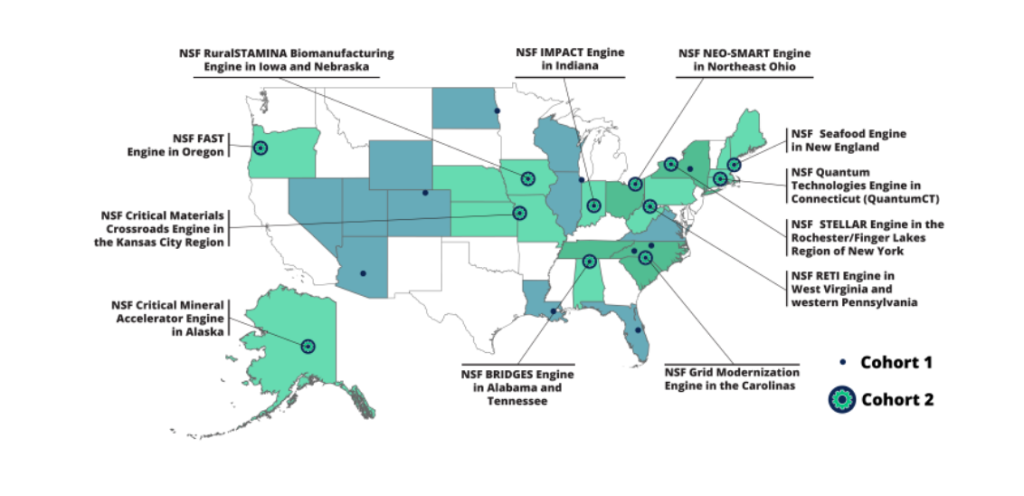
The 12 newest NSF Engines are:
- NSF BRIDGES Engine in Alabama and Tennessee, led by the HudsonAlpha Institute for Biotechnology.
- NSF Critical Materials Crossroads Engine in the Kansas City Region, led by the University of Missouri-Kansas City.
- NSF Critical Mineral Accelerator Engine in Alaska, led by the University of Alaska Fairbanks.
- NSF FAST Engine in Oregon, led by Oregon State University.
- NSF Grid Modernization Engine in the Carolinas, led by the University of North Carolina at Charlotte.
- NSF IMPACT Engine in Indiana, led by Indiana University.
- NSF NEO-SMART Engine in Northeast Ohio, led by Case Western Reserve University with more than 70 regional partners.
- NSF Quantum Technologies Engine in Connecticut, led by the University of Connecticut.
- NSF RETI Engine in West Virginia and western Pennsylvania, led by West Virginia University in collaboration with the University of Pittsburgh, Carnegie Mellon University and the U.S. Research Impact Alliance.
- NSF RuralSTAMINA Biomanufacturing Engine in Iowa and Nebraska, led by Iowa State University.
- NSF Seafood Engine in New England, led by the Northeastern Regional Association of Coastal Ocean Observing Systems.
- NSF STELLAR Engine in the Rochester/Finger Lakes Region of New York, led by the University of Rochester.
To learn more about these NSF Engines, visit the NSF Engines Cohort 2 webpage.