
Researchers Use AI to Make Quantum Circuit Tuning Less Trial And Error
Insider Brief
- Researchers from Texas A&M University, NVIDIA and Los Alamos National Laboratory developed an AI-assisted framework to identify patterns in quantum circuit behavior and reduce trial-and-error tuning.
- The system combines CUDA-Q simulations, automated conjecture generation and LLM-based interpretation to connect QAOA parameters with graph features in MaxCut problems.
- The study found that low-depth QAOA settings were often predictable from a small set of graph invariants, though the pattern weakened for deeper circuits and broader graph families.
A new AI-assisted framework may help researchers find useful patterns in quantum algorithms before they spend scarce time running them on real machines.
The study, posted to arXiv, introduces SCALAR — short for Symbolic Conjecture and LLM-Assisted Reasoning — a system designed to study quantum circuits by combining simulation, automated mathematical conjecture generation and large language model (LLM) interpretation. The team tested the framework on the Quantum Approximate Optimization Algorithm, or QAOA, a widely studied method for using quantum computers to attack optimization problems.
The researchers found that, for some low-depth QAOA circuits, the best algorithm settings could often be predicted from a small set of graph features. That finding could matter for near-term quantum computing, where one of the main costs is not just building the quantum circuit but repeatedly tuning it through many classical optimization steps. Ultimately, if useful circuit settings can be predicted from the structure of a problem, researchers may need fewer trial runs to tune algorithms on costly or limited quantum hardware.
The work, conducted by researchers from Texas A&M University, NVIDIA and Los Alamos National Laboratory, describes SCALAR as an early step toward automated reasoning about quantum circuit behavior, rather than another tool for merely building or compiling quantum circuits.
QAOA is a hybrid algorithm. A quantum computer prepares a trial solution, while a classical computer adjusts the circuit’s settings to improve the result. Those settings, often called parameters, can strongly affect performance. Finding them can require many trial runs, and the search can become costly as problems grow.
The team focused on MaxCut, a standard optimization problem in which the goal is to split the points of a graph into two groups so that as many connecting edges as possible cross between the groups. MaxCut is often used as a test case for QAOA because it is simple to state, hard in general and easy to represent as a graph.
SCALAR was built to ask whether the structure of the problem helped explain where the best QAOA settings come from.
How SCALAR Works
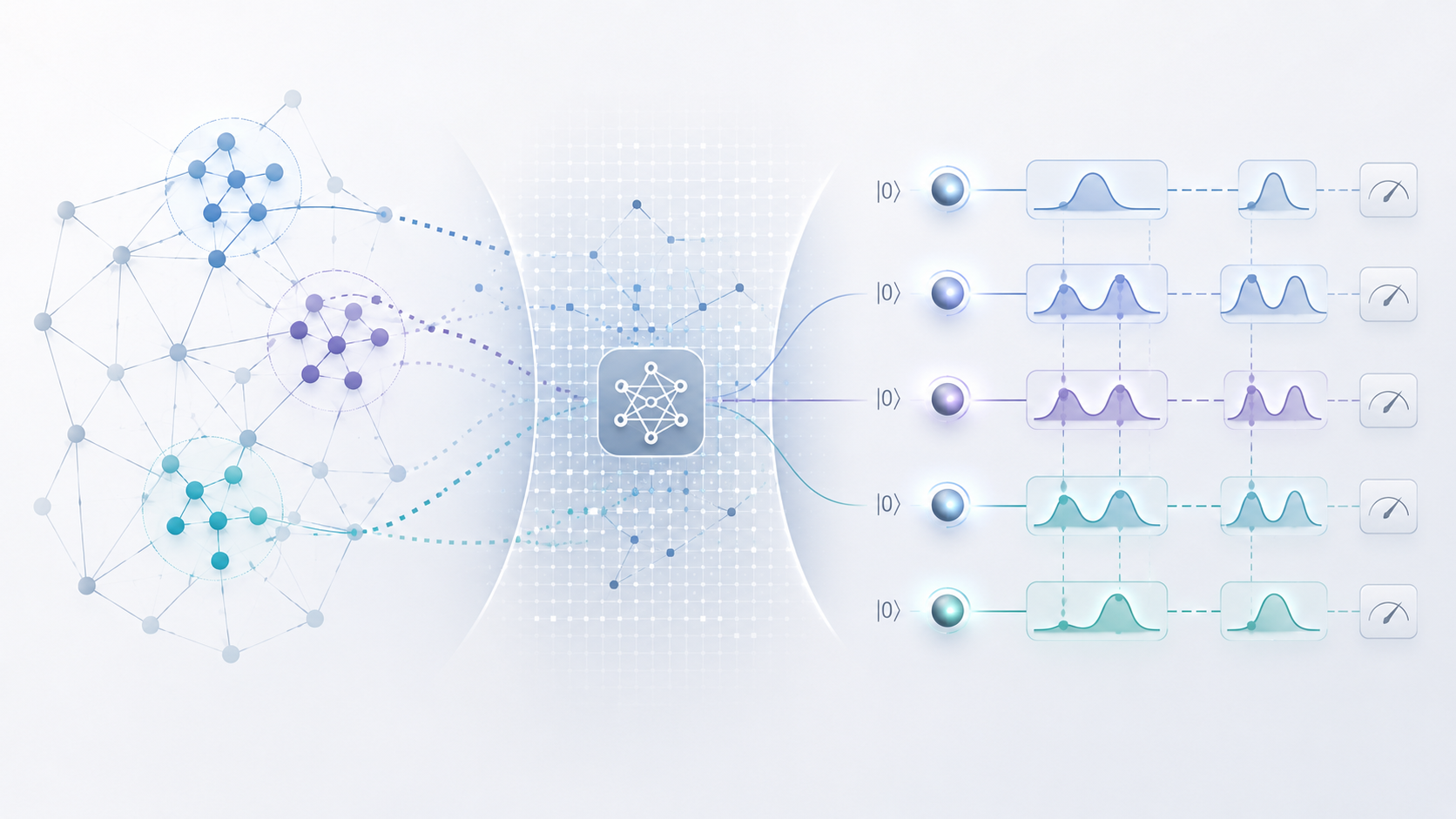
The framework uses a loop, according to the study. First, it runs quantum circuit simulations with NVIDIA’s CUDA-Q platform. Those simulations produce optimized QAOA parameters and performance data for each graph. The system then builds a table that records graph features, such as the number of nodes, mean degree, clustering coefficient, chromatic number and maximum independent set ratio, along with circuit results.
Next, the framework feeds that table into txGraffiti, an automated conjecture-generation tool rooted in earlier graph-theory software. TxGraffiti searches for symbolic relationships — usually inequalities — that connect graph features with circuit behavior. An LLM layer then helps interpret and rank those conjectures, looking for tight patterns and cases where the conjectures fail.
Those failures can be useful information, according to the researchers, who report that rows that violated a proposed bound were not discarded. Instead, the team used them to identify hidden structure in the data and guide the next round of experiments.
That approach led to a key finding that some graphs that violated an early conjecture shared the same structural fingerprint and had the same optimized QAOA parameters. The fingerprint included four graph features — number of nodes, mean degree, mean clustering coefficient and maximum independent set ratio.
The researchers then grouped graphs by that fingerprint and measured how much the optimized QAOA parameters varied inside each group.
Findings From Benchmark Graphs
In the first phase of the study, the researchers tested the system on 82 small MaxCut problems from a standard benchmark library known as MQLib. As mentioned, a MaxCut problem is a type of optimization task where the goal is to divide the points in a graph — a network of points connected by lines — into two groups so that as many connections as possible run between the groups rather than within them. The graphs were small enough that the researchers could check the best possible answer by trying every option, a method known as brute force. That gave them a reliable baseline for judging how well the quantum algorithm performed.
The team then ran QAOA on those problems using computer simulations. The researchers tested circuits with one and two layers. One-layer circuits are simpler and easier to tune, while two-layer circuits can capture more of the problem but are harder to optimize. On today’s quantum machines, deeper circuits are also more likely to run into errors.
SCALAR generated several symbolic conjectures relating the optimized QAOA parameter gamma to other quantities. Some were sanity checks, including a bound reflecting the known parameter range for gamma. Others connected gamma to chromatic number, mean degree and the other QAOA parameter, beta.
The most important finding was not one formula, but a repeated pattern. The researchers found that graphs with similar basic features often needed nearly the same QAOA settings, even when the graphs were not exactly the same.
In the benchmark test, the team found 14 groups of graphs that shared the same basic profile, including size, density and other simple structural traits. In 13 of those groups, the best QAOA settings were almost identical when the researchers tested one-layer and two-layer circuits. The result suggests that, at least for small problems and shallow circuits, researchers may be able to predict useful quantum algorithm settings from the shape of the problem instead of tuning each case from scratch.
The team described this as an empirical observation, not a theorem. In other words, the researchers found a strong pattern in the data, but they have not yet proved that it will always hold. However, the finding at least suggests that, for certain low-depth circuits and graph classes, users may be able to reuse QAOA parameters across problems with matching structural fingerprints rather than optimize from scratch each time.
That could lower one of the barriers to using variational quantum algorithms. On real quantum hardware, each objective-function call can require many repeated measurements. Reducing the number of calls needed to tune a circuit could make experiments cheaper and faster.
The study also found a case where the pattern broke down. In one group of graphs with 14 points, the graphs looked similar under the study’s basic measures, but the quantum algorithm did not settle on the same best settings. Instead, it produced two different sets of answers.
The researchers said that result showed the basic profile they were using was not detailed enough for those graphs. In other words, size, density and a few other simple traits could explain many cases, but they could not capture every feature that affects how the quantum algorithm behaves.
Testing Broader Graph Families
The second phase tested whether the same pattern held beyond the benchmark set. The researchers generated random graphs across four topology models: Barabási-Albert, Watts-Strogatz, Erdős-Rényi and regular graphs. These models represent different kinds of network structure, including scale-free graphs, small-world graphs, structureless random graphs and highly uniform graphs.
The broader test showed that the first pattern did not hold as strongly once the researchers moved beyond the original benchmark problems. In the first test, graphs with the same basic profile usually led to the same QAOA settings. In the larger test, that happened only about half the time.
The team said that one reason is that two graphs can look similar under simple measures but still differ in important ways. For example, two networks may have the same average number of connections, but one may spread those connections evenly while another may have some points with many more links than others. When the researchers added a measure that captured that difference, the pattern became much stronger again for simple, one-layer circuits.
The finding was weaker for deeper circuits. Even after the researchers added more detail about each graph, the best settings became less predictable as the circuits added more layers. The study suggests deeper quantum circuits depend on more subtle features of the problem, not just broad traits such as size, density and clustering.
That result is important because it narrows the claim. SCALAR appears most useful, at least in this study, for finding interpretable structure in low-depth circuits. As circuits become deeper, more global or fine-grained graph properties may be needed.
The team also used CUDA-Q’s tensor network simulator to run a proof-of-feasibility case with 77 qubits. The researchers said the pipeline produced a valid objective value and optimized parameters, but they described this as a single-instance demonstration rather than a full scaling study.
Limits and Next Steps
The study’s results are empirical and limited to finite datasets, unweighted MaxCut and the optimization settings used in the experiments. The researchers noted that the Nelder-Mead optimizer may not always find the true global optimum, meaning some parameter patterns could reflect local minima or optimizer behavior rather than the underlying ideal QAOA landscape.
The work also depends heavily on the graph features placed into the knowledge table. A small set of invariants helped explain low-depth behavior in many cases, but the study does not show that such a compact feature set will work for other problems, weighted graphs, other mixers or deeper circuits.
The LLM layer is another limitation. In SCALAR, the language model helps rank and interpret conjectures, but the system still requires human judgment. The researchers said the framework is not fully autonomous and depends on domain knowledge to decide which features to add and which conjectures are meaningful.
Future work could move from conjecture generation to formal proof. The study says conjectures found by txGraffiti could be exported to the Lean 4 proof assistant, where researchers could attempt machine-checked proofs. That would be difficult for many graph-related statements, but it could turn some empirical findings into formal results.
The research team included Sean Feeney and Andreas Klappenecker, both of Texas A&M University; Pooja Rao, Yuri Alexeev, Stefano Mensa and Elica Kyoseva, all of NVIDIA; and Reuben Tate and Stephan Eidenbenz, both of Los Alamos National Laboratory.
For a deeper, more technical dive, please review the paper on arXiv. It’s important to note that arXiv is a pre-print server, which allows researchers to receive quick feedback on their work. However, it is not — nor is this article, itself — official peer-review publications. Peer-review is an important step in the scientific process to verify results.