
Palm Beach State College Takes Aim at Quantum Workforce Demand
Insider Brief
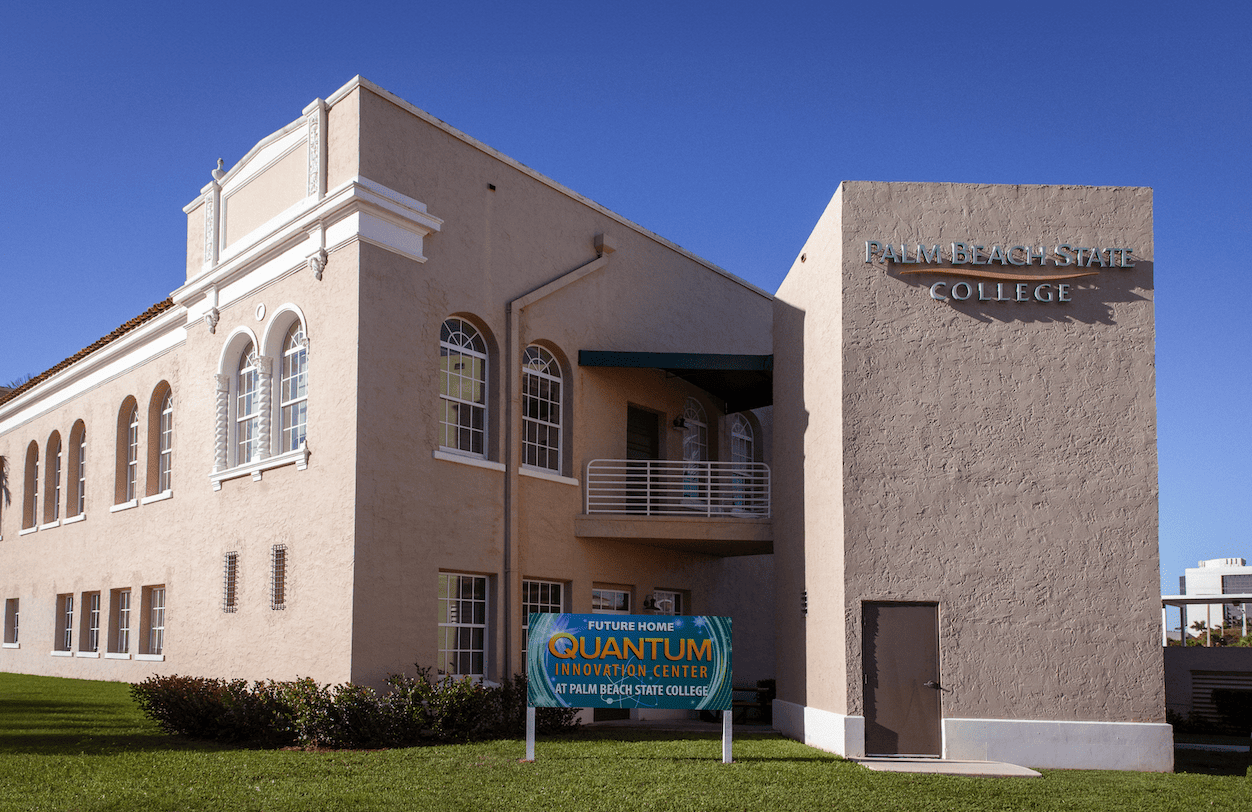
- Palm Beach State College is establishing a Quantum Innovation Center, a transformative hub for education, applied research, industry collaboration and workforce development designed to prepare a new class of technicians and skilled professionals trained to install, operate, maintain, and support quantum computing systems and related infrastructure.
- By focusing on hands‑on, industry‑aligned training, the college is directly addressing a critical and growing labor gap in the quantum economy: the need for a technically skilled workforce beyond PhD‑level researchers to support deployment, scaling, and real‑world adoption of quantum technologies.
- The program uses project-based learning and a quantum simulation lab to teach the practical physics, instrumentation and engineering skills needed to support quantum hardware without requiring extensive advanced mathematics coursework.
- The initiative is being developed with industry and academic partners, including D-Wave, IonQ, NVIDIA, AWS and Florida Atlantic University, as part of a broader effort to build a quantum technology ecosystem in South Florida.
Quantum technology is often portrayed as a field staffed by people with doctoral degrees and years of academic experience.
That may be how it is now, but experts are increasingly concerned that as quantum moves out of theory and into practice and out of the laboratory and into the real world, its success will rely on workers from an array of academic backgrounds and skills.
”“Quantum technology’s future depends on a broader workforce,” said PBSC President Ava L. Parker. “This is where Palm Beach State College steps in – making quantum-focused careers accessible to our community by preparing students with the practical skills needed to help move these technologies from the lab into the real world.”
By building a quantum technology training program aimed at that era, Palm Beach State College is reshaping how the industry develops its workforce and providing a pipeline to talent the industry needs to succeed.
The initiative reflects a growing recognition that quantum technology will require far more than researchers with doctoral degrees. Quantum computers – machines that use the strange behavior of atoms and particles to perform calculations – rely on complex support systems that include cryogenic cooling, fiber optics, classical computers and precision measurement equipment.
Someone must build and maintain those systems. Palm Beach State College believes community colleges can help fill that gap.
“We train people to support industries,” said Dr. Luis Pentzke, Associate Dean of Computer Science, who is one of the leaders of the program, adding that the college’s approach mirrors how it has historically trained technicians for conventional computing systems, teaching students how computers operate and how to support them rather than designing processors themselves.
The quantum training program – backed by a $4.95 million Florida Job Growth Grant – is designed to prepare students for similar roles in the quantum sector. Pentzke said technicians will learn the basic physics concepts necessary to understand quantum behavior while focusing primarily on practical skills.
Quantum computing, still largely confined to research laboratories and early commercial deployments, uses qubits – or quantum bits – that behave differently than traditional binary bits used in conventional computers. While the processors receive much of the attention, these qubits typically sit inside large systems filled with cooling equipment, electronics and networking hardware.
These systems are extremely complex and delicate. Technicians that are trained to install, monitor and maintain those systems could become an essential part of the industry’s future workforce.
A Different Model for Quantum Education
Quantum education today is dominated by universities and research institutions where students often pursue advanced degrees in physics or engineering. Palm Beach State College is taking a different approach.
Instead of requiring students to complete years of advanced mathematics and physics coursework, the program focuses on the concepts needed to understand how quantum systems operate and how to support them.
Students will learn those ideas through projects that focus on applied skills, rather than just traditional lectures.
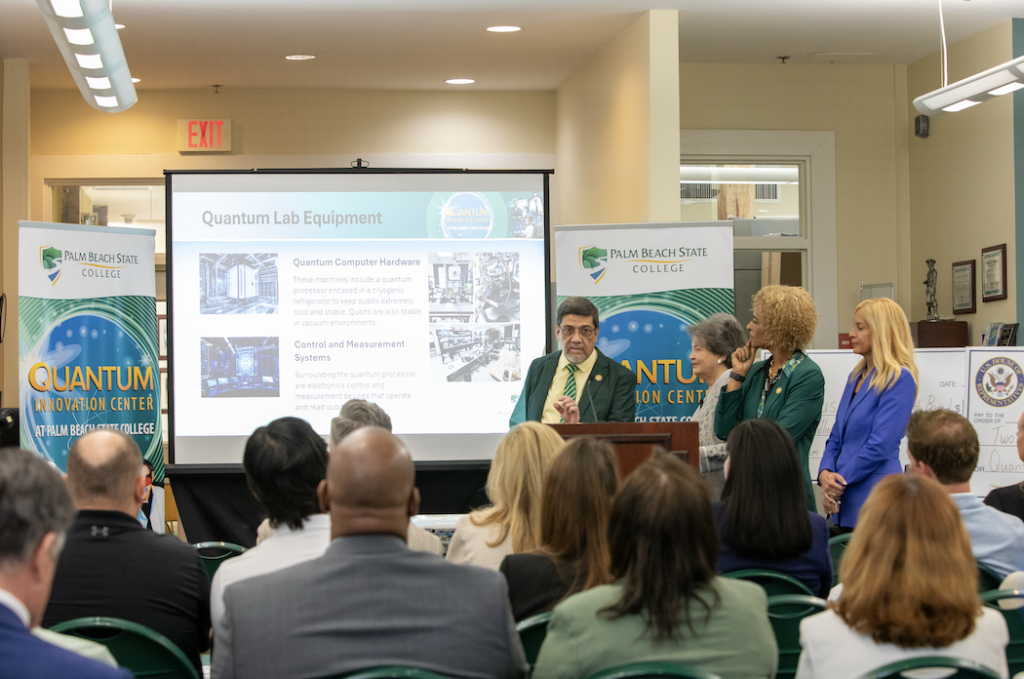
The curriculum will include a quantum simulation laboratory where students can observe quantum behavior through software models and learn how scientists measure it. Students will also train on the types of instruments used in quantum hardware development and manufacturing.
“We’re going to have a quantum simulation lab where students are going to learn about quantum behavior, and they’re going to learn how to measure that behavior,” said Pentzke. “They’re going to learn about the instruments that go into quantum manufacturing. They’re going to learn how to use those instruments. They’re going to learn about the prototyping process and what’s involved in it.”
The program will incorporate hands-on prototyping as well. Students will use tools such as 3D printers to build and test their own designs, learning how quantum systems are assembled and supported.
The goal is to teach advanced concepts using practical engineering tasks, Pentzke said.
“Our technicians are going to learn what is absolutely necessary to be effective technicians when it comes to physics, geometry, calculus and analytic geometry in general,” said Pentzke. “However, if you tell people initially that they have to learn these concepts, they might be intimidated. So our students are going to learn only the concepts that they absolutely need to be effective technicians, and they’re going to learn that by completing real projects.”
Building an Industry Pipeline
The college is developing the program in close coordination with industry partners and academic institutions, Pentzke said. Building bridges between business and industry and the academic community are at the heart of PBSC’s mission.
“We want to be translators between the scientific world and the business world.” he added.
Palm Beach State College has begun discussions with several companies in the quantum computing sector, including D-Wave, IonQ, NVIDIA and IBM. The companies are expected to provide access to their quantum computers through cloud-based platforms so students can run experiments and explore real-world applications.
The college is also working with Amazon Web Services, which could allow students to access quantum hardware through the Amazon Braket cloud platform.
Such arrangements would allow students to run quantum algorithms remotely without needing physical quantum computers on campus.
The program is also part of a broader regional effort to build a quantum ecosystem in South Florida.
Palm Beach State College is coordinating with Florida Atlantic University, which recently acquired a D-Wave quantum computer for its Boca Raton campus. The institutions share a campus location, creating potential opportunities for collaboration and workforce development.
Pentzke said the university could eventually become an early employer of graduates trained to operate and support the system.
Creating a Regional Quantum Hub
The college’s plans integrate student training directly with industry engagement.
Palm Beach State College is developing a quantum simulation lab and a technology incubator that will support both student learning and local companies exploring quantum technology. Students will train in collaboration with industry partners, while businesses will be able to access the lab to run simulations, test use cases, and evaluate how quantum computing could apply to their operations.
The incubator may also provide space and support for startups and research groups working in quantum technology, helping connect education with early‑stage commercialization. Together, these efforts reflect a broader challenge facing the quantum industry: translating highly technical scientific advances into practical tools that businesses and government agencies can understand, evaluate, and adopt.
Many published papers on quantum computing are written for physicists and mathematicians. Decision-makers in industry often struggle to interpret what those developments mean for their organizations.
To help bridge that gap, Palm Beach State College recently launched a free online course explaining quantum technology in accessible language. The course was offered to organizations participating in a regional STEM initiative and has attracted dozens of participants from universities, school systems and industry groups.
The program is part of a wider strategy to build a workforce pipeline that begins in local schools and extends into technical education and university programs.
Palm Beach State College is working with the regional public school system to introduce quantum-related concepts to high school students. Those students could later enter the college’s training program with foundational knowledge in mathematics and physics.
From there, students could progress into an associate degree program and potentially transfer to a university for a bachelor’s degree.
The program could also attract people already working in technical fields who want to transition into the quantum industry.
Pentzke said while the program focuses on the applied, technical side of the quantum industry, he doesn’t discount students becoming so interested in the topic that they move onto those university research programs. This program offers a less intimidating start to one of history’s most complex scientific subjects.
“But, we also know there might be a genius out there in the community who never had the opportunity – because of prerequisites or because of a general fear of taking these subjects – to become involved in this type of advanced technology,” said Pentzke.
Challenges and Future Plans
Despite the program’s ambition, building a quantum workforce pipeline presents challenges.
One of the biggest is faculty development. Quantum technology is evolving quickly, and instructors must continually update their knowledge to keep pace with advances in the field.
Pentzke said faculty members have been attending conferences and studying new materials in order to develop the curriculum.
The program remains in its early stages, and many details are still being refined. But the college sees the effort as a long-term investment in a technology that could reshape industries ranging from cybersecurity to drug discovery.
Quantum computing remains years away from widespread deployment, but many experts believe workforce development must begin well before the technology becomes mainstream.
Palm Beach State College’s approach suggests that preparing that workforce may require expanding quantum education beyond traditional research universities.
If successful, the program could serve as a model for other community colleges seeking to participate in the emerging quantum economy.