
Mayo Clinic Team Wins Quantum Hackathon With Brain-Signal Detection Model
Insider Brief
- A Mayo Clinic team won the Berlin Quantum Hackathon 2026 after developing a hybrid quantum–AI model that detects a person’s intention to move from EEG brain signals, a capability that could eventually inform assistive technologies for people with paralysis.
- The model analyzes electroencephalogram recordings to distinguish subtle differences in brain activity—such as the intention to move a left versus a right hand—using a combination of quantum optimization techniques and classical machine-learning algorithms.
- The project, supported by Mayo Clinic’s Quantum Sensing and Computing program, was presented among six finalists selected from more than 180 applicants in the five-week international competition hosted by Kipu Quantum and backed by Berlin’s Quantum Initiative and Charité–Berlin University Medicine.
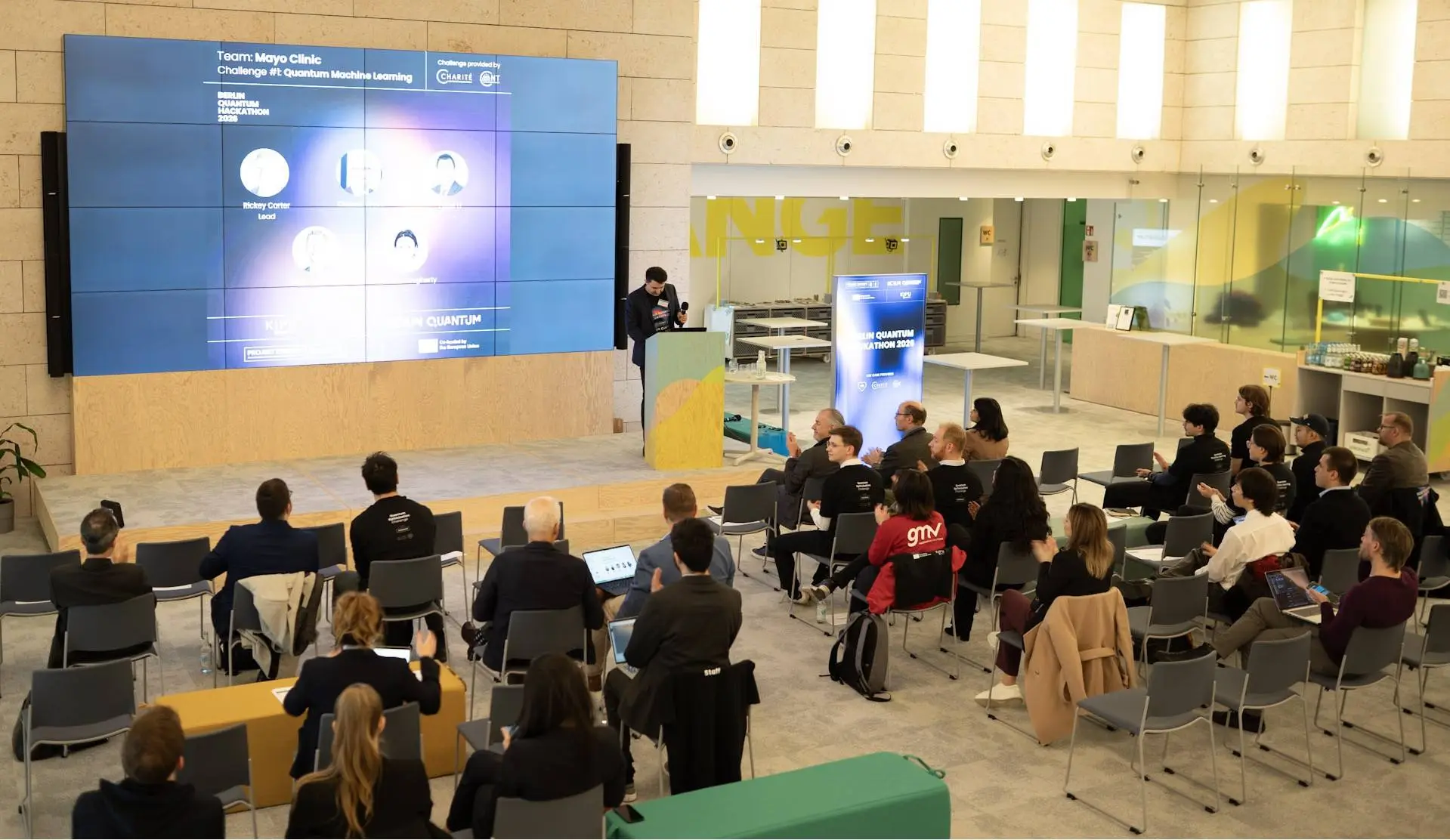
- Image: Attendees watch a team presentation during the Berlin Quantum Hackathon 2026. (Hugo Paquin, Kipu Quantum).
PRESS RELEASE — A team from Mayo Clinic took first place at the Berlin Quantum Hackathon 2026 after building a hybrid quantum-AI model designed to detect a person’s intention to move directly from brain signals, according to a Mayo Clinic news release.
The Mayo Clinic researchers added that it’s a development researchers say could eventually inform future assistive technologies for people with paralysis.
The five-week international competition challenged finalists to demonstrate that quantum computing can address practical problems rather than theoretical ones. More than 180 teams applied, with six selected to compete in the final round. Awards were presented March 5 in Berlin.
According to organizers, teams were evaluated on technical execution, scalability and potential real-world impact. Presentations were delivered to a judging panel of quantum scientists and engineers who examined the models’ assumptions, methods and performance metrics.
The Mayo Clinic entry focused on what happens when the brain intends to move but the body cannot respond, a longstanding clinical question.
In people living with paralysis or certain motor impairments, the brain may still produce signals associated with movement. Those signals travel through neural networks even when muscles fail to respond. Detecting those signals could allow machines — such as prosthetic limbs or assistive devices — to interpret a user’s intent.
The challenge is that these signals are extremely subtle, according to the release.
Researchers attempted to distinguish between the intention to move a left hand versus a right hand using electroencephalogram recordings, or EEGs. EEG systems measure electrical activity in the brain using sensors placed on the scalp. The resulting data appear as waves of electrical signals that reflect brain activity but are often buried in noise from blinking, muscle movement and other background activity.
The Mayo Clinic team developed a hybrid model combining artificial intelligence techniques with quantum computing tools to help isolate the signals associated with movement intention.
According to the team’s presentation at the event, the system analyzes EEG recordings to identify patterns that correspond to specific motor intentions. The researchers said the approach uses quantum optimization methods alongside classical machine-learning algorithms to improve the detection of subtle signal differences.
If validated through additional research, such techniques could help translate brain activity into commands for external devices. In principle, that capability could enable more precise control of assistive technologies for patients with limited mobility.
“When our model executed successfully on a quantum computer, it felt like stepping into the next chapter of science. In that moment, we realized we weren’t just observing this field — we were helping shape it,” Mayo Clinic team member Miko Wieczorek said in the release.

Bridging Quantum Computing and Medicine
The work reflects a broader effort within the medical community to explore how emerging computing technologies could intersect with healthcare.
The Mayo Clinic team had been studying quantum computing for roughly a year before entering the competition. The multidisciplinary group included Dr. Carter, Miko Wieczorek, Dr. Michele Dougherty, Dr. Feifei Li and Dr. Charles Bruce, chief innovation officer at Mayo Clinic in Florida.
Mayo Clinic’s Quantum Sensing and Computing program supported the project. The initiative explores potential medical uses of quantum technologies, which rely on quantum bits — or qubits — that can represent multiple states at once, potentially allowing certain calculations to be performed more efficiently than on classical computers.
Inside the competition venue, teams presented their systems using the vocabulary of quantum science, discussing qubits, circuits and optimization algorithms. Judges questioned teams about scalability — whether the methods could expand beyond small demonstrations — and whether they could ultimately solve real-world problems.
For the Mayo Clinic researchers, the project represented an early step in exploring how quantum tools might help analyze complex biological signals.
Collaborations Across Disciplines
Bruce said the event illustrated the importance of collaboration across disciplines in emerging scientific fields.
“Standing alongside leaders in this field strengthened our work and reminded us that advancement happens together,” Bruce said in the news release. “We entered this challenge as underdogs. None of us had prior quantum computing experience. But progress is built collectively. You learn from one another, blending biology with data science, and the work becomes stronger because of it.”
The hackathon organizers said the winning team’s work demonstrated how quantum computing research may begin moving from theory toward applications in fields such as medicine.
“Some scientific questions remain unsolved not because we lack data, but because of how difficult they are to model. Quantum computing gives us a different way to approach that complexity,” said Li, a former theoretical physicist who is now a medical physicist in Radiation Oncology at Mayo Clinic.
Dougherty, who is a medical physicist in Radiation Oncology, focused her expertise in complex optimization on the project.
“Quantum computing could eventually help us design safer and more precise radiation treatments,” she said in the release. “If it accelerates how we find the best possible plan for a patient, that’s meaningful.”
Future Work
Researchers caution that the system remains an experimental prototype. Future studies will be needed to confirm whether quantum-enhanced approaches can reliably interpret neural signals in clinical settings.
Still, the competition highlighted growing interest in applying advanced computing techniques to neuroscience and rehabilitation technology. The Berlin event also underscored the potential of interdisciplinary collaboration, according to the Mayo Clinic team.
The Berlin Quantum Hackathon was hosted by Berlin-based quantum software company Kipu Quantum and supported by the State of Berlin’s Quantum Initiative and Charité–Berlin University Medicine.
“Quantum computing is proving this year that we can design hybrid quantum-classical solutions for tackling industrial problems,” Enrique Solano, CEO of Kipu Quantum, said in the release. “Medical imaging and life science will occupy a key role in the list of applications. By winning the hackathon, Mayo Clinic is making an important step toward this visionary goal.”