
Researchers Report QPU-Native Traffic Optimization in Real-World Simulations
Insider Brief
- Researchers from Innopolis University and Q Deep report a scalable, QPU-native quantum annealing method that accelerates real-world traffic flow optimization by decomposing large problems into smaller QUBO subproblems.
- Published in Scientific Reports, the Mini-Scale Traffic Flow Optimization approach reduces embedding complexity by shifting more computation onto the quantum processing unit rather than relying on hybrid classical steps.
- Experiments with 100 to 500 vehicles on a complex traffic map in Almaty ran successfully using the Pegasus topology, showing faster solution times and improved optimization performance.
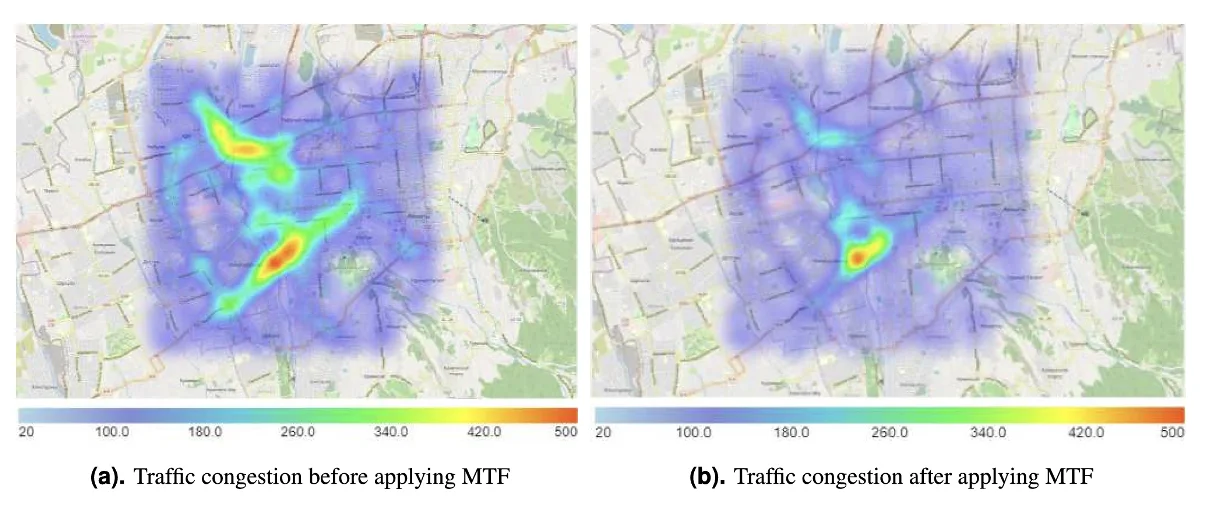
PRESS RELEASE — Researchers from Innopolis University, together with Q Deep, published results in Scientific Reports (Nature Portfolio) July, 2025 issue introducing Mini-Scale Traffic Flow Optimization (MTF) — an iterative QUBO-based method designed to accelerate traffic flow optimization using quantum annealing, while moving computation toward pure Quantum Processing Unit (QPU) execution.
MTF addresses a central bottleneck in quantum traffic optimization: real-world traffic routing problems quickly become too large to be embedded as a single monolithic model on current quantum hardware. Instead, the method decomposes the overall traffic optimization task into smaller, manageable QUBO subproblems, enabling the QPU to be applied where it is most effective and significantly reducing embedding complexity.
In experiments involving 100 to 500 vehicles on a complex traffic map in Almaty, Kazakhstan, the authors report successful execution on the D-Wave Advantage QPU using the Pegasus topology, resulting in a significant acceleration of the solution process and improved optimization performance across all tested scenarios.
The project was led by Hadi Salloum, who stated: “We were able to develop MTF — an algorithm that can compete with Volkswagen’s quantum traffic optimization efforts — while taking a clear step toward running the core optimization directly on the QPU.”
By demonstrating scalable, QPU-native traffic optimization, this work positions quantum annealing as a practical and competitive tool for next-generation smart transportation systems.